
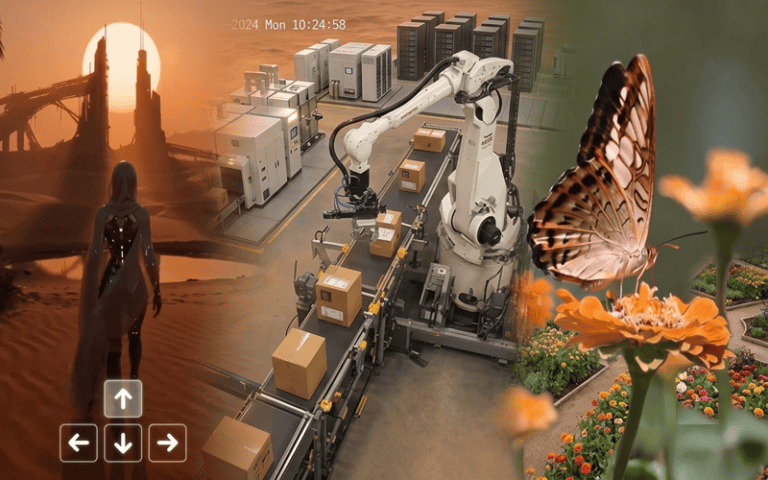
LTX is an AI enterprise company that builds open model software for professional AI video creation and production. The company has this week released LTX-2.5, an open weights world model, built to provide across sectors including film, robotics, and real-time world generation. With so many models now hitting the market from the frontier big players to the Chinese challengers to the smaller niche operation specialist, why should we take note of this one?
Let’s define what’s happening here first.
An open weight world model is a physically aware AI whose trained neural parameters are publicly accessible. It simulates environmental dynamics and physics, allowing software developers to customise and run realistic visual simulations locally.
Many think that open weights are the best way to enable people to build with full control across the hardware they use, model customisation, and control of their intellectual property. This is why builders are already widely using LTX models in production for film, robotics, and real-time rendering.
LTX is so named as the moniker denotes “light tricks” plus X, for experimental AI technologies. The company says that LTX is already the most used open world model, with over 33 million downloads – and the team is working with Asteria (an AI film and animation studio), ComfyUI (an AI creation engine for visual content professionals), and Reactor (developer infrastructure for real-time generative media) to push the envelope here.
World models hold motion, space & sound consistent across time
“World models face challenges that LLMs never had to solve, like holding motion, space and sound consistent across time, which is why efficiency and control matter so much. By keeping LTX open, we let teams own their hardware, their IP, and their model. LTX-2.5 is the most capable model yet, and partnerships like the one with ComfyUI, built on a shared belief in an open future, are how it reaches the teams that need both industry-leading quality and full control,” said Zeev Farbman, co-founder & CEO, LTX.
Through a launch partnership with ComfyUI, all of LTX-2.5 is available from day one inside the node-based environment the open community already builds in, from a first experiment to a standardised production pipeline.
“ComfyUI and LTX share a simple belief that open models build better tools, faster. With LTX-2.5 running natively in ComfyUI, a developer can go from an idea to a working world-model pipeline in an afternoon, and an enterprise can take that same pipeline straight into production on its own hardware. Open is what lets the community move fast and lets businesses build on what it proves,” said Yoland Yan, co-founder & CEO, ComfyUI.
What’s New in LTX-2.5
- Professional-grade output. A new diffusion video decoder that reduces visual artifacts in high motion while keeping the high compression ratio of LTX, and remaining true to existing footage.
- Consistency across sequences. Native multishot generation renders a full sequence as one output, holding character, scene, and voice across cuts, while a custom Gemma 4 language backbone and dedicated prompt enhancer read and understand complex, multi-subject prompts more accurately.
- Domain adaptation. A pretrained checkpoint tuned for physical AI and robotics gives teams a flexible base to fine-tune on their own domain data, so builders can adapt the model to a world that looks nothing like cinematic video.
- Efficiency at scale. A substantially better distilled model delivers the same quality at lower cost and faster inference, so teams can run near-full-model quality on hardware they already own and deploy it economically at production volume.
The result is a sharper, more physically accurate output, generated at a fraction of the cost and render time of closed alternatives. Because LTX-2.5 is open weights, you run it on your own hardware, so your data and IP never leave your devices, and you can fine-tune and extend it for whatever your work demands.
The next infrastructure layer of AI
According to LTX CEO Farbman, Large language models (LLMs) learned to predict the next word, but world models learn to predict the next moment.
“They generate these environments, simulate how they behave, and let you act inside it. They are becoming the foundation for everything from film and advertising to gaming, simulation, and physical AI, supporting robots as they move through a warehouse or factory floor, operating within an offshore rig, the power grid, and so much more,” he noted.
With this release, Farbman says the company is establishing one open model across worlds, characters, audio, and motion, that extends into physical action, and providing innovative companies across media and entertainment, real-time applications, and robotics, access to the foundation for world models they can run within their own environments today.
“The future of media is real-time, and it only works if the underlying model is fast, controllable, and yours to run. Partnering with LTX means we can tune the model to our own infrastructure and bring live, responsive avatars to users worldwide,” said Alberto Taiuti, co-founder and CEO, Reactor.
What should developers think next?
If developers are willing to follow the mantra laid down by LTX, then they will need to share the company’s belief that world models will run behind a large share of what the world watches, plays, and automates over the next decade.
For developers, this open weights release means autonomy over deployment, zero vendor lock-in and the freedom to fine-tune high-fidelity physical simulations directly on local hardware. It (very arguably) shifts AI video from a restricted, third-party cloud service into a customisable, production-ready foundation layer.
LTX-2.5 is available today as open weights on Hugging Face, natively in ComfyUI, and through the LTX API for teams that want managed, production-grade generation and it runs on hardware from a cloud datacentre with GPUs to a Mac, plus it’s free to use for organisations under $10M in annual recurring revenue.