
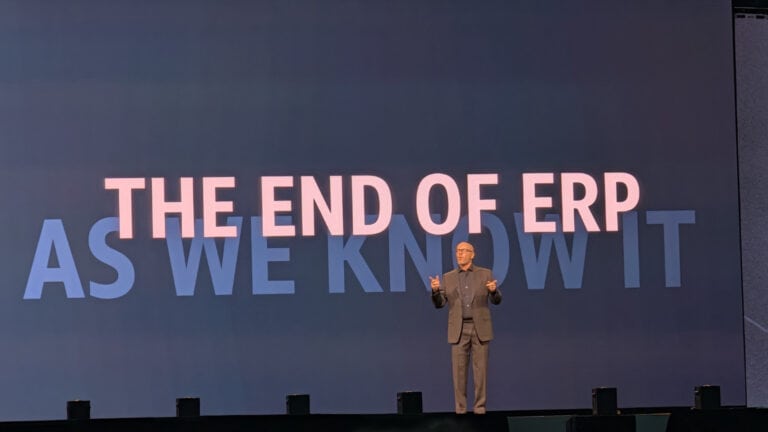
At SuiteWorld 2026, Evan Goldberg declares the end of ERP as we know it today. NetSuite will remain an ERP solution, but with NetSuite Next, ERP is becoming increasingly invisible. Goldberg, one of NetSuite’s founders and now EVP of Oracle NetSuite, says ERP is coming to an end, and the platform is fading into the background. As a result, ERP is becoming invisible and will eventually become increasingly autonomous, though we’ll still need to be patient for that to happen. The world of ERP is set to change due to AI, what do you need to know?
Last year, SuiteWorld focused on “NetSuite Next,” the platform’s new version. This year, the focus is on “now,” according to Brian Chess, SVP of AI, Product and Technology, in an interview with Techzine. The rollout of NetSuite Next began in North America; now it’s the turn of the United Kingdom, Australia, and New Zealand. The Netherlands, Spain, and Sweden will follow early next year. Chess calls Next the biggest update since the platform’s launch in 1998.
To date, 13,000 customers have migrated to NetSuite Next, and approximately 2,500 NetSuite customers are using Ask Oracle. Out of a total of 44,000 customers, that represents about one-third.
Not a complete rebuild, but a programmable platform
Goldberg told us last year that NetSuite began building the Next platform five years ago. Although that sounds like a complete rebuild of the platform, it isn’t. Chess says, “I think we had a solid foundation, so we didn’t need to do that.” According to him, the work lay elsewhere. For a long time, the software had two main components: the application and the user. With AI, a third entity has now been added, and it must be able to use the software just as well as a human.
This means the focus has shifted to making the platform more programmable, expanding APIs regardless of whether the user is human or AI, and building so-called “headless” applications. This API expansion lets AI interact more effectively with NetSuite. The AI assistant, Ask Oracle, can now do more than just answer a question; it can also generate and display reports, or provide a link to a source or a specific record. As we understand it, this is only possible in Next, because that environment is better suited for it.
NetSuite’s MCP server, the AI Connector Service, has been designed to be relatively straightforward for developers. According to Chess, there are about twelve standard tools. One tool reads every type of record, including custom records. Another reads the metadata, allowing the AI to figure out where everything is located and how to construct queries. Chess emphasizes, however, that it remains a layer built on top of the existing APIs. Customers and partners can also add their own tools, and everything falls under the same roles and permissions model as for employees.
Also read: NetSuite goes headless too: SuiteSkills give Claude and ChatGPT ERP knowledge
Invisible ERP, or “headless”
From the NetSuite GUI and Ask Oracle, the ERP remains visible as usual, but with the AI Connector Service, ERP is becoming increasingly invisible. NetSuite has made a conscious decision to grant third-party AI agents access to the platform. This allows OpenAI, Claude, and Gemini (coming soon) to connect to NetSuite from a user’s perspective and perform all possible tasks and actions on the platform. They have access to all the data that the user can access within their permissions and roles.
To keep this experience seamless, NetSuite has published 45 skills on GitHub so an agent knows how processes work within NetSuite and how to invoke them. This ensures you get exactly the same results with Ask Oracle, Claude, and OpenAI. This was also presented in detail during the keynote. NetSuite is now headless; you can use it from your preferred environment.
The skills ensure that the AI receives the correct context when performing an action. However, we’ve noticed there’s still room for improvement in speed. According to a slide, an agent action took 67 seconds; we asked Chess if that wasn’t too long. Chess commented that while users currently accept this level of speed from ChatGPT, they don’t expect it from an ERP application. He believes there’s still room for improvement in terms of user experience. That said, he also noted that a solution isn’t immediately available; ultimately, NetSuite focuses primarily on the quality and accuracy of responses rather than on speed. An AI needs to be given the right information and context; it shouldn’t just work quickly and start guessing when there are gaps, because that’s when things quickly go wrong.
Pricing model reveals how programmable the platform is
On July 6, 2026, NetSuite introduced so-called AI Units. All customers also receive a package of NetSuite AI Units based on the number of user licenses. This means AI isn’t included without limit; it has a usage cap. If customers reach the limit, they can purchase additional AI Units.
What’s striking is that if customers use Ask Oracle, they must pay for AI Units, somewhere between 10 and 200 Units. If customers choose to use ChatGPT or Claude via the AI Connector Service, they do not pay for AI Units. Of course, they do have to pay for ChatGPT and Claude themselves.
This makes sense, since with an external AI, the language model runs at the external AI platform, and NetSuite simply executes MCP/API calls to the platform. However, some other SaaS platforms also deploy AI behind an MCP call; that does not appear to be the case with NetSuite. NetSuite therefore does not need to deploy AI computing power for calls via the AI Connector Service. NetSuite only uses its own AI when customers use Ask Oracle.
This is very positive, as it means NetSuite has excellent control over the platform, how data is loaded, processed, and ultimately presented to users or AI.
Open in all directions
The customer therefore determines for themselves how they work with NetSuite, headless, so to speak. However, NetSuite doesn’t stop there; it does try to convince customers of the added value of Ask Oracle. For example, customers will soon be able to add external data sources to Ask Oracle, such as an Excel file in SharePoint or data from external applications, so that a sales forecast in NetSuite can be accurately compared with sales orders in NetSuite or on an external sales platform.
So if customers prefer to continue working from the NetSuite UI with Ask Oracle, that’s fully supported as well. Goldberg states that customers ultimately work wherever they want. “In a sense, we’re agnostic,” he says. Work that primarily involves NetSuite data is more likely to take place within NetSuite. Work that combines many sources is more likely to take place in an external AI. NetSuite calls this an “outside-in” and “inside-out” approach.
At the same time, greater openness also means a larger attack surface. Chess, who founded a security company years ago, points to the role model: the AI sees nothing the user doesn’t see, and all AI actions are recorded in the audit logs. However, prompt injection remains an attack vector. Within Ask Oracle, NetSuite’s harness must intercept those attacks. When using an external AI, NetSuite customers rely on the security measures of OpenAI or Anthropic or their own harness.
The NetSuite harness was briefly explained during the product keynote: as soon as an agent is invoked and the harness comes into play, the harness verifies and checks the instructions, business context, knowledge (such as company policies), skills, tools, and governance.
How autonomous is the Autonomous Suite?
We also heard the term “Autonomous Suite” several times at SuiteWorld. Although that sounds like an ERP that runs itself, it’s actually something different. NetSuite has currently chosen to always keep a “human-in-the-loop.” Every agent’s action ultimately requires user approval. Goldberg emphasized this himself during the inventory demo: pay attention to what the agent didn’t do. It didn’t change anything on its own, but presented three proposals, each with supporting rationale.
Autonomous Close is the most concrete example. A workspace tracks the progress of closing a period, and an exceptions agent flags non-compliant invoices. Every approval is recorded in an action history, showing who approved what and which agent performed the work. The most advanced agent analyzed the last twelve closings and proposed automatically approving low-risk entries, which would save 5% in time. Every time an agent makes a proposal, it requests approval before it carries out actions automatically. However, the actions to be performed automatically are becoming increasingly complex and extensive.
In conversation with Goldberg, he was cautious about the promise of a “zero-day close.” He also immediately pointed out that he is neither a CFO nor a controller. In the long term, he believes it’s hard to overestimate what AI can do; the question, however, is how long the path to greater autonomy will take. Ultimately, many companies are already quite happy if they can complete a close in 1 or 2 days instead of 20.
Goldberg believes the main benefit right now is agents doing the preliminary work, which users then approve. This allows users to gain experience and build trust in the agents. We expect autonomy to come naturally if this process goes well for long enough. Users will then start asking for it, especially for actions that are always correct and currently require manual approval.
Last year, Chess said that NetSuite wasn’t focusing on autonomous systems. This year, the groundwork seems laid, and it’s only a matter of time before we start seeing more and more autonomy at NetSuite.
NetSuite aims to serve a broader customer base
The biggest strategic shift appears to be at the lower end of the market. For years, NetSuite has been the ERP of choice for the mid-market: companies that had outgrown QuickBooks. When Techzine asked whether that has changed because AI makes implementing NetSuite easier and more affordable, Goldberg was emphatic. “Between QuickStart and SuiteExpress, we absolutely believe that NetSuite will be a good choice for even more companies than before.” He also noted enormous growth opportunities for NetSuite worldwide.
QuickStart is a new, free financial platform for young tech startups in the U.S. It includes accounting, bank integration, accounts receivable, accounts payable, and subscription management. QuickStart aims to let founders never log in: it runs in the background and notifies them only when a decision is needed. The free model, however, is temporary: “It won’t always be free,” Goldberg said. By the time a company goes public, it pays for the service. QuickStart also serves as an internal innovation lab. The new bank reconciliation feature in NetSuite is a result of this.
Faster implementations
SuiteExpress is designed to help organizations roll out NetSuite faster. An AI analyzes a client’s meeting minutes, documents, and recordings, then combines them with NetSuite’s knowledge and best practices for NetSuite environments and implementations. SuiteExpress can quickly set up an environment tailored to the customer’s needs. This should reduce implementation time from months to weeks or even days. As an example, NetSuite highlighted a customer, Worksmith, which had initially anticipated a six-month implementation but went live after just 60 days.
SuiteExpress is new and, for now, available only to software companies in the U.S. and Canada. According to Goldberg, Europe will have to wait a few more months. SuiteExpress may launch in Europe at the same time as NetSuite Next.
Conclusion
NetSuite has a new, clear strategy. It is expanding its market and will be able to serve more customers once QuickStart and SuiteExpress are available. In addition, it is opening up its platform to any AI platform that customers wish to use, making NetSuite “headless.” The ERP remains the platform and continues to manage processes, but is otherwise completely invisible.
When using an external AI, NetSuite does not charge for AI Units, since the processing takes place at OpenAI or Anthropic.
Finally, the “Autonomous Suite” currently appears to be primarily a message looking toward the future. NetSuite sees opportunities to execute business processes completely autonomously in the future, but it’s still too early for NetSuite’s target audience. What NetSuite is demonstrating now are agents that prepare all the work, make proposals, and then wait for approval. Once approved, the agents can carry out all the work for the user. This is a sensible approach for a system that handles accounting; it provides visibility into the platform and its processes and builds trust. Once this becomes standard practice, autonomy will naturally follow.
We believe the future of NetSuite will vary by customer. One customer might be very enthusiastic about being able to fully use and control NetSuite from within Claude or ChatGPT, while another customer might place great value on NetSuite’s own UI and Ask Oracle. However, NetSuite does seem to have a solid technical foundation and appears prepared for the future.