
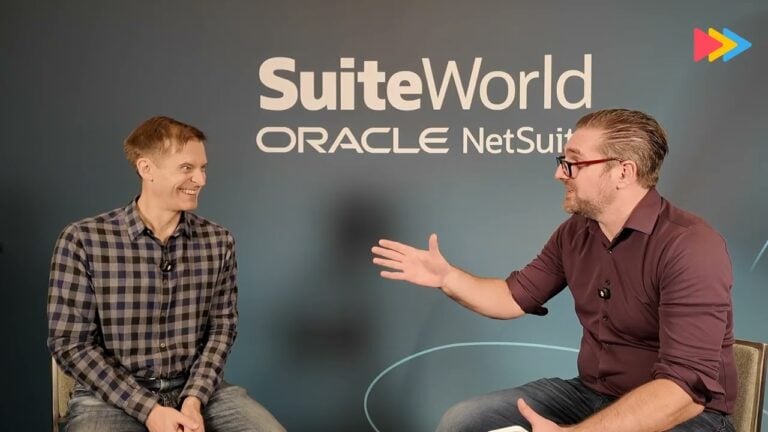
At SuiteWorld in Las Vegas, Brian Chess, the SVP AI Product and Technology at Oracle NetSuite, explained the vision behind NetSuite Next. It comes down to a multi-year architectural rebuild. It positions NetSuite Next to make generative AI work better inside an enterprise ERP platform. The platform is better programmable than before.
A rebuild that started before generative AI existed
NetSuite began rebuilding its platform roughly six years ago, well before generative AI became a mainstream topic. Brian Chess, the executive who led that effort, describes the timing as fortunate rather than prescient. The team was rearranging and straightening out what the platform should look like in the future. The platform should be better programmable and controllable through API’s. When generative AI arrived, it all came together and, to use his words, “turbocharged it.”
NetSuite’s longstanding strength made this possible: organizing all business data in one place. That is precisely what AI needs to be effective. The platform was also designed to be open; data can flow in from anywhere and out in whatever format a user or system requires. That same openness extended naturally to how AI was integrated.
Read our analisis on NetSuite: NetSuite declares the end of ERP: The future is invisible
A new three-party model
One of the most important conceptual shifts Chess describes is moving from a two-party model, software and user, to a three-party model that includes AI. Historically, the goal was to build the most efficient system a human user could navigate. Now, the AI must also be able to use the software. That programmable interface or headless as many vendors call it, makes a platform more suitable for different use cases.
This insight drove many of the platform decisions. Making APIs more programmable and making the user interface more programmable turned out to be exactly what AI needed. As a result, when a user asks a question inside NetSuite, they do not just get an answer. They will get the answer, the data sources behind it, and the ability for the AI to drill down, generate a report, or create a record on their behalf.
The MCP server and AI Connector Service
Oracle NetSuite announced its MCP (Model Context Protocol) server, called the AI Connector Service. Chess is clear that this was not simply a wrapper placed over existing APIs. It was built on the platform itself, which means it inherits the platform’s openness and extensibility. The standard toolset that ships with the AI Connector Service contains roughly a dozen tools. That number is deliberately small. One tool handles reading any record, including custom records added by a customer. Another reads metadata, allowing AI models to construct their own queries. The simplicity is intentional: it gives AI enough power to act decisively without overwhelming the context window.
Critically, all tools share the same roles and permissions system that governs employee access. If an organization wants the AI to have read-only access, it grants that the same way it would for a new employee. If it wants the AI to write certain record types but not others, it defines a role accordingly. This makes AI governance familiar and auditable rather than a separate system to manage.
Because NetSuite’s documentation is publicly available and AI models have been trained on it, Chess notes a practical advantage: AI systems already know how to use NetSuite before any custom configuration takes place.
Headless ERP is available today
Chess confirms that headless ERP, the ability to interact with NetSuite entirely through AI interfaces rather than the traditional UI, is supported through the AI Connector Service. Organizations can connect whichever AI system they prefer, add their own custom tools to the MCP server, and integrate data from other systems. The architecture is designed to be as open as possible at every layer.
Ask Oracle: an agent harness built for NetSuite
Separate from the external MCP Connector Service, NetSuite has built its own internal agent harness called Ask Oracle. Chess is careful to distinguish this from the Ask Oracle that runs across Oracle Fusion applications, while the name is shared, the underlying technology is different and was built specifically for NetSuite.
Ask Oracle is more than a chatbot. It understands how to navigate the NetSuite application, take users where they want to go, and present results in the format they need. When it surfaces a chart or summary, it also provides the underlying CSV data and links to the specific reports or records it drew from. This is a design decision rooted in the reality that users trust good news without question but demand sources when results are unexpected or bad.
Converting an Ask Oracle conversation into a persistent agent requires one instruction: “turn this into an agent for me.” The same harness that powers the chat interface also powers the agents, and all agent actions follow the same permissions model.
Speed versus accuracy: an honest trade-off
Chess is candid about performance. When asked whether Oracle, as a database company, has fully optimized AI response times, he responds directly: “No way. Not a chance.” The current priority is accuracy. NetSuite’s AI is scoped strictly to business tasks; asking it who won the World Cup will produce a redirect, not an answer. That discipline keeps the AI on task and trustworthy, even if it means responses take longer than users accustomed to application-speed interactions might prefer.
Context window management is an active area of work. The goal is to bring enough data into context for the AI to make meaningful decisions, not so little that it cannot act, and not so much that it slows down or overwhelms the model. Deterministic pre-processing workflows that reduce data volume while increasing quality are part of the answer.
Upgrading to NetSuite Next
For existing NetSuite customers, the upgrade path to NetSuite Next is presented as a banner at the top of the screen. Chess says the simplicity of that click reflects genuine back-end engineering effort. Customers have two adoption paths: they can embrace the full NetSuite Next experience, which enables AI navigation and agent creation, or they can adopt Ask Oracle alone, leaving the existing interface intact while gaining conversational AI capabilities.
Compatibility with existing partner integrations is guaranteed at 100%. Customers running a customized NetSuite instance with partner applications have no reason to delay upgrading. NetSuite guarantees all these partner applications keep working as well, when upgrading to NetSuite Next.
Several thousand customers have already migrated to NetSuite Next, and more regions can upgrade to NetSuite Next soon. Like Chess said, for Netsuite Next the moment is now, when customers upgrade and get a more powerful ERP at the dissposal.
Tip: NetSuite goes headless too: SuiteSkills gives Claude and ChatGPT ERP knowledge