
At TechEd, SAP announces a series of AI innovations for developers. Joule Work is gaining an orchestration layer for agents; a new Enterprise AI Gateway will centralize governance; and the SAP-RPT tabular model will soon run on the ISS. This will deploy AI agents more effectively to handle complex protocols, in which the Agent2Agent (A2A) and MCP protocols play a dominant role.
With these announcements, SAP aims to make the Autonomous Enterprise a reality. The company presented this vision earlier this year at Sapphire 2026; it entails SAP software autonomously executing business processes. Central to this is the SAP Business AI Platform, where the Business Technology Platform, the Business Data Cloud, and SAP Business AI converge. It is designed to provide organizations with a single environment to build, contextualize, and manage AI, both within SAP and in third-party environments.
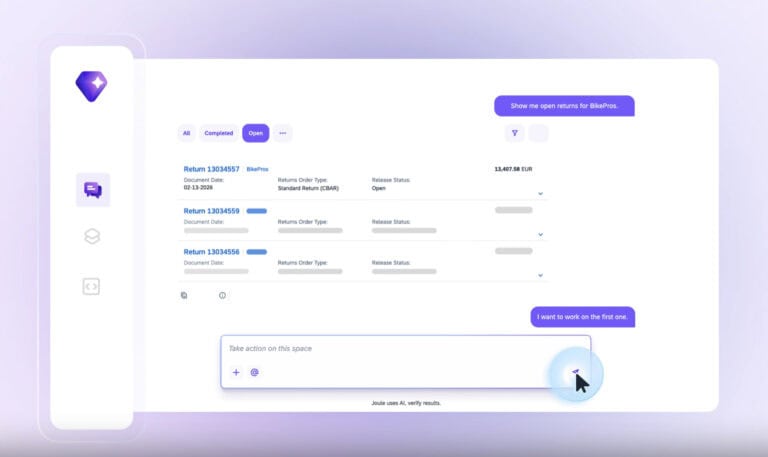
According to CTO Philipp Herzig, the focus is now shifting. “This year, we are showing how we are moving from AI learning your business to running it,” said Herzig. Joule Work is intended to be the place where users can express their intent and get work done across the entire SAP landscape. In Joule Work, users formulate goals in natural language, drive workflows, and combine information from both SAP and external systems.
Tip: SAP is launching the Autonomous Enterprise at Sapphire 2026
Orchestration and governance
Joule Work will feature a new agent-based orchestration layer, designed to enable assistants and agents to complete complex, multi-step workflows more reliably. It achieves this through A2A and MCP. SAP Knowledge Graph also retrieves data from additional SAP and non-SAP sources, which users can query using natural language.
Third-party agents will also be able to invoke Joule Agents via a governed agent gateway. By enforcing access control, SAP states that agents from different software platforms can collaborate on business workflows without compromising governance.
For centralized control, SAP is introducing the Enterprise AI Gateway. It consolidates authentication, policy enforcement, routing, monitoring, usage tracking, and auditing of all AI traffic. A new AI Governance Assistant is also designed to help customers comply with the EU AI Act.
Joule studio temporarily free
Joule Studio, the development environment for agents, offers no-code and pro-code tools and access to more than 70 AI models. New features include observability and management functions that provide insight into agent behavior, model usage, and costs. Participants in the early adopter program can also build n8n workflows there. Running custom agents on the SAP-managed runtime remains free for selected customers through December 2026. SAP emphasizes that it does not share customer data to train LLMs.
Tabular AI reaches new heights
On the data front, SAP Business Data Cloud will gain an Ontology Manager and lakehouse functionality from Dremio, with native support for Apache Iceberg and Apache Polaris. SAP announced in May that it would acquire Dremio and Prior Labs. The latter, creator of the tabular model TabPFN, has been an official part of SAP since July.
The new SAP-RPT 2.0 goes beyond classification and regression, offering anomaly and outlier detection as well as analyses using embeddings. SAP-RPT-TS focuses on forecasting within SAP Integrated Business Planning. In collaboration with HPE, SAP-RPT will also run on the Spaceborne Computer-2 aboard the ISS. There, the model will predict malfunctions and reconstruct missing sensor values without sending data back to Earth. “The same SAP-RPT model that powers global supply chains also works in space,” says Herzig.
Finally, SAP is working with Intel on integrating business workflows with autonomous robots. New solution extensions with DocuSign, Palantir, Parloa, and Redwood are designed to enable end-to-end execution of core processes without the need for data transfers between systems.
Tip: SAP launches Joule Work: the AI chatbot that turns questions into action