
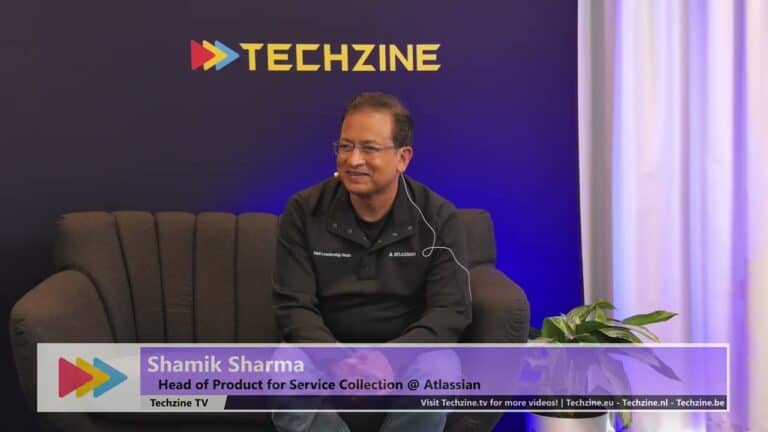
Atlassian’s Service Collection has crossed $1 billion in annual revenue and is rapidly expanding beyond IT service management into other areas. At Atlassian Team ’26 Europe in Amsterdam, we spoke with Shamik Sharma, head of product for the Service Collection. How does Atlassian plan to beat the likes of ServiceNow at their own game?
The Service Collection is Atlassian’s bundled offering of four products: Jira Service Management (JSM), Customer Support Management (CSM), Assets, and Rovo Agents. While each product addresses a distinct use case, they are sold together as a single collection at one price. In addition, there is flexible seat allocation across all four.
Most customers already have the Teamwork Collection (which includes Jira, Confluence, Rovo Agents, and Loom) as their foundation, Sharma says. From there, moving to JSM is described by Sharma as a natural and easy step. This is because JSM is deeply familiar to anyone already working in Jira.
A billion-dollar business in a two-horse race
Atlassian announced earlier this year that the Service Collection crossed $1 billion in revenue. It is one of the company’s fastest-growing segments. Sharma notes that Forrester has described the ITSM market as a two-horse race between ServiceNow and Atlassian. Furthermore, Atlassian sits in the top quadrant of Gartner, Forrester, and other major analyst rankings for service management providers.
The growth is being driven by the depth and by the breadth of the portfolio. Over the last two years, Atlassian has expanded from purely IT service management into other business functions such as HR. More recently, it has expanded into customer support management for external-facing teams.
A modern approach
Sharma attributes Atlassian’s market share gains to a fundamentally different architectural philosophy. Unlike legacy ITSM vendors, Atlassian built its service products on top of a platform that is developer-friendly, he argues. It is also extensible and composable. The UX is designed to feel modern and usable. The open marketplace allows partners and customers to extend the platform for specific verticals.
This platform-first approach is now paying dividends in the AI era, Sharma says. Because Atlassian’s systems expose APIs and MCP endpoints, building Rovo agents on top of the platform is significantly easier to do. In addition, calling it from external AI platforms is easier on Atlassian than on any of the legacy tools, he claims.
Number 1 MCP
One of the most striking data points Sharma shares is that the Atlassian MCP server has been cited by Anthropic as the number one MCP server in the world by call volume. That is, more external agents call into Atlassian’s MCP endpoint than any other. This is a logical result of Atlassian’s strategy to actively support headless usage of its products.
Customers can use the Atlassian UI, but they can also build Rovo agents inside the platform, or call Atlassian’s APIs and MCP layers from an entirely external agent platform. According to Sharma, Atlassian encourages all three approaches. It doesn’t matter which surface users use, as long as the result feeds back into the Teamwork Graph. As always, that is what Atlassian as a whole is built on and around.
Asset management for everything
Assets in the Service Collection is built on a platform-level asset store that exists independently of the rest of the collection. What comes bundled with the Service Collection specifically are the workflow applications on top: hardware asset management, software asset management, and discovery capabilities.
Atlassian defines an asset broadly. According to Sharma, anything with tangible value that appears on a company’s balance sheet, from laptops and projectors to hospital scanners, injection consumables, and port cranes is an asset. For standard IT assets, Atlassian provides out-of-the-box discovery. To help large enterprises that already have a dedicated discovery tool such as Flexera or Lansweeper, Atlassian partners with those vendors to ingest data directly into Assets.
For highly specialized verticals Atlassian relies on marketplace partners and system integrators to build vertical-specific discovery and lifecycle management workflows. These all eventually feed into the same asset store, connected to the Teamwork Graph.
AI-native customer support management
Customer Support Management was built from the ground up as an AI-native product. The core thesis is that virtually every incoming ticket should be resolvable by AI, with humans serving as supervisors, trainers, and reviewers. When an AI agent cannot resolve a ticket, the system observes what the human does. Then it uses that to self-train for future similar cases.
Sharma estimates that Atlassian is currently seeing 30–40% AI resolution rates in its own internal use of the product. When we probe a bit deeper, he contextualizes that number a bit more. Roughly 10–15% of tickets are simple lookups that were never really support requests. Another 10% sits on the boundary of automation. That combined 25% was already being resolved before the AI era through basic automations and lookup systems.
Atlassian’s 30% figure, Sharma goes on, is measured on top of that baseline. Competitors claiming 60–80% resolution rates, he suggests, are typically working with smaller customers, simpler use cases, and looser definitions of resolution.
Two unsolved problems in AI-powered service management
Not everything has been resolved by Atlassian Service Collection, though. Sharma mentions two major unsolved challenges in AI-driven service management. The first is the cold start problem: AI is only as good as the context it has access to. Unlike coding, where vast amounts of public code on GitHub and Bitbucket provide rich training material, customer support and IT support documentation is often sparse or nonexistent inside enterprise environments. Atlassian is working to address this by observing human agents. Additionally, it is proactively suggesting what knowledge bases should contain.
The second challenge is trust. It is technically straightforward to achieve high resolution rates by giving an AI agent unconstrained autonomy. However, there will also be more hallucinations, and overall a worse customer satisfaction. Users might get answers that technically close tickets but leave them unhappy.
AMP: multi-agent oversight for enterprise trust
The AMP multi-agent framework is Atlassian’s structural answer to the trust problem above. AMP allows multiple agents to collaborate. One can do the work, while another reviews it. Yet another one can verify trustworthiness (whatever that may mean, of course). After that is done, the output may be acted upon. This mirrors the maker-checker processes used in human workflows, where a second set of eyes reviews work before it is finalized.
Sharma sees AMP as a critical piece of infrastructure for making AI-powered service management viable at enterprise scale.
Also watch/listen/read: ROI of AI for development does not exist yet: how can we change that?