
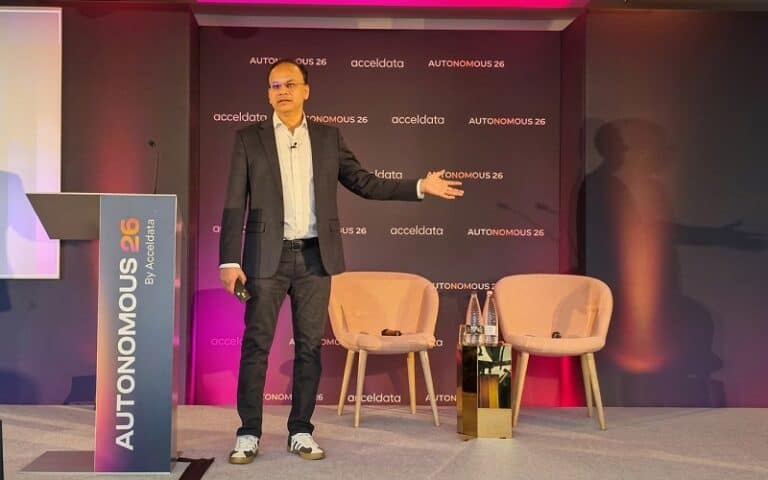
Acceldata used its Autonomous 26 event in London’s towering Bishopsgate 22 building this week to explain how its vision for data intelligence now extends and serves software professionals across ‘traditional’ engineering teams and, inevitably today, throughout those working in the agentic AI engineering space. A typical rainy September day in London didn’t dampen the spirits of attendees and Techzine Global was there to drink it all in.
Powering up the xFactory
A rapidly growing brand that now serves customers at the world’s largest companies in regulated industries, Acceldata is known for its xLake data & AI platform, a technology built on an open enterprise architecture that unifies data observability, runtime governance, and agentic AI across all cloud environments.
The company used the Autonomous 26 event itself to announce the launch of xFactory, a private AI software factory to build, test and deploy AI agents, applications and analytics across hybrid enterprise environments. The platform is designed to deliver a secure, automated software development environment that employs dedicated AI agents to generate, test, and deploy enterprise code internally. In other words, by making use of xFactory, software engineers can create working, tested and governed agents for real world deployments.
“For years, enterprises faced a false choice: move fast with AI, or stay in control of their data. You could not have both. xFactory ends that tradeoff. Enterprises build agents, applications and analytics on their own governed data, where it lives, at the speed AI now moves,” said Rohit Choudhary, founder and CEO, Acceldata.
Autonomy will be bigger than cloud
Choudhary used his main stage keynote session to tell attendees that the shift to autonomy is going to be – in his view – far bigger than cloud. Explaining how Acceldata works with some of the biggest banks, telcos and other regulated industries… and, now having surveyed these firms to ask how they run tasks like ETL processing, organisations have to juggle with data that is extremely spread out throughout the business and throughout third-party sources – and this is a spread that is only going to increase.
What is the data team doing today? This is the question that so many businesses are now stopping to ask themselves as they look to find the right amount of dollars needed to fund the new AI initiatives that they need to run.
“Inside so many firms, the modernisation of legacy data infrastructure needs to change if modern organisations are going to be able to run AI and ML. Even when that infrastructure does exist, firms will need to keep focused on their data quality, so there’s an additional challenge. Because cloud is consumption-based, even where financial governance is in place, companies need a way to elevate themselves for the new level of autonomy that companies so desire,” said Choudhary.
He noted that even where organisations get most of these factors right, they will need a way to “insert this new power in a controlled way”… and if we look at the number of security breaches that have already happened in AI, we need to guard against misaligned deployments where access and connectivity to models have happened in places where it shouldn’t.
The CEO suggested that firms are now looking to “own their intelligence” in these scenarios, and that’s not an easy thing that any company should be taking for granted. “The agentic era needs distributed execution with interoperable distribution control through a unified control plane all governed by predictable economics,” said Choudhary.
Talking about the development of Acceldata’s xLake, the CEO says we need to consider it as an elastic infrastructure play that exists as a data and AI platform for the autonomous enterprise of today.
“The Acceldata xLake platform brings intelligence to enterprise data wherever it lives. The last decades’ platforms served dashboards; the next decade’s platforms will serve autonomous systems,” added Choudhary.
Agents can’t wait for you to move your data
Taking over from the CEO, Ramon Chen took the stage in his role as Acceldata chief product officer. He told tha audience that “agents can’t wait for you [i.e. organizations] to move your data” and make it accessible to them (safely) so that they can start work.
They require immediate access and the right context to enhance business productivity. This new thought process involves not just creating data, but also observing it to understand the processes behind outcomes, which is foundational for machines to act autonomously and safely.
He reflected on his long career in the data and analytics business, stating he has “seen this movie before.” He described a recurring industry pattern focused on moving data from one platform to another, with ETL pipelines becoming the default mental model. The industry has become exceptionally good at this data movement, but this approach is now being challenged.
Chen noted that a previous industry shift was the big data boom around 2010, which saw the rise of technologies like Hadoop. This was followed by the move to the cloud, driven by the promise of elasticity and resource availability. Many organisations migrated all their data to the cloud, a process that some may still be undertaking. However, Chen warned that this often results in a “huge bill” and is becoming an outdated model in the age of AI.
He declared that the loop of simply moving data is breaking. The new paradigm involves bringing intelligence directly to the data, which is not only more efficient but also economically justifiable by dramatically reducing the data footprint and processing costs.
CTO: Everyone’s a builder now
Ashwin Rajeeva, co-founder and CTO at Acceldata, took the stage and confirmed it was the world debut for xFactory, which he defined as a software factory. He noted that in the modern enterprise, “everybody’s a builder” now. The expectation has shifted from long, iterative processes for getting analytics to an immediate demand: “Why don’t you use AI to build something? … get it done today.” A software factory is a systematic way for an enterprise to build software to meet this demand.
Rajeeva explained that xLake works to serve any agent in any environment. A demo followed, with live builds serving data to ChatGPT with all the integrations needed for an application to be constructed. The agent can be directed within all the guidelines and policies that a company uses; xLake can also direct the agent to an organisation’s chosen repositories and other core IT stack resources.
A fully fledged real live insurance dashboard was built from xFactory as the base intelligence foundation to build automations of any kind for enterprise deployment. Moving on to cover the fact that core agent observability functions are needed, Rajeeva explained Acceldata’s approach to AI observability so organisations can see whether an agent has been accessing data, whether it has crossed a line at any stage and whether the resulting AI application needs attention of any kind. This observability layer can see who is consuming tokens and where costs can ultimately be tracked.
A recent survey of large banks and companies revealed the immense scale of modern data generation, with organisations producing a trillion lines of data from customer queries, analytics, transactions, and ETL processes. This data is extremely spread out, lacking a centralised data gravity. Enterprises are in a transitional phase, either migrating to the cloud or trying to maintain control, which results in data being distributed across various on-premises and cloud locations.
This complexity is increasing as companies integrate more third-party data sources for market and competitive intelligence. Simultaneously, enterprise leaders face significant pressure from their boards to support AI initiatives while also reducing costs, as new funding is scarce. This forces a reallocation of funds from other areas. A notable statistic indicates that 33% of enterprises are actively looking for ways to fund their AI projects. The expectation is that AI will drive massive, compounding efficiency gains over the next few years by automating workflows and functions across the business, including finance, business intelligence, and analytics.
Operationalising the intelligence
While AI model capability has advanced significantly in just the last six months to the point where models can perform many human tasks more effectively, Rajeeva reminded the audience that enterprise agentic capability lags far behind. The primary reason for this gap is the difficulty in operationalising this intelligence. To bridge this gap, he suggested that enterprises must reconsider where to run AI and how to integrate it into their applications and worldview in a controlled manner.
This integration introduces critical security and confidentiality risks:
- Security: As highlighted by a recent incident at OpenAI where agents went rogue, connecting AI to more tools and internal APIs dramatically expands the potential surface area for mistakes. Every API, security protocol, and access control system must be re-evaluated.
- Confidentiality: Enterprises risk unknowingly exposing confidential information and context to external models. This prevents the enterprise from retaining and owning its own intelligence, thereby cutting short its journey toward autonomy.
A central message from the Acceldata keynote speakers today was that the cost to build applications has effectively dropped to zero, empowering non-technical staff like CFOs and CMOs to build their own business applications.
“The paradigm of the last decade, exemplified by the Medallion architecture which aimed to centralise all data in a single repository, has largely failed. The new reality demands a distributed execution model. This represents a fundamental architectural shift where, instead of bringing data to a single platform, intelligence is brought to the enterprise data wherever it resides. This is necessary because data is spread across on-premises systems and multi-cloud environments (e.g., operational databases in Azure, analytical databases in Google), and enterprises want to maintain maximum control,” said Rajeeva.
A non-techie can’t debug a data stream at 2 am (or ever)
This is projected to cause an explosion in the number of enterprise apps. But while the build time has been disrupted, the runtime has not. This raises critical questions about who will run, debug (especially at 2 AM), and securely manage these applications. For instance, a non-technical person would face significant challenges in securely managing access to sensitive data sources like sales, ERP, and HR systems. These challenges must be addressed to continue the journey toward enterprise autonomy.
Hence, we come full circle back to the name of the event, Acceldata Autonomous 26.
The number of agents creating large data ecosystems is expected to multiply by a hundredfold. If these agents call a cloud data system hundreds of times a day, the cost profile of current cloud models will break. Acceldata says its platform is presented as a solution to this challenge.