
Nextcloud today announced the latest version of its collaboration platform. With Nextcloud Hub 26 Winter, the company is, as always, bringing all kinds of new features to the platform. Under the hood, however, the architecture has also undergone some major changes. In this article, we position Nextcloud in the current market and take a closer look at what has been added and updated in Nextcloud Hub.
Nextcloud is often mentioned in discussions about sovereignty. The company offers a suite of various collaboration tools. Just under ten years ago, the founders started offering an open source alternative for sharing and synchronizing files. Over the years, various other tools have been added. Think of Nextcloud Talk as an alternative to Teams and similar services, but also an Office alternative based on LibreOffice. In addition, attention has also been paid to optimizing collaboration, with components such as Flow and Deck.
Nextcloud Hub 26 Winter is even more about sovereignty
Nextcloud now combines most of the components it offers in Nextcloud Hub. To this end, it has opted for a new naming convention for its quarterly releases since the previous release. After Nextcloud Hub 25 Autumn, it is now time for Nextcloud Hub 26 Winter. The message that Nextcloud wants to convey even more emphatically than usual with this new release is that it is ready to be the sovereign European alternative to parties such as Microsoft and Google, but also services such as Dropbox and Box.
The above message is not new for Nextcloud. It has been the company’s narrative for years. However, recent events and discussions have made it much more relevant in the world today.
The increased attention naturally generates enthusiasm at Nextcloud. After all, it means that more organizations are considering which provider they want to use. During a call we attended, Jos Poortvliet, co-founder of Nextcloud, revealed that the Municipality of Amsterdam is conducting a trial with Nextcloud.
Nextcloud code is 100 percent open source
A customer such as the Municipality of Amsterdam is nothing new for Nextcloud, incidentally. The company informs us that the Austrian Ministry of Economy and the French Ministry of Education also use Nextcloud. Around 25 percent of all its customers come from the public sector.
It should be noted that Nextcloud is 100 percent open source, the company informs us when asked. This means that the code is completely open. Anyone can view, modify, and roll it out in their own way. According to Nextcloud, the Enterprise version used by the public authorities mentioned above has been optimized and tested for rollout on a large scale and in critical environments. In addition, support is of course available from Nextcloud in the form of documentation and the like.
Can Nextcloud keep up with developments in the market?
With around 150 employees, Nextcloud is not a huge organization. The Municipality of Amsterdam alone, for example, has around 200 developers. Can the company meet all the wishes and requirements of such customers? According to the company, their own resources are never the limiting factor. There is also a community that helps with development. Nextcloud builds and maintains the platform, while many of the applications that run on it are built by others. The whole is therefore greater than the sum of its parts, we are told.
Of course, it often happens that customers are looking for something that is not included in the standard offering. That offering is mainly focused on the greatest common denominator, we hear from Nextcloud. In other words, the company focuses on building features that serve the largest possible group of customers. Any specific features or customizations must be done by customers themselves or by partners who serve customers.
If customers want things to be different in the general platform, they can make adjustments. When we ask about this, we are told that this is usually done in collaboration with Nextcloud. For some customers, Nextcloud maintains a separate code branch with specific changes in collaboration with the customer. This often involves adding improvements to a previous version. Here, too, many customers do not want to rush into updating the platform and prefer to backport new features to an earlier version.
Architecture scales better with ADA engine
Nextcloud already has quite a few customers and runs on more than 500,000 servers worldwide. According to the company, some of these have millions of users. The French government is a good example of this. However, Nextcloud continues to think about and work on the underlying architecture to improve its scalability. The most recent result of this is the ADA engine. Just like Nvidia’s Lovelace GPUs, named after the British mathematician Ada Lovelace, ADA actually stands for Accelerated Direct Access.
The new ADA engine takes on a much more active role than the previous engine. By this we mean that it proactively performs calculations and uses caching for data access and the permissions that come with it. This should ensure that users have immediate access to data, partly because it is actively pushed to clients. This should make the entire system more responsive. Overall, it should bring Nextcloud’s performance closer to the non-sovereign alternatives it wants to replace.
Ultimately, making a choice based on ideological convictions is fun and, from a certain perspective, also good and brave. However, if the performance could potentially cause people’s productivity to decline, especially if a platform can expect solid growth, they will derive little pleasure from it.
For a detailed explanation of the latest innovations in Nextcloud’s architecture, please refer to this blog post by Nextcloud itself.
Better migration
Two other issues that receive a lot of attention in Nextcloud Hub 26 Winter are migration and federation. Migration in particular is an important topic of discussion when it comes to sovereignty. The ability to (easily) migrate data from one location to another is an important prerequisite for guaranteeing data sovereignty. This concerns the control that users have over their data.
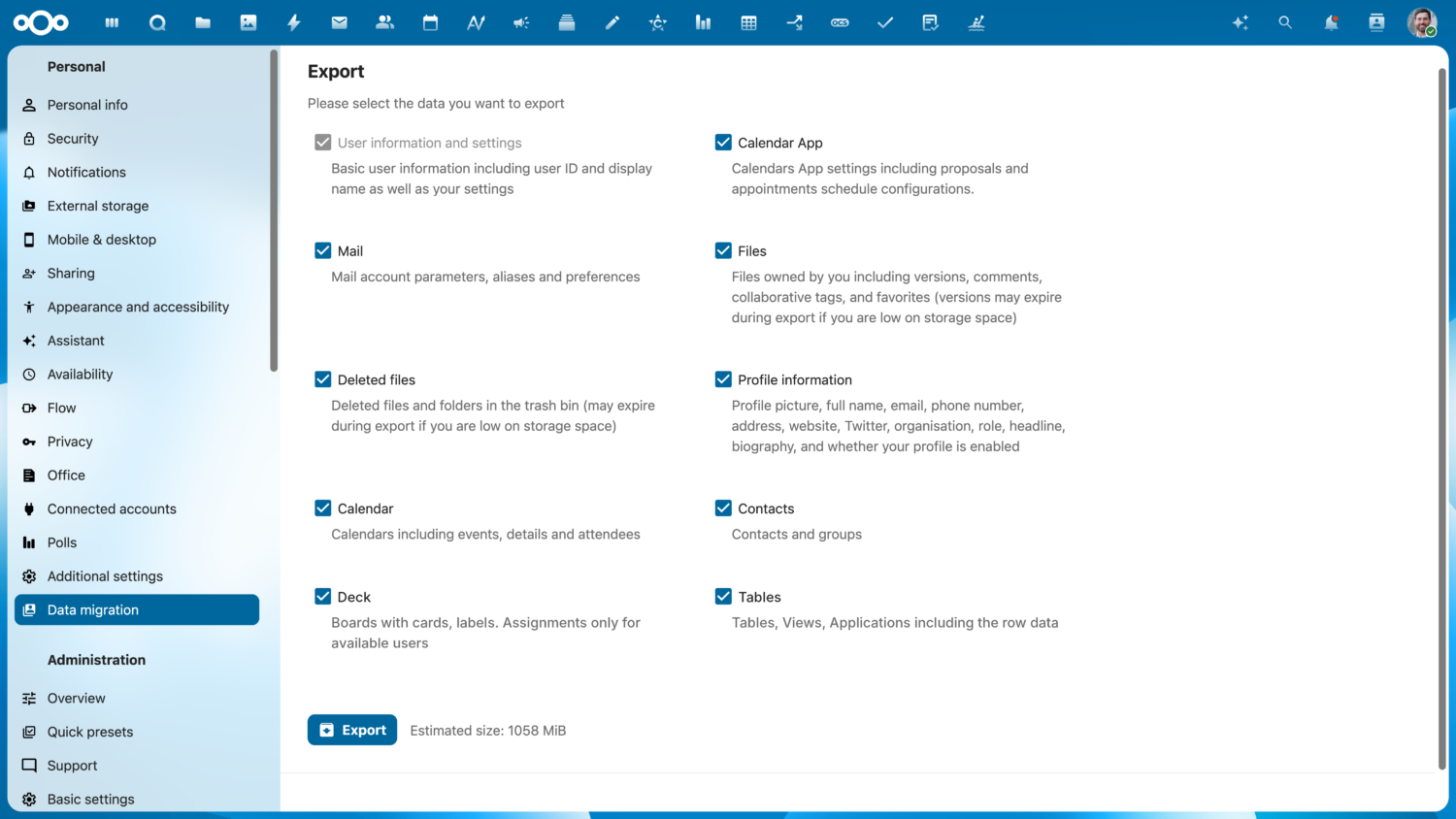
The ability to easily migrate data has always been a part of Nextcloud Hub. However, this has been further improved in Nextcloud Hub 26 Winter. Previously, the Data Migration application was an optional part of Nextcloud Hub. It is now installed by default. According to Nextcloud, the application itself has also been greatly improved. Starting with this version, more Nextcloud applications are supported. In addition to Files, data from Mail, Contacts, Calendars, Tables, and Deck can now also be easily migrated between Nextcloud instances.
More federation
When we talk about federation in the current context, it is mainly about easier collaboration between instances/servers. In the decentralized world in which Nextcloud operates, this mainly means that it must be easy to collaborate with people outside your own organization or server.
Many applications in the collaboration landscape do not allow this. For example, most messaging platforms are closed. It usually isn’t possible to send messages from one platform to the other. Email, in general, is federated, in that it is possible to send an email from Outlook to Gmail. This is the difference between a centralized or a decentralized architecture.
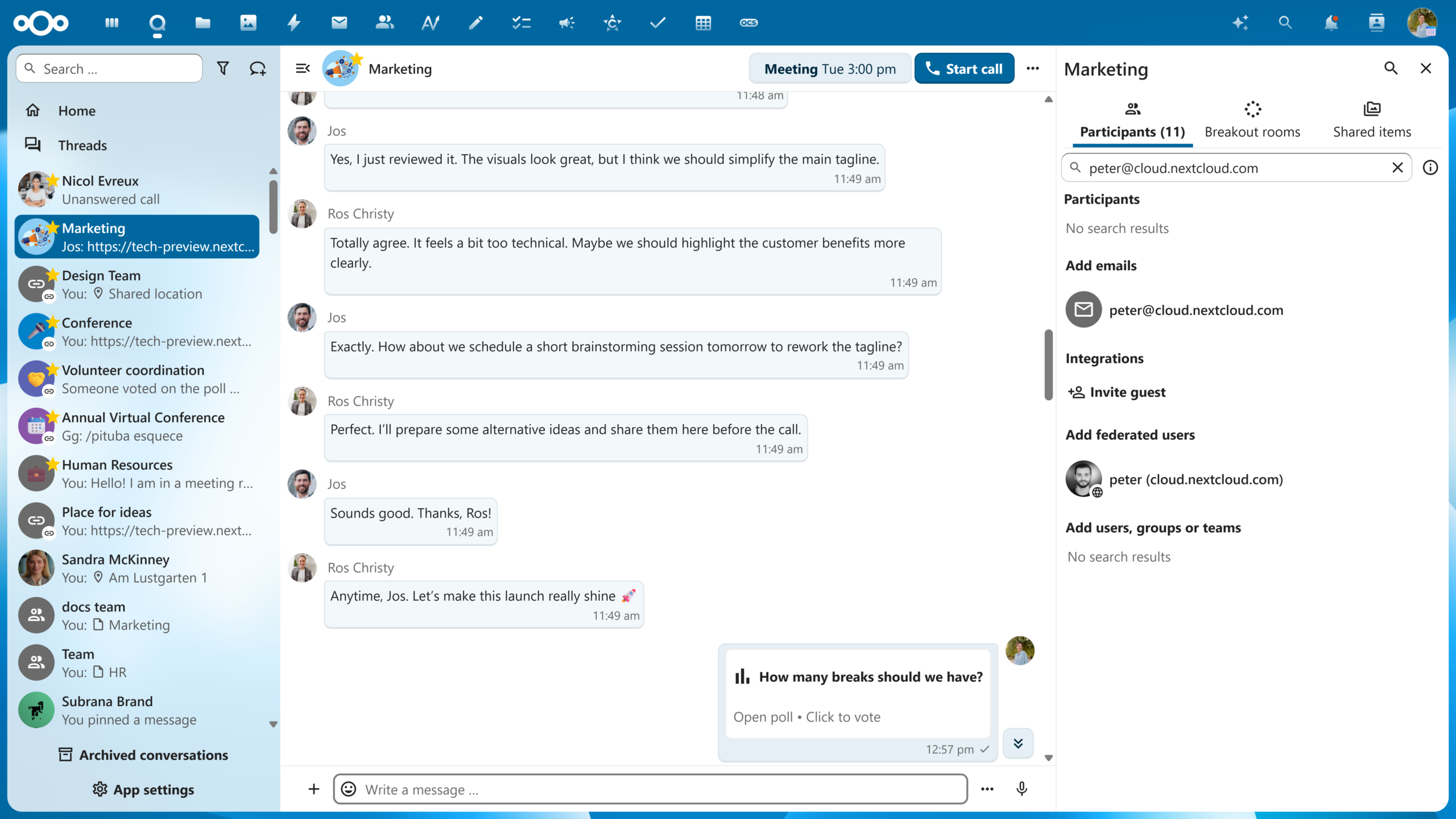
Nextcloud is fundamentally decentralized, thus allowing for federative features. Within Nextcloud Hub 26 Winter, federation is once again an extension of existing functionality. It was already possible to create direct share links for files with users on other servers. Support for the project management application Deck, the calendar, and the communication app Teams has now been added. Nextcloud has not forgotten about security either. Locking files is now also possible when sharing federated items with each other.
Nextcloud is far from finished (or complete)
It is clear that Nextcloud wants to make the most of the momentum sovereignty has at the moment. If sentiment remains as it is now, the company could well experience rapid growth. As it happens, that is precisely the company’s intention.
When we ask about its ambitions in this area, we hear that Nextcloud wants to hire significantly more employees than the approximately 150 who currently work there. The company explicitly states that the input and support of customers, partners, and the open source community remains as important as ever.
As companies become increasingly ‘serious’, the open source content may also come under increasing pressure. This is something that Nextcloud must also be wary of, although we believe that this is largely driven by sincere open source people. This fact should also ensure that Nextcloud can find the people it wants to hire in the first place. The idea is that many developers like to work for this type of company.
Nextcloud has also unveiled its own Sovereignty 2030 program. This is an investment program through which the company intends to invest more than €250 million in digital sovereignty by 2030. These investments will go towards areas such as R&D, product innovations and partner enablement, but also towards educating the general public about sovereignty and towards community projects specifically related to digital sovereignty in Europe.
The future looks bright for Nextcloud
At the end of the day, a large part of Nextcloud’s long-term success will depend on how well the software works. Many of the features we have seen so far are also available on other platforms. Nextcloud probably won’t win a feature by feature comparison with offerings from outside Europe. It will be difficult to outgun the big tech companies. However, that does not mean that Nextcloud cannot be successful, especially if a real ‘European technology, unless’ trend takes off. Then Nextcloud will definitely be at the front of the queue. With Nextcloud Hub 26 Winter, the company has in any case done what it can at this moment to provide customers and users with sovereign software.
Read also: Deutsche Telekom starts European cloud service with Nextcloud