
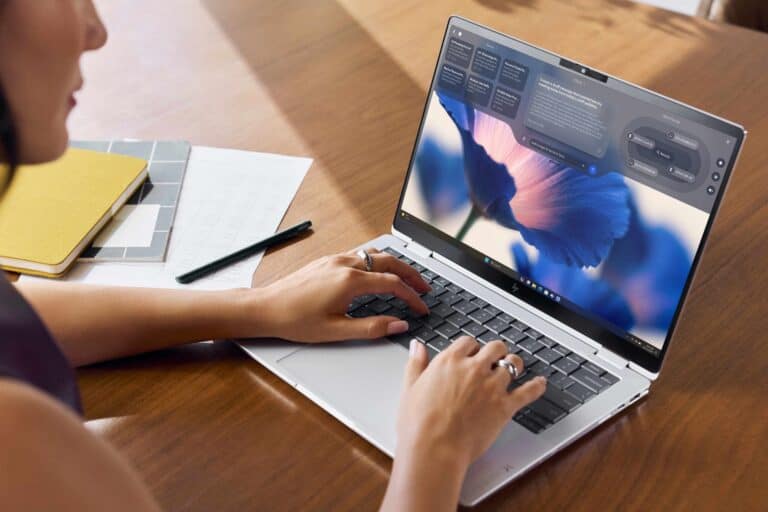
As usual, HP is showcasing new hardware to the global press this week at HP Imagine 2026. However, in our view, the most eye-catching announcement isn’t the latest Qualcomm-based HP EliteBook 6 G2q with up to 85 TOPS of AI computing power. It’s HP IQ. HP IQ offers a glimpse into the company’s vision regarding the use of AI on and across devices. In other words, it gives all those so-called next-gen AI PCs that it is also announcing more meaning and impact for organizations. This is because it utilizes an on-device AI model with 20 billion parameters. But is it truly something new, or just yet another AI assistant?
At first glance, HP appears to be following a market trend with the announcement of HP IQ. Lenovo announced Qira during the most recent edition of CES, so now HP is coming out with HP IQ. In itself, it makes sense for PC manufacturers to make these kinds of announcements. It also makes sense that the two biggest players worldwide are competing in this area. After all, they supply the hardware that the world’s AI assistants use anyway. If we’re all actually going to get our own personal assistant—one that runs right on the devices themselves—why wouldn’t the manufacturers develop one themselves?
HP IQ is a business-focused AI layer
With HP IQ, HP seems to be choosing a different positioning than Lenovo did with Qira. Whereas Qira was presented (at a trade show aimed at consumers) as an ambient assistant for all sorts of everyday tasks in the private sphere, HP explicitly calls what it has developed a “workplace intelligence layer.” It is therefore clearly aimed at business users. That’s why it will initially be available starting this spring on ProBooks, EliteBooks, EliteDesks, ZBooks, and Poly devices. These are all devices aimed at business users.
As far as we’re concerned, HP’s business focus for HP IQ is a smart move. Consumers already have plenty of choices when it comes to AI assistants to find the best restaurant in the neighborhood. A PC manufacturer isn’t going to make a difference there anymore. However, if, like HP, you’ve been saying for several years that on-device AI is going to be huge in the business market, something like HP IQ is exactly what you’d expect. It should enable organizations to get more out of their investments in HP hardware.
What is HP IQ?
Conceptually, it’s clear what HP IQ is supposed to be. Or rather, “become” is a better verb in this case. In the documentation we’ve seen, HP explicitly refers to HP IQ 1.0. That gives us the impression we’re dealing with a first-generation product that certainly doesn’t yet include everything we might expect. Of course, that’s the case with virtually all new announcements from companies. Still, it certainly caught our attention. Perhaps the intention is to immediately signal a commitment that they are working hard on the next version—that an investment in PCs and/or meeting hardware that supports it will yield even greater returns in the long term.
Whatever the exact reason for the specific naming may be, the concept behind HP IQ is, as mentioned, clear. HP aims to improve the user experience for people using HP hardware. You could view it as an integration initiative. If a company chooses to purchase everything (laptops, desktops, workstations, and meeting equipment) from HP, then HP IQ should be an interesting additional AI layer that makes people in organizations more efficient in their daily tasks. This is while organizations and employees don’t have to worry about issues such as privacy and (data) sovereignty, because the AI that HP IQ uses runs on the devices themselves.
HP IQ is an AI assistant
To answer the question from the introduction: yes, HP IQ is definitely an AI assistant. You can ask it questions (both written and spoken). Questions about the status of your hardware, what key information you need from your meeting notes, or questions about other aspects of your work.
HP IQ can also summarize documents and identify the tasks that need to be done. A transcript of an (online) meeting is also part of the offering. Furthermore, you can use HP IQ to configure your PC with the optimal settings for your work and preferences. Finally, users can use HP IQ to get answers to questions they have about the HP products they own.
The real added value of HP IQ
So far, we’re not particularly impressed by HP IQ. These are tasks for which you can use any tool already on the market. In fact, there likely aren’t many organizations that would specifically want to use HP IQ for these kinds of tasks. Perhaps an on-device AI assistant like HP IQ is faster than one in the cloud. Additionally, one could argue that it’s particularly important for sensitive data that the AI runs locally. But those are generally niche use cases.
As far as we’re concerned, the added value of HP IQ doesn’t necessarily lie in the AI assistant as we’ve known it for several years. The real added value comes into play when multiple HP products are used together.
HP NearSense
HP NearSense is a fundamental technology in this regard. It ensures that HP devices can find and connect with one another. Think of meeting participants who can connect to the Poly equipment in the room with the push of a button. PCs can also connect to each other, for example, to share files quickly and seamlessly. Pairing HP/Poly headsets and other peripherals should also become much smoother this way. NearSense is designed to make PCs more like smartphones and tablets, which have offered these kinds of capabilities for some time. Apple, in particular, has been very good at this for quite a while, but Android devices are also improving in this area.
Based on what we’ve read about HP IQ, HP claims it will even be possible in the future to address one of the biggest annoyances for many employees: connecting a PC to a printer. Based on our own experiences—and undoubtedly those of many others—this is still not a smooth process. For a short time, it seemed we had a solution with cloud printing. This made a printer available via the cloud, and users didn’t need to install drivers to use it. This still exists, but it hasn’t quite lived up to our expectations. HP IQ will also make it possible in the future to connect to a printer or MFP without having to install a driver. So it seems the old Wi-Fi Direct is being revived.
Only for HP devices
For the sake of completeness, HP IQ is (for now) something that only works if you purchase certain HP devices and use the Visor interface—developed specifically for HP IQ—on them. This is a kind of overlay on top of your operating system through which HP aims to make everything HP IQ has to offer available. You don’t have to switch between applications this way.
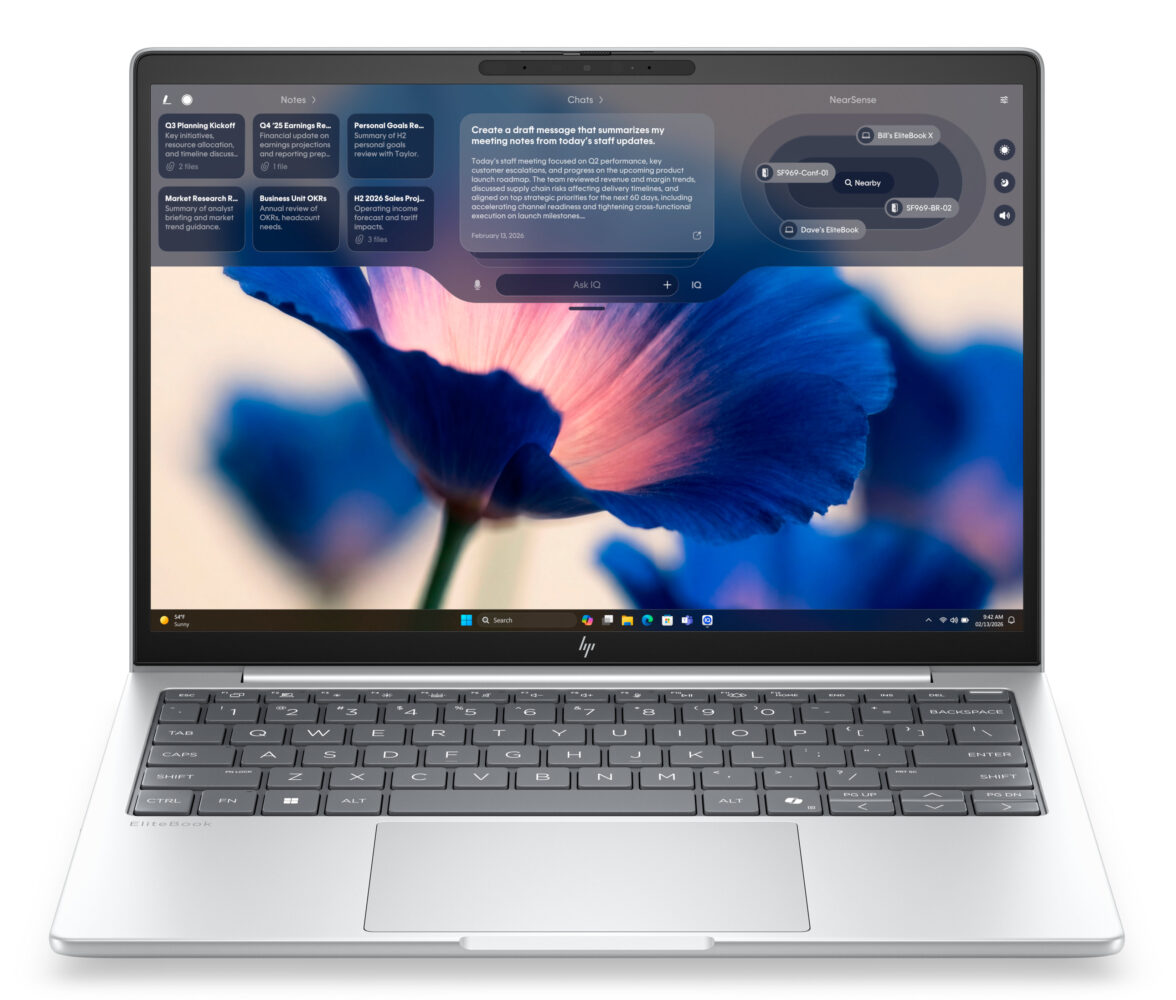
Of course, Visor is yet another interface you’ll be interacting with throughout the day. If it takes over all the AI tasks you would otherwise have done with another tool—and can even offer more—that’s not a problem in itself. However, if it becomes just another tool in the mix, the results really need to be good to make employees happy. If HP succeeds in properly implementing the NearSense concept and all it has to offer, that should certainly be possible. There’s truly a lot of potential there.
Of course, it would be even more interesting if HP made the capabilities of HP IQ—particularly NearSense and, to a somewhat lesser extent, the on-device AI assistant—available for third-party devices as well. In theory, that should be perfectly feasible, since PCs in particular don’t differ vastly from one another at the underlying level. For HP, however, HP IQ and the capabilities it offers are something that sets it apart from other manufacturers. This, coupled with the full-stack approach it has adopted in recent years, should ensure that customers buy more from HP and less from third parties.
HP and customers are in control
To draw the analogy with mobile ecosystems again, what HP is trying to do with HP IQ likely resembles Apple’s approach more than Google’s for now. That’s perfectly justifiable, by the way. In our view, Apple has a much better handle on things than Google, mainly because it has far more control over the hardware. Based on our initial impressions, that’s what HP is aiming for as well.
So it appears HP retains a fair amount of control over HP IQ. It won’t be something you can just install on any HP device. For now, HP determines where it will be available. In principle, the system requirements aren’t particularly demanding, by the way. PCs must run Windows 11 and support Bluetooth LE 4.0, 5GHz Wi-Fi, and Wi-Fi Direct, but based on what we’ve seen, there don’t appear to be any specific hardware requirements. For example, looking at the list of supported devices, there doesn’t seem to be a lower limit on the number of TOPS the NPU can deliver. The list includes an Intel-based ProBook with 17 TOPS, as well as the latest Qualcomm-based EliteBook with up to 85 TOPS.
Naturally, customers who choose to use HP IQ also want to maintain control. That is certainly possible. HP is using this new offering to make its own Workforce Experience Platform (WXP) a bit more relevant again. This serves as the management layer for HP IQ. Through WXP, customers can perform general configuration, roll out updates, and set up and monitor security and compliance. HP IQ may run locally, but it is still a non-deterministic AI model, so oversight and visibility remain important. In addition to WXP, HP IQ is also compatible with other management tools, such as Microsoft Intune.
Everything hinges on quality
HP IQ has the potential to add significant value to HP devices. Of course, it’s a way for HP to sell more products; that’s just how the world works. As far as we’re concerned, it’s certainly no reason to immediately dismiss this new offering from HP as part of a lock-in strategy. Well-integrated devices can, after all, make life a lot simpler and better. That’s what HP says it will try to achieve with HP IQ.
As far as we’re concerned, the AI assistant isn’t particularly exciting, except perhaps from the perspective of privacy and sovereignty. Everything that NearSense makes possible is undoubtedly that, if it were up to us. As always, its success depends entirely on the quality of what is offered. In other words, the main question for us is how good HP is at integrating hardware and software, something Apple has been doing well for so long.
The comparison with Apple doesn’t quite hold up, of course, because Apple has much more control over the entire stack. However, it is the vision that HP seems to be pursuing with part of HP IQ. In any case, it gives organizations an extra reason to consider HP when purchasing new equipment. And at the end of the day, that’s what it’s all about, of course.
Availability
For the sake of completeness, we’ll conclude with the availability of HP IQ. Since this is functionality that HP installs on devices, availability depends heavily on when those devices hit the market. The first models are coming this spring, with more devices to follow this summer. Poly Studio Video Bars will also be part of that rollout. More devices will be added during the next update cycles in the fall. HP doesn’t mention costs at all. This suggests that, at least initially, there are no extra costs. For now, HP isn’t installing the full HP IQ on the devices, but rather a so-called stub app.
Finally, HP explicitly states that HP IQ does not run entirely on the device itself. Some tasks are sent to the cloud. At this time, we do not know which tasks these are. However, HP does indicate that organizations can decide at any time whether or not this is desirable.
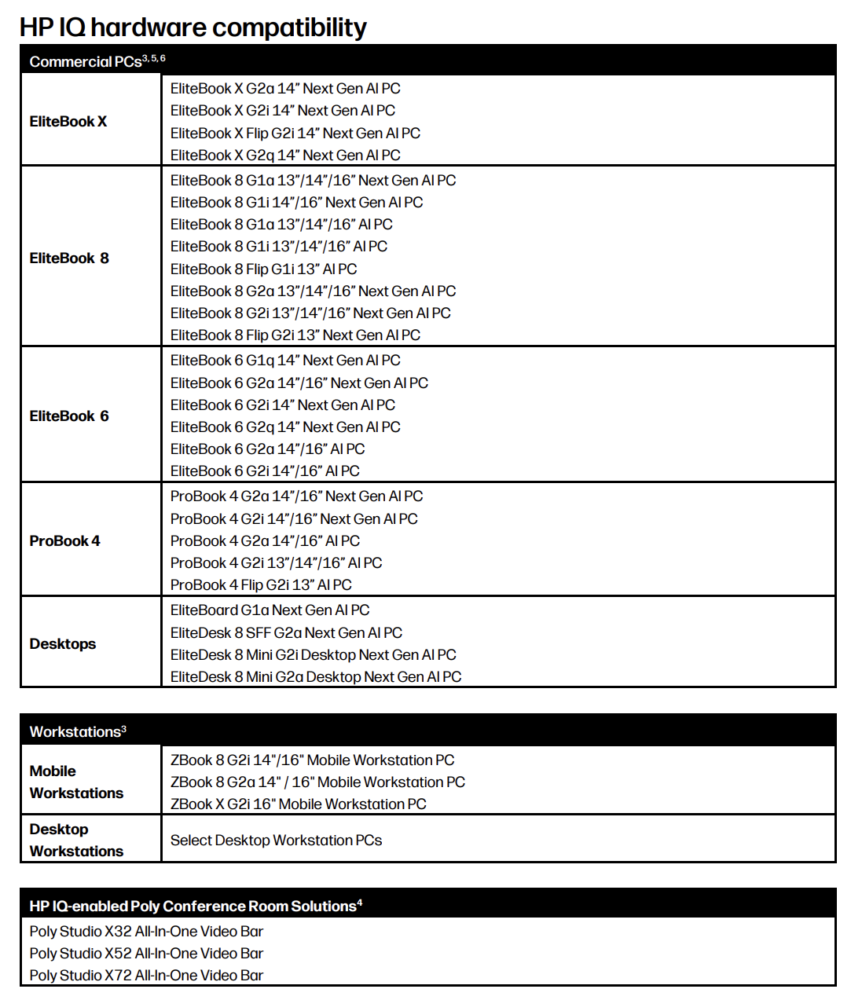
For completeness, below is a list of products for which HP IQ will become available:
Read also: HP Workforce Experience Platform gets new productivity tools