
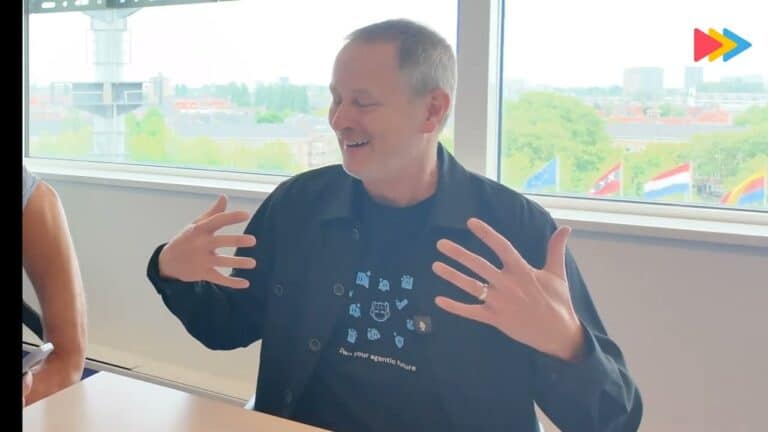
At OutSystems One in Amsterdam, CEO Woodson Martin laid out a sweeping platform vision. The 24-year-old enterprise platform has a new cloud-native development environment and a freshly announced self-hosted edition with a bold push into agentic AI. In this interview with Techzine TV, Martin clarified the company’s strategy, addressed competitive pressures from Salesforce and Microsoft, and made a candid case for why token economics could become the next enterprise headache.
OutSystems has been building enterprise software since 2001. Thousands of customers are running mission-critical systems, from custom ERP, banking front-ends, healthcare back-office applications to insurance platforms. Outsystems has long operated at a different scale than most low-code vendors. The time has now come to reposition itself as an agentic systems platform, a move that puts it in direct competition with some of the largest players in enterprise technology.
Martin frames the transition not as a break from the past but as an evolution. “A lot of what customers are building today are agentic applications,” he told Techzine. “But if you want an agentic application, first you have to have a modern application to connect it to.” That logic underpins OutSystems’ dual-platform strategy, which keeps the established O11 environment alive while pushing the newer OutSystems Developer Cloud (ODC) as the preferred foundation for net-new developments.
Also read: OutSystems focuses on control and consistency in AI projects
ODC self-hosted edition: run your agents anywhere
The headline announcement at OutSystems One was the ODC self-hosted edition. Until now, the OutSystems Developer Cloud was a cloud-only platform. The self-hosted edition changes that. Applications and agents built on ODC can now be packaged in Kubernetes and deployed anywhere. On-premises in a customer’s own data center or cloud, or in an EU sovereign cloud environment.
Martin’s best example comes from a Dutch customer: “We’ve got customers here in the Netherlands who’ve run our platform on ships, completely disconnected environments.” The self-hosted edition now gives customers the ability to take the cloud-native development environment and run it where they want, even air-gapped. For European organizations navigating data residency rules and regulatory requirements, this makes all the difference.
O11 is not going away, it’s even getting better
One of the most frequently misunderstood elements of OutSystems’ strategy is the status of O11, the original platform that has been available since 2001. Martin told us that O11 is not a legacy platform. “We’ve extended the life of the O11 platform indefinitely,” he said. More than that, OutSystems announced at the conference that developers can now use agentic coding tools: Claude, Cursor, Kiro from AWS, and Codex directly on the O11 platform. This includes not just documentation and code analysis, but actual application building and code refactoring. New capabilities continue to be added to O11, not just to ODC.
The longer-term goal is a unified platform strategy. The ODC portal is evolving to manage O11 environments as well, bringing user management, data management, and development tooling under a single interface regardless of which runtime environment a customer is using. “We’re really doing the work to unify these platforms so customers can use all of these technologies together without having to start over,” Martin said.
Agentic AI in production: real customer stories
Travel Essence, the Dutch travel company has deployed 50 AI agents to support its front-end travel experts in building custom vacation experiences. The system has been live for more than 18 months and is helping drive 20% year-over-year growth. Travel Essence runs its core booking services on O11 and its agentic layer on ODC, using the Agent Workbench orchestration platform. They combine both environments rather than a migration from one to the other.
Axos Bank, the US digital bank has built the entire front end of its web and mobile banking experience on OutSystems, and is now layering agentic experiences directly into those applications.
Heineken is using OutSystems’ new Agentic Systems Engineering capability to build applications and agents that help run and scale its global operations.
Competing with tech giants
Positioning OutSystems as an agentic systems platform means competing directly with Salesforce, ServiceNow, Microsoft, and Google. Companies with vastly greater market capitalization and ecosystem reach. Martin, who spent 18 years at Salesforce, does not shy away from the comparison. At the time of the conference, OutSystems was running approximately 30,000 agents across 2,000 enterprise customers, which comes down to roughly 15 agents per customer. Martin acknowledged this is not at the scale of the largest enterprise AI deployments. He does believe that Outsystems has the quality and customers to deploy mission-critical AI workloads which can set the company apart. The platform’s strength, he contends, is not raw agent count but the ability to build agentic systems deeply integrated with existing enterprise applications and data.
Token economics ot tokenomics: the AI cost crisis
Martin also addressed token economics. He argued that AI inference costs, while partially subsidized by venture capital today, are already creating financial stress for enterprise CFOs. In April and May, many organizations saw their token bills grow by 50%; some saw increases of 500%. The reason, Martin explained, is that the reasoning loops built into modern AI models are doing significantly more work per request than they did months ago, in pursuit of better results.
“People were very excited because agents were helping them do things fast, easy and cheap,” he said. “Now they’re starting to get really, really expensive and it’s starting to be a significant portion of my P&L.”
Martin’s argument for OutSystems in this context is about model agility. Building directly on a foundation model ties an organization to a specific model stack. An agentic systems platform, by contrast, allows organizations to swap foundation models in or out, whether to reduce cost or improve quality, without re-engineering the underlying agentic system. This model-agnostic flexibility is increasingly relevant as the cost and capability landscape for AI models shifts rapidly.
What OutSystems wants the market to understand
Asked what OutSystems does not get enough credit for, Martin’s answer was consistent with the theme of the conference: the depth and breadth of mission-critical deployments already running on the platform. Leading financial institutions, insurers, retailers, and healthcare organizations around the world run their core systems on OutSystems and are now building agentic capabilities on top of that foundation.