
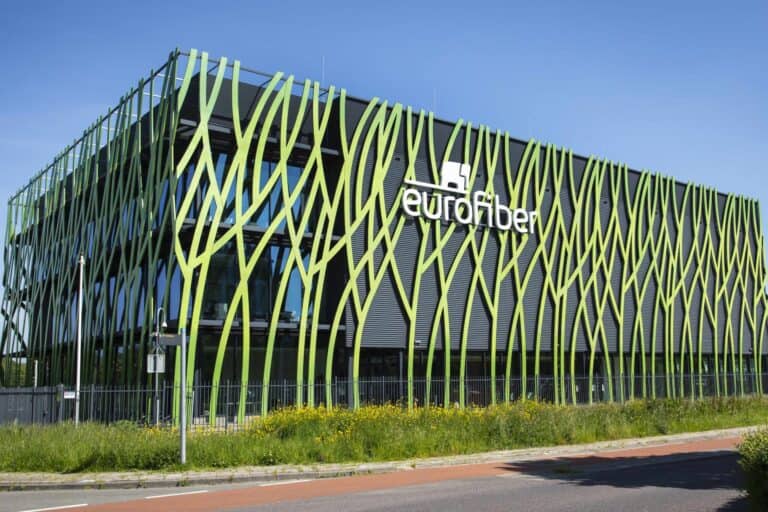
We’ve known for some time that the Netherlands’ first AI factory will be located in Groningen. As of today, we also know for certain who will be providing the services for SURF, a cooperative of more than 100 Dutch educational and research institutions. Eurofiber Cloud Infra will provide data center services to SURF from its own existing data center in Groningen.
As mentioned, the choice of Groningen is not new. The government had previously committed 70 million euros to the project, after which the European Union also contributed the same amount.
Like other AI factories in Europe, the new AI factory will become part of the EuroHPC JU. This so-called Joint Undertaking within Europe aims to make the continent a global leader in supercomputing and AI. The infrastructure must be capable of being used to develop reliable, advanced, and, above all, sovereign AI models.
As an aside, we find it striking that the EuroHPC JU seems to lump supercomputing and AI factories together, even though they are truly distinct disciplines. Of course, a great deal of computing power is needed to roll out AI at scale, but that doesn’t necessarily have to be supercomputing power. But as mentioned, that’s just an aside. As far as we’re concerned, collaboration within Europe to properly establish AI is undoubtedly a good idea, whatever it’s called.
Green data center
Returning to today’s announcement, it’s striking that there’s a strong focus on sustainability. This was a non-negotiable requirement from SURF and is also something Eurofiber is actively working on. Just recently, we wrote an article about Eurofiber’s participation in the European MISD project, which, among other things, places a high priority on sustainability.
Eurofiber’s data center design enables direct cooling of AI processors, eliminating the need for drinking or surface water. Virtually all residual heat is fed into WarmteStad’s district heating network via data thermie. This provides heat for approximately 2,000 homes. According to Eurofiber, this results in a CO2 reduction of about 85 percent.
According to the company, the PUE (Power Usage Effectiveness) of the data center that will house the AI Factory is well below that of conventional data centers. However, Eurofiber is not making any definitive statements on the matter.
An expert from Nvidia recently told us that Dutch data centers are generally unsuitable as AI factories. This is because they were designed for air cooling and handle about 10 to 15 kW per rack, while AI racks can easily require 30 to 60 kW. Eurofiber’s data center will need to be a suitable home for SURF’s AI factory.
Limiting grid congestion
The power grid is also a key consideration in the development of the AI factory in Groningen. Eurofiber designed it in collaboration with the grid operator. The goal was to avoid placing additional strain on the regional power grid. In fact, the facility is even intended to help reduce that strain. Eurofiber is achieving this in part through the use of battery systems.
The parties involved are not yet disclosing the capacity in MW of the AI factory in Groningen. However, they have indicated that it will be completed in the course of 2027. The AI factory is expected to be operating at full capacity by early 2028.