The words “cloud” and “containers” go hand in hand. That is to say, many workloads in the cloud run in virtual containers. If the initiators of the Modular Integrated Sustainable Datacenter (MISD) project have their way, they will also run in physical containers in the future. You can read about how that works in this article, which we wrote based on a conversation with Magiel Bruntink of TNO (The Netherlands Organisation of Applied Scientific Research) and Jan Bonke of Eurofiber, two of the organizations behind MISD.
Before we delve into exactly what MISD is, let’s briefly outline how and where this initiative fits in. In late 2023, the European Commission gave the green light to IPCEI-CIS, or Important Project of Common European Interest – Cloud Infrastructure and Services. With this, the Commission aims to provide a framework for (currently) 12 EU member states to strengthen Europe’s digital and technological sovereignty. In other words, it is a framework for developing a cloud infrastructure and associated services that will counterbalance providers of such services outside Europe.
An important initiative that utilizes the framework and also the investment opportunities offered by IPCEI-CIS is the 8ra initiative. Its goal is to build a so-called Multi-Provider Cloud-Edge Continuum reference architecture in Europe. Hence the name. The ‘8’ resembles the symbol for infinity and thus represents the continuum, while ‘ra’ stands for reference architecture. At least, that is how we interpret the name.
Currently, around 120 companies and research institutions have joined the 8ra initiative. These include smaller, local players, as well as European players such as Eurofiber, and large, globally operating companies such as SAP, Siemens, Bosch, and Airbus.
MISD Project
If we delve a layer deeper into the European innovation ecosystem, we arrive at the MISD project. This Dutch project is thus receiving funding from the layers above it. “It is essentially a state aid program, because it has been determined that there is a market failure,” according to Bruntink of TNO. In other words, market forces have not produced a viable European alternative to what MISD aims to achieve. The companies that launched this project are Asperitas, BetterBe, Deerns, Eurofiber, NBIP (National Management Organization for Internet Providers), TNO, and the University of Twente.
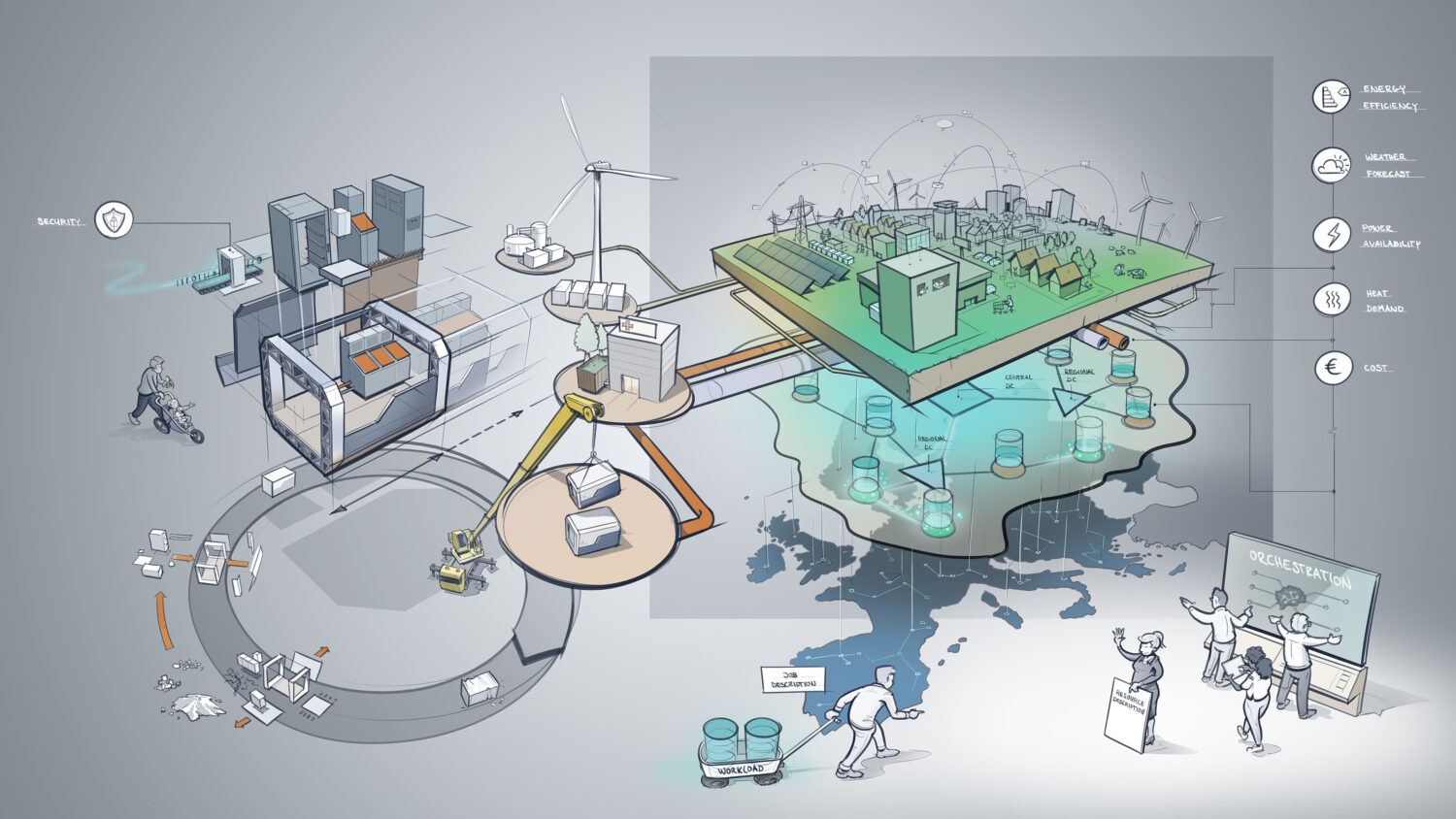
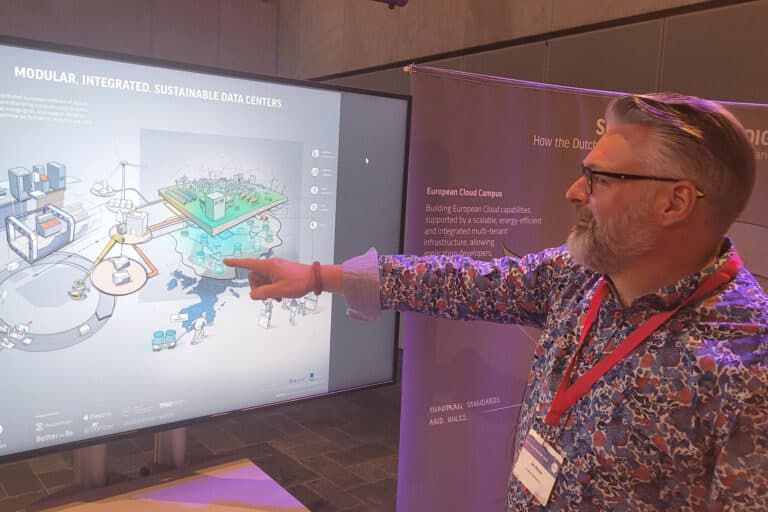
MISD stands for Modular Integrated Sustainable Datacenter. The data center of the future must consist of all kinds of modular components. These modules all integrate with each other. Above all, however, the data center deploys them in the most sustainable way possible. This approach explicitly links modularity and sustainability.
In addition to sustainability, MISD must also provide the infrastructure for a European cloud, Bruntink notes. We discussed this at length last year in an article about ECOFED. That initiative also falls under IPCEI-CIS and focuses primarily on how workloads can move freely through a European cloud via a federated layer. MISD can serve as the infrastructure where this is to take place.
What does MISD mean by modular data center construction?
Modular construction has been a buzzword in the data center world for years. Partly out of necessity, partly out of vision, data center providers have been building their data centers incrementally for quite some time. That is to say, they build in increments of x number of MW at a time. This makes it easier to obtain building permits. It also allows them to stay more closely aligned with technological developments.
However, this approach to modular construction is not what MISD is all about, we hear from Bonke of Eurofiber. “By modular, we primarily mean distributed. We want to build modules where the energy transition is also possible,” he explains. There isn’t space everywhere on the power grid to build data centers. The data centers (i.e., the modules) must therefore go where it is possible. This could be, for example, locations with alternative, renewable, energy sources. In doing so, they also seek out locations where they can use existing infrastructure as much as possible. They will place a container at that location and send workloads there.
The idea behind the modules is also that they make the entire concept of the data center itself more flexible and sustainable, Bonke continues. “Current data centers are built to last 25–30 years. They are difficult to retrofit and upgrade. With the modular concept, it’s different: containers are built to last 5 to 6 years. After that, a new container is deployed, and we refurbish the old one.”
Incidentally, in this article we’re referring to physical containers as “carriers” for the modules. However, that doesn’t necessarily have to be the case, Bruntink notes. “Modular doesn’t always mean a container; it can also simply be modules placed inside an existing building. All sorts of options are conceivable.”
Compute only, not the data
When we talk about distributed systems like those envisioned by the MISD project, it’s obviously important not to lose sight of data availability and security. Spreading data centers across a larger area via modules/containers also makes the system potentially more vulnerable. That’s certainly not the intention.
Bonke therefore emphasizes that the vision from an MISD standpoint isn’t to simply store the data anywhere. All existing regional data centers will remain in place. That’s where the data stays. What MISD envisions is extracting the computing power from the data centers and deploying it elsewhere. So it’s the computing power that needs to go into the containers. When we note that this does go somewhat against the prevailing view that data and compute should preferably be located close to each other, Bonke admits that they need to assess what is feasible and what is not. This is where TNO’s role becomes clear. They are examining what is needed in terms of orchestration to make this happen.
More focus on the software
The software component, which TNO is primarily focused on, is in any case a key element of the MISD project’s vision. After all, a distributed data center involves more components that must be coordinated. And thus also more data sources for software to retrieve telemetry.
“As TNO, we sit between the infrastructure and the service provision,” says Bruntink, explaining TNO’s participation in the MISD project. It must develop the software that coordinates these two components. With MISD’s goal in mind, this involves knowing where the peaks and troughs in the power grid are, for example. The software must also provide insight into how much power is being consumed.
Thinking differently about an existing issue
On paper, the MISD project sounds quite interesting to us. It approaches a problem we as a society are grappling with (How do we ensure that data centers can continue to meet the needs of the population?) by thinking about it in a different way. While decoupling compute and data is generally seen as undesirable, the MISD project explores to what extent that is actually justified. And how much flexibility there is.
If it is possible to deploy compute wherever feasible while keeping data regionally and well-secured, this opens up quite a few new possibilities. After all, compute accounts for the highest energy consumption and therefore benefits from flexible deployment spread across the Netherlands (and later Europe).
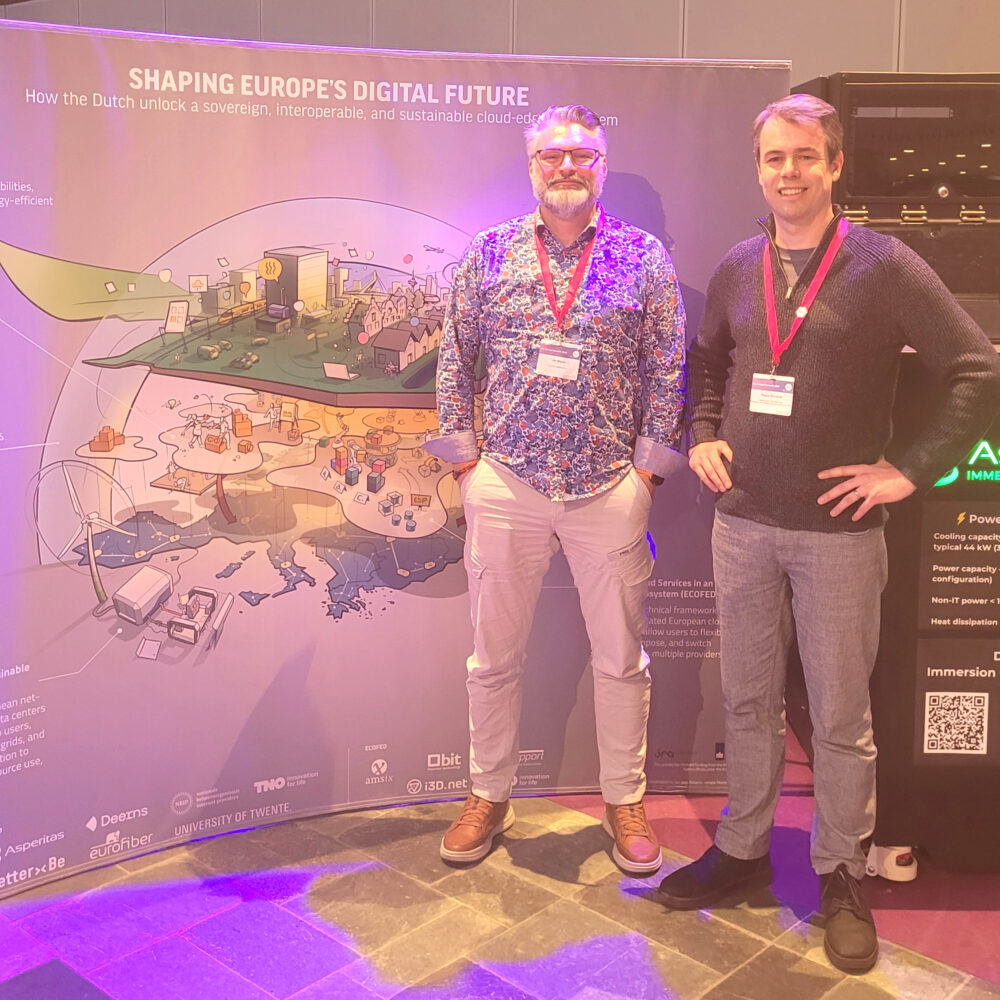
We certainly see advantages in what MISD aims to achieve. One advantage of such a distributed data center is that redundancy is built in by design (provided it is properly configured, of course). It is also an advantage from a security perspective that workloads can run in a variety of different locations. This makes it harder for attackers to strike during runtime than when everything is located in a single place.
On the other hand, a distributed data center does offer a larger attack surface, even though the data is not stored in the modules that are part of the MISD vision. Compute is certainly not inherently uninteresting or immune to attackers and attacks, so this must also be carefully considered when it comes to security. We can also imagine that even the relatively small compute modules/containers cannot and should not simply be placed anywhere. That still needs to be clarified. There is a chance that this will only happen once the project enters its final phase.
How realistic is MISD?
How realistic are the goals the parties behind the MISD project aim to achieve? Since we are still largely in the exploratory phase, that is a question that is difficult to answer at this time. Bruntink notes that Eurofiber is also testing and setting up various things in a so-called staging lab at their data center in Arnhem. In the near future, they plan to move forward with field labs. That will make things a bit more concrete.
As soon as we get the chance to see the first tangible results up close, we will certainly seize it, because parties that look at existing issues in a new way deserve attention in any case. The old way no longer works, or at least not well, so new ways must be found. In any case, we don’t expect to see a decrease in the number of data centers. In fact, this market is only going to grow even faster. So we simply can’t just say that things aren’t possible; we have to find ways to make it work, in a sustainable way.