
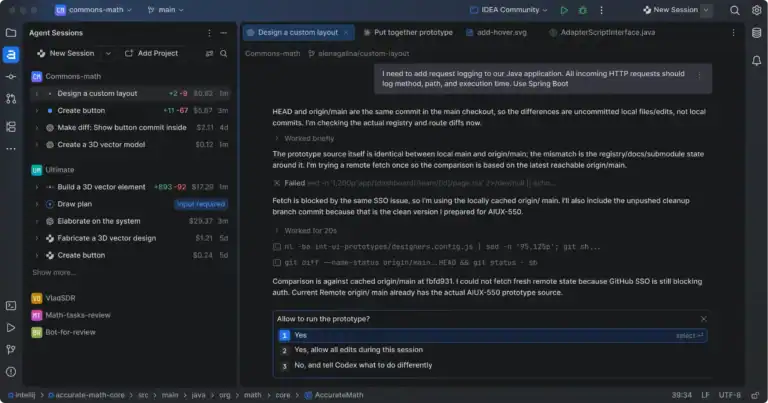
JetBrains is consolidating its agentic development tools under the name JetBrains Air. It is an open system of products for developers, teams, and organizations that also supports agents from other vendors. JetBrains Central will continue as Air Governance.
Six months ago, JetBrains began publicly experimenting with agentic development environments. During that same period, the company introduced JetBrains Central, an open control and execution system for agent-driven development. It later added a CLI, shared context, cloud agents, automations, and AI cost controls.
These separate components are now being brought under a single umbrella. JetBrains Air consists of Air in JetBrains IDEs, Air Teams, and Air Governance, formerly JetBrains Central. The coding agent Junie, which independently plans and executes multi-step tasks within the IDE, is supported across all Air interfaces.
For JetBrains, this marks a break from 26 years of product focus. All that time, the company focused primarily on the individual developer workbench. Now it is building for the broader system in which agentic work is initiated, executed, coordinated, assessed, and managed. The IDE isn’t going away, but it no longer serves as the sole window into the entire development process.
The connecting layer is the Agent Client Protocol (ACP). This protocol standardizes the connection between an IDE and an agent’s full suite of capabilities, including scheduling, tools, model routing, and observability. Earlier this year, JetBrains joined the ACP, which was developed in collaboration with Zed. Through the ACP Registry, developers can discover and run compatible agents.
Governance lags behind adoption
JetBrains states that developers are adopting agents faster than organizations can build the infrastructure to support them. Context, coordination, governance, and cost control are not keeping pace. According to the company, costs are surfacing elsewhere: in reviews, rework, security, infrastructure, and spending.
Air Governance is designed to provide visibility and cost management across multiple providers and tools. JetBrains cites multi-vendor support as a fundamental design principle and does not anticipate market consolidation in the short term. The company states: “Supporting multiple models and agents is the floor, not the ceiling.”