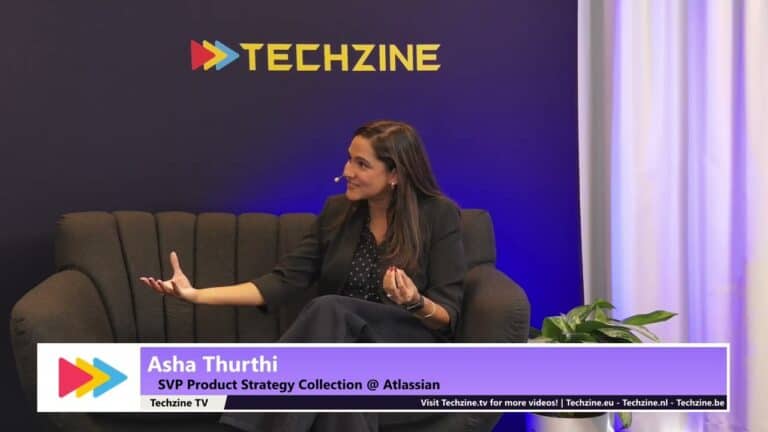
How do strategic objectives align with what is actually happening on the production floor? In order to answer this question, and many more like it, Atlassian came up with Strategy Collection. At its Team Europe ’26 event, we sat down with Asha Thurthi, the SVP at Atlassian who is responsible for Strategy Collection.
How big is the divide between board/C-level and the production floor? In order to illustrate this, Thurthi draws from Atlassian’s own State of Strategy report. This report, based on interviews with more than 300 senior enterprise leaders, shows that eighty percent of leaders say they know their strategic priorities. However, only 11% have work linked to those priorities in a single system. In other words, many companies run the risk of having a lot of strategic drift.
Strategic drift is not the result of bad intentions, Thurthi points out. Teams on the floor face daily demands, for instance new customer requests, shifting dependencies, competing priorities. As a result of that, they slowly pull away from the strategic direction they originally aligned on. By the time leadership notices, the gap has often widened over an entire quarter or even a full annual planning cycle.
What is Atlassian’s Strategy Collection?
Strategy Collection is Atlassian’s solution designed specifically for leaders. It sits above the software development lifecycle (called AI-native SDLC by Atlassian nowadays) as a business value context layer. The goal is to provide a single connected operating model. Leaders can use it to declare their strategic intent. That is, their priorities, big bets, and objectives for the company. They can also define their investment in people, budget, and AI costs, and set the key results they want to drive.
Thurthi describes it as a top floor-to-factory floor view. Team members executing on the ground can see how their work connects to strategic priorities. Leaders can see where execution is drifting from strategy. Both sides benefit from the same connected model.
Three pillars: intelligence, capital management, and planning
Strategy Collection is organized around three value propositions.
Strategic intelligence
Strategic intelligence is a living signal from a connected operating model, Thurthi tells us. That sounds a bit vague. What she wants to stress by saying that, however, is that the result of this pillar of Strategy Collection isn’t another dashboard, but something more alive. That is, at any point, a leader can pull insights, via the Atlassian platform, or through the Atlassian Model Context Protocol in any agentic tool of their choice, and get answers to questions. Examples of those questions: Where are my investments bottlenecked? Which goals are trending at risk? Where are my dependencies creating risk?
Human and AI capital management
As AI adoption accelerates, leaders obviously want to know that teams are executing faster. However, they need to know whether AI tokens are going to the right priorities and unlocking the right outcomes too. Strategy Collection brings AI consumption and investment alongside human capital. This gives leaders visibility into whether both people and agents are working toward the goals that matter. Thurthi stresses that this is not only about cost. It is also about preventing burnout and ensuring humans and agents collaborate sustainably toward outcomes.
Strategic planning
The third pillar gives leaders a consolidated view of all strategic priorities alongside total capacity: people costs, agentic costs, and non-labor costs. This is increasingly important as planning cycles compress. Thurthi illustrates this point by referencing a customer who described their planning horizon shrinking from annual to quarterly to, effectively, a matter of days. This is driven by how fast AI is accelerating the development lifecycle. Having a ‘living’, connected operating model allows leaders to steer even as that cycle shortens.
AI makes strategic drift worse
A recurring theme in the conversation is that AI does not solve strategic drift on its own. In fact, it accelerates it, Thurthi says. When teams execute faster with AI, the window in which a leader can detect and correct misalignment shrinks. As mentioned earlier, leaders need to know whether AI is delivering the right business outcomes, not just whether it is delivering faster.
According to Thurthi, Strategy Collection addresses this by making AI investment visible within the same strategic context as human investment. Leaders can see where AI tokens are going, which priorities those tokens are serving, and whether the goals tied to those priorities are on track.
The Teamwork Graph underneath
Underlying Strategy Collection is Atlassian’s teamwork graph. That is no surprise, because that is underneath everything that Atlassian does. It combines knowledge context, work context, communication context, code context, and people and data context in one place. This graph can ingest strategic direction data from wherever leaders store it. It doesn’t matter if the data is in PowerPoint presentations, Confluence documents, Notion pages, spreadsheets, or any third-party tool, Teamwork Graph can use that context to guide leaders toward better choices, Thurthi argues.
When we ask Thurthi about the type of data Atlassian uses to improve the Teamwork Graph, she points out that they do not aggregate anonymized data across customers to train insights. The insights drawn from the Teamwork Graph are grounded entirely in each customer’s own connected context. If a customer wants benchmarking data from their industry vertical, that data needs to be connected to the graph by the customer.
Mean time to pivot
One of the important concepts we talk about with Thurthi is mean time to pivot. This is the time it takes an organization to gain awareness that a strategic direction is not working, make a decision, and take action. Without a connected operating model, that awareness often arrives months too late. Strategy Collection is designed to compress mean time to pivot by giving leaders a continuous signal rather than a quarterly snapshot, she tells us.
Leadership quality still matters
To be clear, Strategy Collection is a tool, not a substitute for leadership, we hear from Thurthi. She acknowledges that her most important conversations with enterprise customers are not about the product. They are about something else. What are the biggest bets? What does success actually look like? Strategy Collection gives leaders a shared vocabulary and alignment language. This is important, as that creates the conditions for what-if scenario modeling, and surfaces data that can ground disagreements in evidence rather than opinion. However, the strategic intent still has to come from the leaders themselves.
Do we need predictive outcomes?
It’s all very interesting to hear about how Strategy Collection wants to align different parts of organizations and prevent strategic drift. However, is there some predictive certainty built into Strategy Collection too? That is, is there a spectrum of outcomes before leaders commit. Strategy Collection today delivers visibility and insight, and AI assistants working against the Teamwork Graph can suggest probable paths based on historical data and organizational context. Full predictive modeling remains a frontier, though. Based on Thurthi’s responses, we get the impression that her product teams are looking into this.
Also read: Atlassian AMP: how can enterprises run and govern agentic AI teams?