
According to Nvidia, of every gigawatt an AI data center draws from the power grid, only 60 to 70 percent is actually used for AI work. Nvidia and Vertiv want to reduce that loss and measure an AI data center’s efficiency in tokens per watt, that is, how much output each watt generates. Brussels also wants data centers to use power more efficiently, but is focusing on a building’s energy and water consumption through a new energy label.
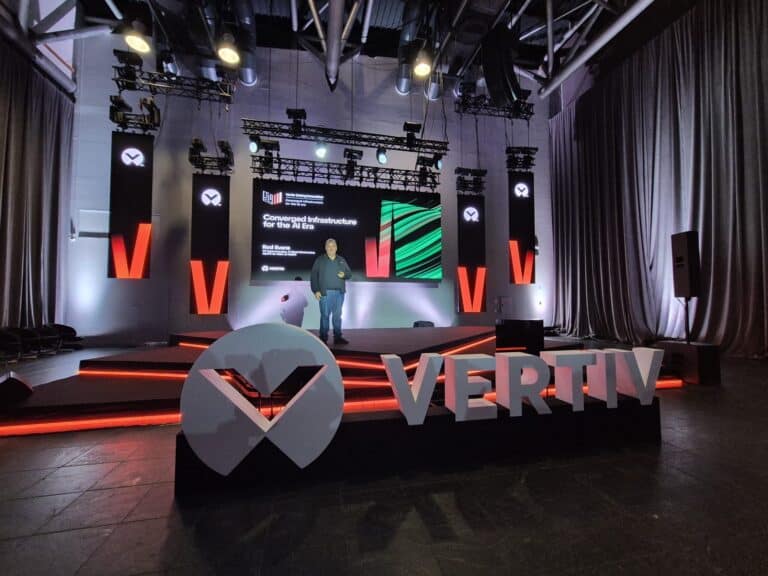
Rod Evans, Vice President of Supercomputing, AI Cloud Infrastructure, and AI/HPC for EMEA at Nvidia, broke it down step by step during Vertiv’s annual EMEA press conference in Zagreb. A one-gigawatt AI data center loses about 20 percent of its power to the building itself: cooling, power distribution, and conversion. Another 10 percent is lost to racks that are not optimally configured, and 10 percent to failures and restarts. What remains, about 600 to 700 megawatts, performs the work for which the data center was built.
That work increasingly consists of inference: trained models that answer questions and perform tasks. The output of this process is measured in tokens, the units a language model breaks down and processes text into, roughly equivalent to a word segment. Nvidia refers to data centers built for this purpose as “AI factories”: power goes in on one end, and tokens come out on the other. “Inference is the workload, and tokens are the new currency,” says Evans.
For a long time, the chip determined how much AI capacity a company could build. Anyone who could buy enough GPUs could grow. Now, network connectivity is increasingly the bottleneck, as new data centers sometimes wait years for sufficient power. When the amount of power is fixed, what matters most is how much work you get out of each watt, which is why Nvidia and its partners present “tokens per watt” as the metric by which an AI factory is evaluated. “The first thing my cloud partners want to know is how quickly the first token comes out after powering up,” says Evans. “That’s how they make their money.”
The bottleneck is in the software
According to Nvidia, part of that 30 to 40 percent loss can be prevented. Evans cites three causes: unused power capacity, fixed and conservative settings for power and cooling, and ample reserves for outages and spikes. “A data center is actually designed for peak load and outages, not for what it typically uses.”
Nvidia uses software to address the 10 percent of power lost in the racks. A next-generation rack can draw up to 224 kilowatts, but runs at 164 kilowatts in its most efficient mode. This allows more racks to fit within the same power budget, and according to Evans, this approach yields better results, especially for inference, than running everything at full power. For training, a cluster runs at full capacity; for inference, it switches to energy-saving mode.
Nvidia bundles this approach into DSX MaxLPS, part of its DSX platform for AI factories. At the AI Infra Summit, a trade conference held in Santa Clara, California, in mid-September, the company claimed that MaxLPS delivers up to 1.4 times more tokens per megawatt. In a technical explanation, Nvidia cites up to 40 percent more GPU capacity within the same power budget.
Power behind the meter
In addition to the 30 to 40 percent loss within the data center, another shortfall arises right at the grid connection. “You sign a contract for 100 megawatts, but you never actually get that,” says Evans. “With a bit of luck, you’ll get 93 megawatts, and at certain times of the day, even less.” He recommends closing that gap with on-site power generation, behind the meter, that is, off the public grid. In the United States, this is often natural gas; in Europe, it’s more likely to be hydropower, solar, or wind.
Power isn’t the only thing slowing data center construction. According to Evans, 12 gigawatts of new data centers are planned for this year in the United States, but only about 5 gigawatts will be completed because permits and preparations aren’t finalized in time. For 2027, 36 gigawatts are planned, of which he expects about 7 gigawatts to be completed. He says Europe is making up for a large part of that shortfall, with major construction programs in Spain, Portugal, Scandinavia, and, increasingly, Eastern Europe as well.
One of those projects is the Lisbon Atlantic Hub, a scalable, modular data center near Lisbon scheduled for completion in 2028, with Vertiv as a partner. Jorge Paraiba, the Hub’s executive director, notes that nearly all projects are facing delays, whether due to permitting issues or grid constraints. “Once you have power, you face other challenges,” he says. “But the biggest challenge remains finding a location where power is available.” According to Paraiba, the Portuguese Hub was fortunate to secure a site just one kilometer from the power grid.
AI’s new currency
Paul Ryan, Vertiv’s EMEA president, notes that the challenge varies by location. “In one place, there’s power, but you can’t get the permit approved,” he says. “In another, the permit is granted quickly, but there’s no power. And sometimes you have both, but the location is so remote that you can barely get the equipment there.” According to him, Vertiv focuses primarily on the total lead time, from order to a fully operational data center.
Vertiv primarily supplies power and cooling systems within data centers, but is also looking beyond that to secure power more quickly. In early September, the company announced the acquisition of UtilityInnovation Group, a specialist in microgrids: small, local power grids with on-site generation, behind the meter. “This allows us to further expand our offerings along the power chain,” says Ryan. “We can then industrialize microgrids and advanced power control in our factories and deliver them anywhere in the world.” Vertiv is paying approximately $1.45 billion for the company, plus a potential additional $1.15 billion if UIG meets its earnings targets.
Gautham Gnanajothi, senior vice president and global head of best practice analytics at research firm Frost & Sullivan, sees this trend across the entire sector. According to him, power is shifting from a utility service to a strategic requirement that determines where and how AI capacity can be built. “Computing power and energy have become the two currencies of AI,” says Gnanajothi. “The question is no longer how much computing power you can buy, but how much you can deploy, power, cool, and run profitably.”
Racks heading toward a megawatt
Power supply is also changing within the data center, as power consumption per rack continues to rise. According to Evans, Nvidia is working toward racks of nearly one megawatt by 2028, more than four times the current 224 kilowatts. “If you try to deliver one megawatt per rack with the current power supply, you’ll need 32 cables per rack,” says Evans. “That’s never going to work.”
The solution is 800 volts of direct current. In the new setup, the data center converts the grid’s alternating current to 800 volts of direct current, then steps it down to 54 volts at the rack level. The higher the voltage, the lower the current required to deliver the same power, and thus the fewer cables needed. Furthermore, the AC power from the grid no longer needs to be converted at multiple points on its way to the servers (after all, every conversion step consumes power). Evans expects that this will increase the efficiency of an AI facility from 60 to 80 to 85 percent.
Nvidia is collaborating with Vertiv on this. According to Ryan, however, the transition won’t happen quickly. “This isn’t a matter of flipping a switch,” he says. “Liquid cooling became standard in about a year; 800-volt direct current will be adopted much more gradually, application by application and, initially, location by location.”
In addition to the power supply, cooling, the other major source of energy loss in a data center building, is also changing. The racks in Nvidia’s Vera Rubin generation are fully liquid-cooled, including the switches and power supplies, and no longer have internal cables. The cooling water enters at 45 degrees and exits at 65 degrees. According to Evans, 45-degree water is available virtually everywhere in the world, and because it circulates in a closed loop, fewer chillers are needed, and 95 percent of the water is reused.
Reusing waste heat
Moreover, that warm water doesn’t have to go to waste. Evans cites district heating in Scandinavia, salmon farms that need warm water for young fish, and data centers in forested areas that use their residual heat to dry wood, eliminating the need to transport freshly cut wood, which is half water, by road. In Sweden, the latter is already happening, said Isabelle Kemlin, vice president of the Swedish Data Center Industry Association, the day before during Vertiv Week 2026 in Zagreb. The Netherlands is also already reusing waste heat. “In Rotterdam, there’s a data center located in the old logistics building of the Van Nelle Factory,” says Stijn Grove, director of the Dutch Data Center Association. “Thanks to that waste heat, the historic complex is largely off natural gas.”
A data center still needs complete infrastructure for power and cooling around those racks, and that’s where Vertiv comes in. Normally, various suppliers assemble six or seven separate products on-site, such as switchgear, power rails, and UPS systems, and test them there. According to Ryan, Vertiv supplies complete systems that have already been tested together in the factory. “That speeds up the time to the first token,” says Ryan, “but it also improves your tokens per watt, because all the components work together as a single system.”
But before anything is built in a factory, the data center already exists on the computer as a digital twin: a virtual model in which power, cooling, and networking are simulated. Nvidia provides a blueprint for this through its DSX platform, which, according to Evans, is designed to prevent every data center builder from constructing facilities in their own way. More than 250 organizations are now participating, and Vertiv is using it to develop its prefab data center for Nvidia’s Vera Rubin racks, the OneCore Rubin DSX. In its Frontiers report, Vertiv claims that digital twins and prefabrication together can cut the time to first token by up to half.
Everyone measures something different
Nvidia and Vertiv group their efforts to reduce power loss, ranging from more energy-efficient racks to direct current, liquid cooling, and prefabrication, under a single metric: tokens per watt. But exactly what that metric measures depends on who you ask. Nvidia calculates based on the power coming from the grid, which includes all losses in the building, racks, and system failures. Vertiv describes the metric on its own slides as limiting the power consumption of all supporting infrastructure surrounding the chips.
Gnanajothi notes that, in addition to PUE, the ratio of total power consumption to IT power consumption, operators are increasingly looking at WUE and CUE, which measure water and carbon consumption. He did not mention tokens in his presentation. Brussels is also focusing on energy and water. Starting in 2027, data centers with a capacity of 500 kilowatts or more will receive a label that shows their energy and water consumption, as well as their contribution to the grid, for example, by supplying residual heat, adding clean generation, or responding flexibly to demand. A proposal for minimum requirements for new data centers will follow in the second quarter of 2027.
The Netherlands’ current status is already partially evident. In the Commission’s first report, Dutch data centers averaged a PUE of 1.17, which the Commission considers excellent, and a WUE of 0.70. However, these figures are based on limited data, as only about 36 percent of EU data centers required to report actually did so.
Ryan sees no surprises in the label and says Vertiv is prepared for it. However, he emphasizes that policymakers and the data center sector in Europe must come together to achieve the pace the market demands. Evans of Nvidia concluded his presentation with a call to partners such as Vertiv. “Together, we want to build sustainable AI data centers,” he said, “where the focus isn’t on maximizing power output, but on getting the most out of every watt.”