
Snowflake is expanding its AI agent CoCo (Cortex Code) with cloud agents and automations that monitor and repair data pipelines. In addition, the company is introducing real-time analytics, enabling up to 20 GB per second of data to flow into a single governed platform. Engineers retain final approval over what goes into production.
Snowflake is making these announcements during Snowflake Expedition 2026. At its core, the company is having AI agents take over repetitive tasks: building, running, and repairing pipelines. According to Snowflake, data teams still spend a lot of time on pipelines and streaming systems that consist of multiple tools. If an agent works with yesterday’s data or a broken pipeline, it acts on incorrect information.
“Every AI success story has a data team behind it,” says Christian Kleinerman, EVP of Product at Snowflake. “However, even as AI scales across the enterprise, those teams are still keeping data accurate largely by hand.”
Agents in the cloud, on schedule
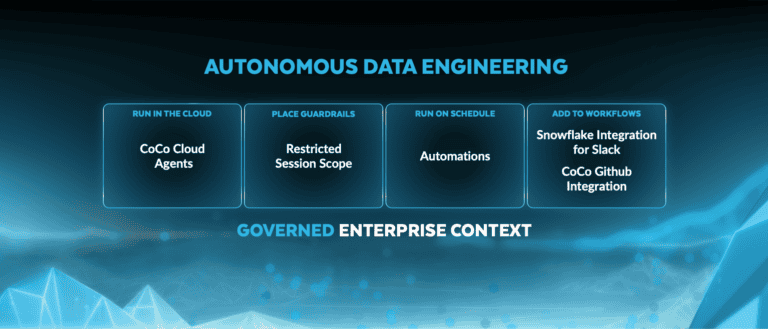
With CoCo Cloud Agents, CoCo no longer runs on an engineer’s laptop but in an isolated cloud environment managed by Snowflake. Each session is assigned its own secure container and works with files in a shared Snowflake Workspace. With CoCo Restricted Session Scope, engineers can limit what the agent can do. Moreover, the work continues even after the engineer logs out.
CoCo Automations add scheduling capabilities. Engineers describe a recurring task in plain language, such as checking pipelines or investigating failed jobs. If a run detects a problem, CoCo identifies the likely cause and suggests a fix. Who decides what goes into production? The engineers. Through the GitHub integration, code changes go through the existing review process, while Snowflake for Slack brings the agent into the channels where teams are already working. Because everything runs within Snowflake, CoCo understands an organization’s lineage, catalog, and governance policies.
For new pipelines, there’s Pipeline Builder, a visual editor in Snowflake Workspaces.
Real-time data without separate tools
The second part focuses on live data. Snowpipe Streaming automatically scales with Elastic Channels. With Snowflake Datastream, companies using Apache Kafka can send their apps directly to Snowflake without having to manage brokers or connectors. Minted, Nexon, and Zywave are already doing this. Streaming Transformations transform data in transit using standard SQL.
Interactive Analytics is designed to eliminate the need for a separate serving database. It delivers answers with sub-second latency to dashboards, apps, and AI agents, even during peak loads. According to Snowflake, companies can stream up to 20 GB per second, with a median time to usability of less than three seconds.
Migrating Spark workloads
For Spark teams, Snowpark Connect now supports DataFrame Writer V2 APIs and flexible partitioning for Iceberg tables. This allows Spark pipelines that write to Iceberg tables to migrate to Snowflake with fewer code changes.
A File Reader for Apache Spark loads JSON, CSV, and Parquet files directly into Snowflake. With Write-Audit-Publish, teams can first test pipelines on a data branch. CoCo can also rewrite existing Spark code for Snowflake, after which a Monitoring UI shows how jobs are performing.
Tip: Snowflake Cortex Code is now called CoCo and performs autonomous development work