
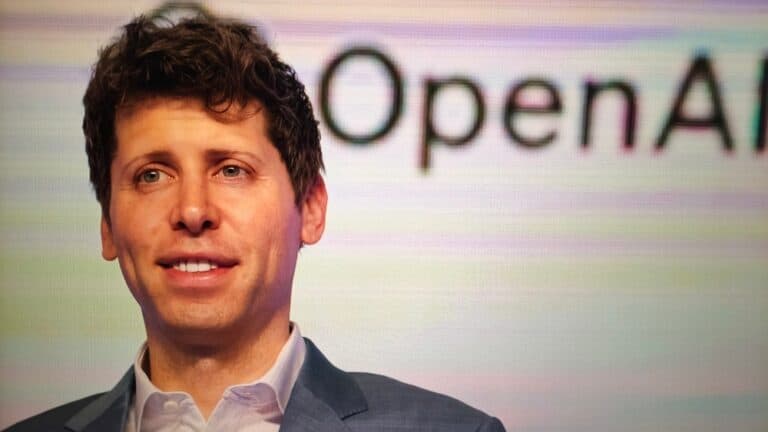
While a race between OpenAI and Anthropic to go public seemed imminent, the maker of ChatGPT is postponing its planned IPO. In addition, the U.S. government has asked OpenAI to severely restrict the release of GPT-5.6, meaning this model will not be widely available until later.
OpenAI does not plan to go public until 2027, according to The New York Times, citing three people familiar with the internal decision-making process. The AI company had previously filed a confidential application for a U.S. IPO, aiming for a valuation of one trillion dollars. CFO Sarah Friar is said to have already informed employees that 2027 is the target year. OpenAI’s advisors presented management with two options: postpone the IPO until 2027 while maintaining the one-trillion-dollar valuation, or go public now at a lower valuation. CEO Sam Altman made it clear that the latter is not an option. Any adjustment to the one-trillion-dollar valuation is a “non-starter” for him.
U.S. puts the brakes on GPT-5.6 access
Apart from the IPO discussion, there is another issue at OpenAI. The U.S. government asked the company to roll out its latest model, GPT-5.6, in phases due to security concerns. That request came from the Office of the National Cyber Director and the Office of Science and Technology Policy, according to The Information.
Altman informed employees that GPT-5.6 is currently available only in a limited preview for selected partners. The government grants access on a per-customer basis, according to Altman. The model will therefore not be made widely available while those approvals are pending.
It seems that since the U.S. government blocked Claude Fable 5, we have entered a new paradigm. From now on, we must expect the U.S. to use AI access as a tool of power due to security threats. This is a dangerous game, given that the recently released open-weight model GLM-5.2 from the Chinese company Z.ai is already coming quite close to the performance of GPT-5.5 and Claude Opus 4.8. Just as the world’s best AI is being restricted, it may well be surpassed by a downloadable alternative.
The reactions are already coming in. The Chinese security firm Qihoo 360 has already concluded that Anthropic’s Mythos model is effectively a “cyber-nuclear weapon.” Just as was the case with the Cold War arms race, some form of Mutually Assured Destruction is apparently required. An AI bug finder from Qihoo 360 is said to have already surpassed Mythos in that regard.
IPO application already filed confidentially
Returning to OpenAI: that company likely did not take the turmoil surrounding AI models very well. Its IPO plans have been in the works for some time and now appear to have fallen through just before the intended finish line. Incidentally, an exact date for the IPO had not yet been set.
Read also: OpenAI and Broadcom unveil Jalapeño AI inference chip