
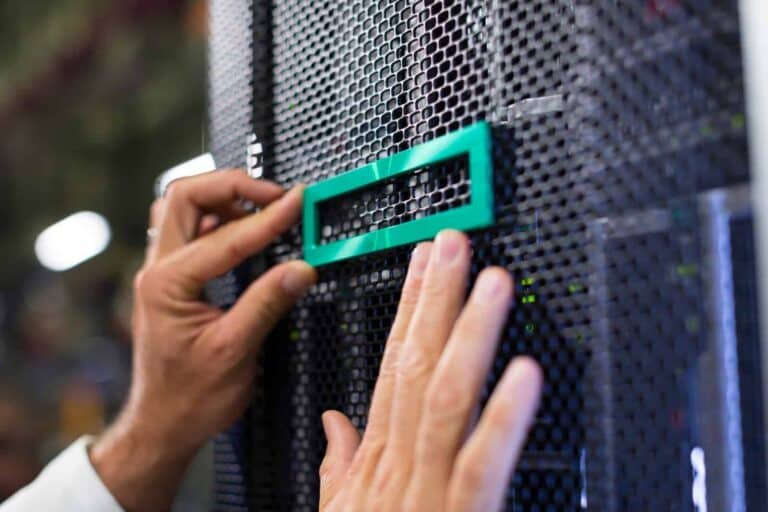
HPE has announced the AMD “Helios” AI rack-scale solution, a complete rack for AI training and large-scale inferencing. This new AI rack features 72 AMD Instinct MI455X GPUs, 260 terabytes of bandwidth, and 2.9 AI exaflops of FP4 performance. HPE is also committed to open standards, and this is the first AI rack to use an Ethernet network. The new AI solution will be available worldwide in 2026.
HPE and AMD are joining forces to create AI infrastructure that will enable large-scale inferencing. The new rack combines hardware, software, and network capacity in a single system. Antonio Neri, CEO of HPE, emphasizes the importance of open standards: “With the introduction of the new AMD ‘Helios’ and our purpose-built HPE scale-up networking solution, we are providing our cloud service provider customers with faster deployments, greater flexibility, and reduced risk in how they scale AI computing in their businesses.”
The collaboration between HPE and AMD has been in place for more than ten years. Both parties have previously delivered multiple exascale systems for supercomputing.
The architecture is based on specifications from the Open Compute Project (OCP). The Open Rack Wide (ORW) design combines energy-efficient liquid cooling with a practical maintenance setup. HPE Services delivers the system with direct liquid cooling and experience with exascale installations.
Read also: With HPE Private Cloud AI, you can run all your AI workloads on-premises
First Ethernet-based scale-up switch
The most notable aspect of the announcement is the new HPE Juniper Networking scale-up switch. According to HPE, this is the first switch to deliver optimized performance for AI workloads over standard Ethernet. The switch was developed in collaboration with Broadcom and uses its Tomahawk 6 networking chip.
The solution is based on the open Ultra Accelerator Link over Ethernet (UALoE) standard. This allows workloads to exchange large amounts of traffic over the network, such as high inferencing throughput and massive model sizes. Using Ethernet minimizes vendor lock-in and enables faster feature updates.
The only real alternative for AI workloads to exchange traffic is to use NVLink or InfiniBand. However, both of these technologies are owned by Nvidia following its acquisition of Mellanox InfiniBand. By scaling up Ethernet and using open standards, they can now work around this.
Broadcom CEO Hock Tan emphasizes the importance of open Ethernet: “Our high-performance silicon delivers industry-leading ultra-low latency, massive performance, and lossless networking with the scalability and efficiency modern AI workloads require. Together with HPE and AMD, we are enabling customers to build powerful AI data centers with standard Ethernet, maximizing choice and flexibility while delivering exceptional scale.”
The new HPE scale-up solution complements existing scale-out and scale-across offerings. With this, HPE offers a complete “networks for AI” portfolio. The switch features AI-native automation and is guaranteed to simplify network operations.
Open standards and software ecosystem
The AMD Helios architecture uses open source AMD ROCm software and AMD Pensando networking technology. This should accelerate innovation and reduce the total cost of ownership. The system supports modern AI and HPC workloads without compromising on capacity and data processing.
With this solution, HPE is primarily targeting cloud service providers, including neoclouds. Demand for AI computing capacity is growing rapidly, and organizations are looking for flexible, interoperable, and energy-efficient solutions. The combination of HPE’s system innovation and AMD’s complete compute stack is designed to address this demand.
The global availability of the AMD Helios AI rack-scale solution is planned for 2026. HPE confirms that it is one of the first companies to deliver this complete turnkey rack.
Also read: AMD’s bold claim: Nvidia has no moat