
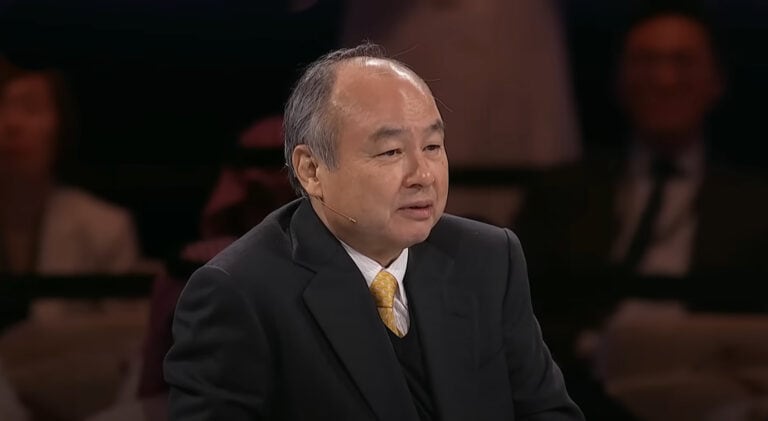
The $22.5 billion investment is one of the most ambitious moves by SoftBank founder Masayoshi Son (photo), who wants to reposition his company at the heart of the AI industry. The focus is almost entirely on OpenAI, which is rapidly developing into one of the most important players in generative artificial intelligence.
This is according to Reuters. To secure the financing, SoftBank has already sold its entire stake in Nvidia and a large portion of its shares in T-Mobile US. At the same time, it has made significant internal cuts in costs and personnel, while new investments have largely been put on hold.
Behind the scenes, SoftBank still has several financial levers at its disposal. For example, the group can borrow additional funds using its stake in Arm as collateral, an option that has become more attractive as the share price has risen sharply since the IPO. In addition, SoftBank still has billions in cash on its balance sheet and holds stakes in various listed companies that can be monetized relatively quickly.
An important potential source of cash is the planned IPO of PayPay, the Japanese payment app in which SoftBank has a large stake. That IPO was recently postponed due to the prolonged shutdown of the US government, but is now scheduled for early next year.
Competition from Meta and Google is increasing
The urgency is not without reason. OpenAI desperately needs the capital to expand its infrastructure. Together with SoftBank, the company is investing in large-scale data center projects. These are necessary for training and running increasingly powerful AI models. Meanwhile, competition is rapidly increasing. Among others, from Meta and Alphabet, which is fully committed to the same market with Google and the Gemini model.
Since SoftBank joined in April at a valuation of approximately $300 billion, OpenAI is already worth a lot more, according to insiders. There is talk of new investments that would push the valuation toward $900 billion. For SoftBank, that means a substantial paper profit.
The pressure is also high at OpenAI itself. CEO Sam Altman recently spoke internally of a code red situation, in which improving ChatGPT has been given absolute priority. The ambitions are enormous. OpenAI ultimately wants to build tens of gigawatts of computing power, a scale that requires investments of unprecedented size. The coming months will therefore be decisive, not only for SoftBank and OpenAI, but also for the future balance of power in the global AI industry.