
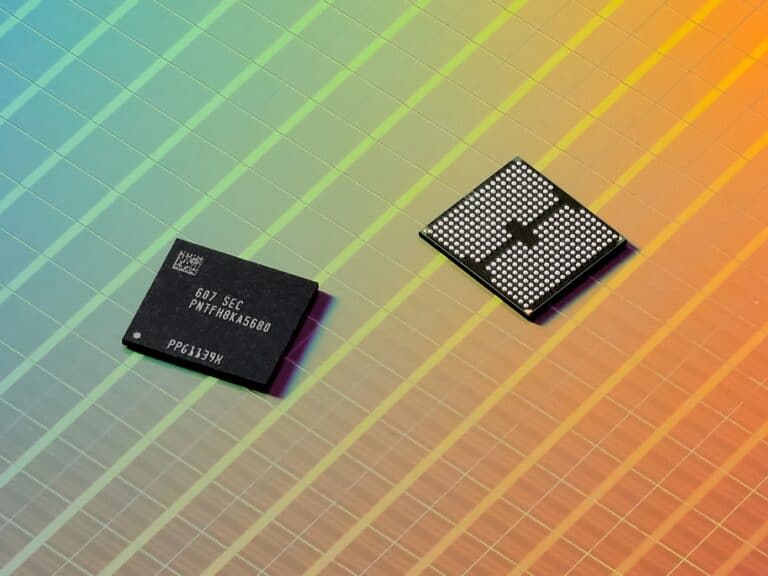
At the Future of Memory and Storage (FMS) 2026, Samsung presented a range of new memory technologies for AI. In addition to a prototype of V10 BV-NAND with more than 400 layers, the company also showcased concepts for new 3D memory architectures, including zHBM and zNAND-O. The announcement comes at a time when Samsung aims to further strengthen its position in the AI memory market.
The announcements demonstrate that chip manufacturers are no longer focusing exclusively on faster AI processors. The way memory and storage are organized is also becoming increasingly important as AI systems process larger datasets and inference workloads account for an ever-growing portion of the load.
First NAND with wafer bonding
The most concrete introduction is V10 BV-NAND. This generation of NAND uses wafer bonding, a process in which memory cells and peripheral logic are first produced separately and then bonded together. According to Samsung, this is the first time this production method has been applied to NAND flash.
The prototype consists of more than 400 layers. According to Samsung, the storage density is approximately 58 percent higher than that of the current V9 generation. Read, write, and I/O performance have also been improved.
Alternative to existing HBM architecture
In addition, Samsung presented a concept for zHBM. In current HBM solutions, the memory stacks are located next to the AI processor. In the new design, however, the memory is placed directly above the AI accelerator, reducing the distance data must travel.
According to Samsung, a future implementation could thus deliver approximately eight times the performance of HBM5. Thanks to the new bonding technology, memory density could be more than 10 times higher, while power consumption and heat generation are reduced. This is explicitly a research concept; no launch date was mentioned.
zNAND-O is also still in the concept phase. This V-NAND-based architecture is designed for AI applications where low latency and high I/O performance are critical, such as edge AI and real-time data processing.
During FMS, Samsung also showcased its existing AI memory portfolio, including HBM4E, HBM5, LPDDR5X-PIM, and enterprise SSDs. In addition, the company demonstrated new storage products for AI data centers.
These announcements align with a broader trend in the AI market. While demand for AI memory was initially driven primarily by the training of large language models, the need for fast storage for inference is now growing as well, Reuters explains. This refers to generating responses while using AI applications. As a result, demand is increasing for memory with higher capacity, greater bandwidth, and lower power consumption. Consequently, innovation is shifting not only toward faster AI processors but also toward the underlying memory architecture.