
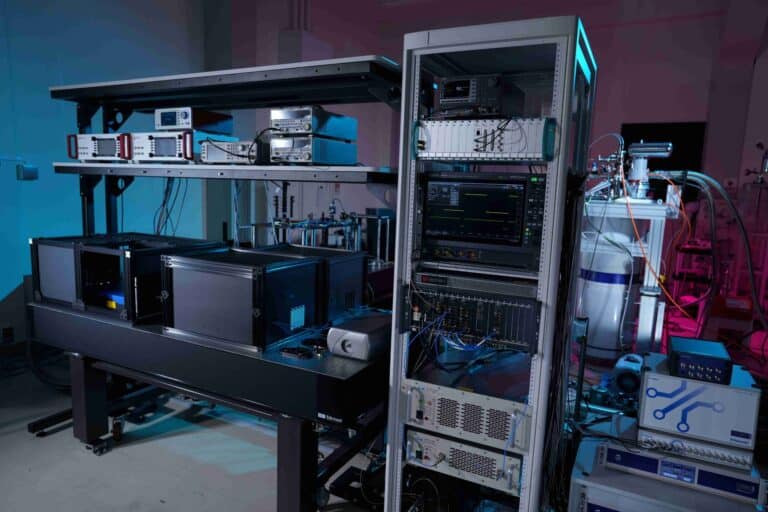
Fujitsu, in collaboration with QuTech and TU Delft, has unveiled a working prototype of a quantum computer based on diamond spins. The system uses tin vacancy centers in photonic chips and operates at -271.6 °C. A multi-module version is scheduled for completion in 2027.
The prototype uses SnV centers integrated into photonic integrated circuits. According to Fujitsu, this is a world first. A notable detail: the system operates at -271.6 °C, well above the typical operating temperature of superconducting quantum computers, which is -273.13 °C. This significantly affects cooling requirements.
Fujitsu also demonstrated in a test environment that the prototype can be controlled via its own Hybrid Quantum Computing Platform, without requiring users to have additional specialized knowledge.
The foundation was laid in 2020, when Fujitsu, TU Delft, and QuTech began joint research. In January 2024, the Fujitsu Advanced Computing Lab Delft was established to create a blueprint for modular quantum computers that can scale to more than a thousand qubits. Last year, the partners already reported a complete set of quantum gates with an error rate below 0.1 percent.
Three technologies under the hood
Fujitsu developed technology to bond diamond substrates with implanted tin to aluminum oxide and silicon dioxide substrates, and to thin those diamond layers from hundreds of micrometers to hundreds of nanometers. In addition, a fabrication process was developed for photonic circuits using aluminum oxide optical waveguides, along with a mechanism that converts quantum circuits into control sequences using light, microwaves, and radio frequency waves.
CTO Vivek Mahajan highlights the potential for integration. “The diamond-spin-based approach we’ve applied in this prototype not only offers exceptional scalability on its own but could also potentially be integrated with superconducting quantum computers.”
Kees Eijkel, managing director of QuTech at Delft University of Technology, calls it an important milestone in the collaboration. “Demonstrating the expected scalability of quantum computing with diamond spins remains a long and challenging journey.”
The roadmap targets 250 logical qubits by fiscal year 2030 and 1,000 logical qubits by fiscal year 2035.