
Apple is developing a server for AI applications that will be equipped with multiple units of its most powerful in-house processors. The system could hit the market in 2029, marking Apple’s return to the server market after nearly two decades of absence.
Ars Technica reports this based on coverage by The Information. Apple is exploring two versions of the server, featuring two and four of the future M8 Ultra chips, respectively. The project is said to have started about a year ago and received support from John Ternus, who was then in charge of hardware development at Apple and became the company’s CEO this month.
Macs popular for AI
These plans align with the growing use of Apple hardware for AI workloads. Mac mini and Mac Studio systems, in particular, are proving popular for this purpose. According to The Information, AI companies such as OpenAI have purchased tens of thousands of these computers. They are used, among other things, to train AI agents using reinforcement learning, in which models learn through repeated attempts which actions yield the best results.
Anthropic is also reported to be using Apple hardware. The company is said to be renting Mac mini systems through Amazon Web Services. The interest in Macs among AI developers may offer Apple a foothold in a market where the company has not been directly active for quite some time.
Possible collaboration with Nvidia
Notably, Apple may be looking to use Nvidia technology to connect the chips. Both companies are reportedly in talks about using NVLink Fusion, which allows processors and accelerators within powerful AI systems to communicate with one another. Apple is exploring whether this technology can be used to link multiple M8 chips within a single server system.
No decision has been made yet. The server project itself is also still in development and, according to The Information, could still be scrapped. Apple may also decide to release the system without Nvidia’s technology.
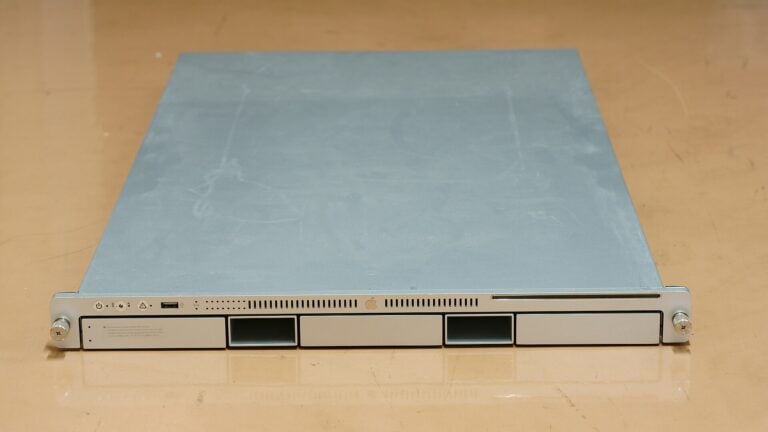
Apple exited the market for its own servers in early 2011, when it discontinued the Xserve (photo). A launch in 2029 would therefore mark the first full-fledged Apple server in nearly two decades.
Memory shortage could derail plans
A complicating factor is the ongoing shortage of memory chips. The rapid expansion of AI data centers has sharply driven up demand for memory. This affects not only servers but also PCs, smartphones, and other consumer electronics.
Apple is also facing this issue. Higher memory costs have already contributed to price increases for various products. For a server equipped with multiple powerful Ultra chips and large amounts of memory, memory availability could therefore become a key factor in its planned 2029 launch.