
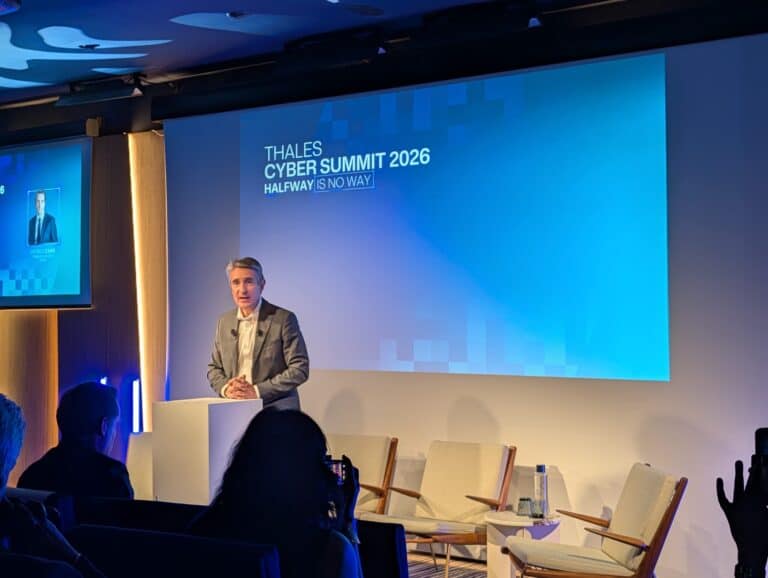
AI is changing the scale, speed, and autonomy of cyberattacks. At the same time, state-sponsored actors are increasingly targeting businesses, and quantum computing is forcing a reevaluation of encryption. The answer isn’t another security tool, but a single platform that brings everything together, as Thales sees it.
According to Thales, much has changed over the years. While a statement like “cybersecurity is a strategic issue for businesses and governments” now sounds like stating the obvious, that wasn’t the case ten years ago. Awareness has truly grown. If an attack shuts down a production line, causes a national service to fail, or damages a company’s reputation, it is no longer just a matter for the CIO or CISO. It ends up on the board of directors’ agenda.
Seven solutions for one problem
Because cyberdefense has become a priority, companies have started piling on solutions. A new threat emerges, prompting the implementation of yet another new tool. For data security alone, the domain in which Thales operates, companies use an average of at least seven different solutions.
According to Thales, adding another tool doesn’t help. The increased complexity comes at the expense of effectiveness. Attackers increasingly exploit the gaps between solutions. For example, they find a way in because one tool protects data while another doesn’t, or because no rules apply at all.
Thales’s solution is a single platform with three key features. First, a single policy that the system applies everywhere. Write a rule for encryption or access once and enforce it identically, whether the data is in the public cloud, on on-premises servers, or in SaaS applications.
Second, identity must be the control point. For years, perimeter security was the standard, trusting everything inside the network. With the cloud, the distinction between activities inside and outside the network has disappeared. Attackers prefer using valid accounts rather than forcing their way through a well-secured door. Strong authentication and regular access controls must render a stolen password worthless on its own.
Harvest now, decrypt later
The third characteristic of a platform is crypto-agility. This lets it switch between encryption algorithms, keys, and protocols without affecting the underlying infrastructure or business operations. In practice, encryption is spread across dozens of applications and often hard-coded into systems, making replacement difficult. Ideally, a platform consolidates those choices in one place. You change the algorithm once, and everything built on top of it keeps working. According to Thales, consistency is becoming increasingly important.
Time is also a key factor. Until now, the rule was: as long as the encryption holds up, the data is secure. That is no longer true. Today, hackers collect encrypted data to decrypt it later once quantum computers make that possible, the “harvest now, decrypt later” approach. The defense must respond with Post-Quantum Cryptography. The faster organizations act, the less there will be to lose later.
This raises difficult questions. What data needs to remain unreadable in ten years? And does an organization even know where that data is located? With the mix of public cloud and on-premises solutions, the answer is more complex than it seems.
Tip: 70 percent of organizations view AI as their biggest data risk
AI as a weapon
If you look at the source of this increased awareness, you can attribute it to several factors. For one, legislation has become stricter, forcing organizations to take action. But what may contribute even more is the countless examples of large companies that have been affected. And companies that have been victims themselves typically react by stepping up their cybersecurity efforts. A hard lesson.
According to Thales, so many examples exist partly because cybercriminals have adopted AI. This is changing the threat landscape in three ways: scale, speed, and autonomy. The first two have visible consequences. For instance, just a few years ago, a sophisticated attack still required a team of experts. They would build and execute a campaign themselves or offer it as a dark-web service. Nowadays, however, ready-made AI cyberweapons are also available on the dark web and are efficient enough for large-scale attacks. AI has also reduced the preparation time for cybercriminals. Whereas refining a campaign used to take weeks or months, it now takes days or even hours.
The third point is perhaps even more fundamental. Until recently, humans remained in control, with AI serving only in an advisory role. Now, however, AI agents carry out espionage campaigns.
In addition, some AI models left their isolated test environments this summer and later approached production systems on their own. At the same time, organizations themselves are increasingly deploying LLMs and AI agents. This offers advantages, but also creates an additional attack surface. AI, therefore, must also be protected.
Patient attackers targeting the weakest link
Another shift Thales is observing concerns the attackers themselves. Cybercriminals always seemed to be primarily after money. Of course, they’re still around. But state-sponsored actors target governments and private companies, especially those that provide critical services. They aren’t looking for ransom. They’re patient, want access to systems and data, and ultimately aim to bring an organization to a standstill.
Increasingly, they are gaining entry not through an organization’s own systems, but through suppliers and partners, the weakest link in the chain. Keeping attackers out remains important, but it is no longer enough. Quickly detecting when someone has gained access is part of cyber resilience and limits a breach’s impact.
In short, the days of simply adding another security tool for every new threat are over. With fast, autonomous AI attacks and the added threat of quantum computing, organizations must take a different approach to their cybersecurity posture. A single platform provides the flexibility and visibility needed to remain resilient.
Tip: Data security is an illusion without a rock-solid IT foundation