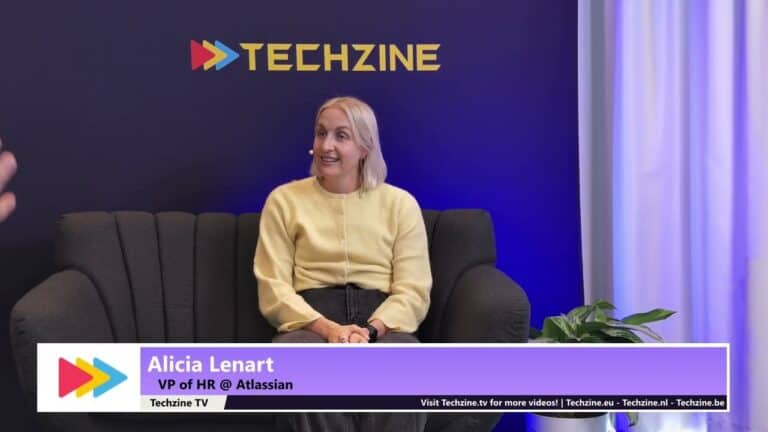
Atlassian has achieved 99% weekly AI adoption among its non-technical employees, and it did so without mandating anything. At Atlassian Team ’26 Europe in Amsterdam, we spoke with Alicia Lenart, VP of HR at Atlassian, about the strategies, failures, and cultural choices that got them there. What follows is a practical account of what enterprise AI transformation actually looks like from the inside.
Many companies are inserting AI usage into performance reviews and issuing top-down directives to adopt new tools. Atlassian has taken a different path, as it doesn’t believe in AI mandates. “At Atlassian, we fundamentally believe you can’t mandate your way to an AI transformation,” she says. “Telling people or forcing people to do things doesn’t generally get them wanting to do it.” The result of mandates, she argues, is compliance and rising adoption metrics, but not necessarily innovation. Fear replaces curiosity, and colleagues end up looking over each other’s shoulders rather than experimenting freely.
Instead, Atlassian focused on building excitement from the ground up, Lenart says. It created a learning loop and an experimentation culture where people wanted to use AI. They did not want it because they had to, she stresses, but because a colleague showed them something faster or better.
How Atlassian approached its internal AI journey
Atlassian has been on its internal AI adoption journey for approximately two years. One of the earliest and most powerful motivators was customer demand, according to Lenart: when Atlassian’s sales and customer teams went out to help enterprises adopt AI products, customers kept asking, “How are you doing it at Atlassian?” Building a credible internal story became a strategic priority.
Lenart points out that the discourse around AI is often dominated by companies like Anthropic and OpenAI, who actually represent only a small percentage of the AI market. The other 95% are traditional enterprises with legacy systems and complex organizational structures. Atlassian deliberately wanted to learn what it means to turn a large enterprise AI-first, so it could share those lessons with its customers.
Starting with open doors, not mandates
Rather didn’t roll out AI to all its people all at once. Rather, it identified champions in each function. That is, HR people trained HR people, finance people trained finance people, salespeople trained salespeople. These domain-specific trainers understood the context, the pain points, and the potential in their respective areas far better than any central AI team could.
Technical employees, particularly engineers, took to AI quickly. Non-technical employees were a different story. “It’s quite scary and hard,” Lenart acknowledges. The response was to meet people where they were: showing them how to open a tool, where to click, and which use cases applied to their daily work. Hands-on keyboard sessions, not training videos, became the standard approach.
Adoption metrics
Atlassian’s non-technical AI adoption rate now sits at 99% weekly usage. The company has evolved its metrics over time: it started with a target of over 95% of people using AI every week, hit 99%, and then shifted focus to driving the number of “super users”. Atlassian defines these as employees with 40 or more AI interactions per week. That metric revealed that non-technical teams lagged behind engineering teams. To close this gap, Atlassian adapted its approach rather than issuing directives, Lenart tells us.
From automation to real AI
Atlassian deliberately chose workflows across legal, finance, sales, and marketing to demonstrate that AI transformation is not an engineering story alone. One of the most successful use cases has been onboarding. Atlassian built an AI agent to answer new hire questions, which Lenart identifies as among the company’s best-performing deployments. Not everything has succeeded, however. In fact, quite a number of things have failed along the way. That is part of the culture of constant tinkering and makes failure productive.
On the question of where to start, Lenart’s advice is that companies shouldn’t try to identify an entire workflow. Pick a portion of a workflow, see the value, and get moving. Let each function decide what the most painful, time-consuming processes are, then start there.
AI agents are not teammates
AI vendors increasingly use language like “colleagues” and “coworkers” to describe agents. That’s not how Lenart sees them. “My personal vision is that an agent is not a teammate,” she says. “It’s not a person.” Work will be done by both humans and agents, but she draws a clear distinction between managing people and overseeing agents.
Managers, she argues, do not need to provide agents with the same “love and care” as human team members, but agent-produced work should not go unchecked. Teams should agree in advance which work will be reviewed.
Trust, people data, and AI in hiring
In HR, trust is not abstract, as it directly involves personal identifiable data. When asked about how she handles this, Lenart says that Atlassian has established clear boundaries around where AI will and won’t be used in people processes. AI will not make hiring decisions. AI will not make performance decisions. These are firm lines.
On the question of using AI to screen applicants from large candidate pools, Lenart notes that Atlassian does not use AI to filter applications. They review all applicants through human-determined criteria. For final hiring decisions, she has something similar to say: AI can schedule interviews, help write up interview notes, and summarize conversations, but decision-making authority remains with humans.
The most effective trust-building mechanism Atlassian found was manager role modeling. Research from Atlassian’s Teamwork Lab found that when managers visibly use AI, employees are four times more likely to adopt it themselves.
The biggest HR challenge: what does a team look like now?
Lenart’s biggest current challenge is an easy one to define, but a very hard one to solve: what will teams look like in an AI-first world? The traditional functional org design may no longer be the right structure when agents are part of the team. Atlassian is actively trialing outcome-based org design. Rather than asking “what craft constraints apply here?”, the question becomes “here’s a problem I want to solve, what humans and agents do I need to solve it?” The traditional organization, Lenart believes, will not survive the AI era unchanged.
Also read/watch/listen: Atlassian’s Teamwork Lab researches and fixes broken work