
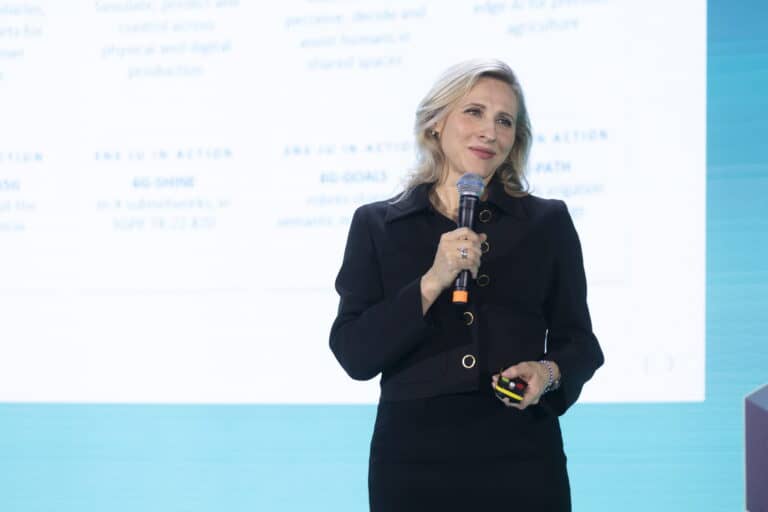
Europe is staking a claim to a leading role in the development of 6G. It is determined to exert influence over the establishment of international standards for this technology. To that end, it is preparing a new round of research funding totaling €220 million. Artificial intelligence will play a central role in this effort.
This was announced by Erzsébet Fitori, executive director of the European Smart Networks and Services Joint Undertaking (SNS JU), during the Techritory conference in Riga. The organization is a public-private partnership between the European Commission as the public partner and the 6G Industry Association as the private partner. Under the current European budget period (2021–2027), Horizon Europe, the European program that funds innovation and research, provides €900 million. The industry is investing a comparable amount.
According to Fitori, 6G is fundamentally different from previous generations of mobile networks. “We’re not talking about just another faster radio access network,” she clarified. “6G doesn’t just improve the functions of existing networks. It will literally form the nervous system of the AI economy.”
Unlike 5G, 6G must integrate computing power into the network infrastructure from the design stage. “It will be the first native AI communication technology. This creates new possibilities, such as integrated sensor and detection functions. The new systems will be able to perceive their environment through integrated sensor technology.”
Applications range from autonomous vehicles and industrial robots to ports and logistics systems. In addition, satellite networks, terrestrial mobile networks, and connections via air and sea must become part of a single integrated communications system.
European influence on 6G standards
The European research program follows the schedule set by 3GPP, the international consortium that develops technical standards for mobile networks. According to Fitori, the complete technical definition of 6G should be available by March 2029. Europe is determined to exert significant influence in this area. The research program is therefore structured so that European research findings can be incorporated into the international standardization process in a timely manner. Approximately one hundred research projects have now been launched, in which, according to Fitori, €630 million in European funding has been invested.
With the next funding round of €220 million, Europe aims to bridge the gap between research and practical applications. About twenty new projects are expected to launch.
“Unlike in previous work programs, we will emphasize large-scale field tests in these projects,” Fitori clarified. “The technology is now sufficiently developed to be tested in realistic environments in collaboration with companies.” Special attention will be given to the development of AI-native networks. In addition, projects will focus on optical connections for large-scale AI systems, among other things.
The work program is set to be finalized later this year. The call for project proposals is expected in January 2027. The projects will then begin in 2028.
New projects
In Riga, Fitori also announced five new research projects, with a total of €22 million in European funding available. One of these projects connects eight test environments across six EU member states. This will give researchers and companies, with a special focus on SMEs, access to infrastructure for testing 6G systems.
Another project will develop an open-source simulator that generates synthetic datasets to train AI models. The results are to be made available through a European data space.