
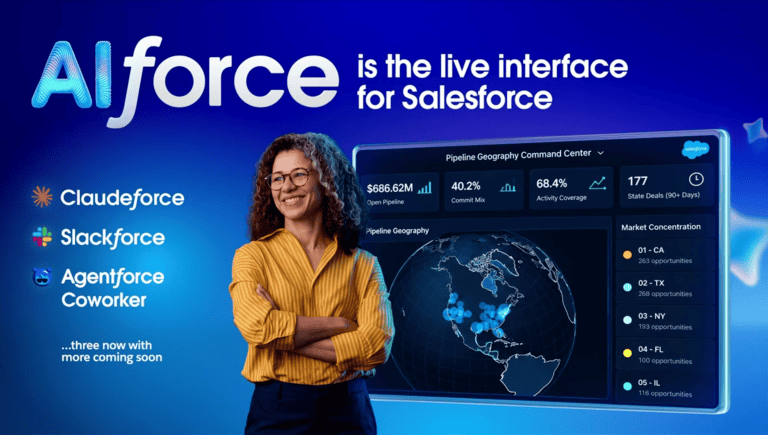
Last week, Salesforce unveiled the next chapter of its Headless strategy. It introduced AIforce, a collective term for a number of solutions that bring Salesforce capabilities to other platforms. These include Claudeforce, Slackforce, and Agentforce Coworker. All three solutions deliver Salesforce data and actions to a platform of your choice via extensions built by Salesforce. This immediately puts the Headless strategy into action.
In April 2026, we wrote about the introduction of Headless 360. Headless 360 is now called Headless Toolkit, and it is Salesforce’s answer to those who still talk about the “SaaSpocalypse.” These days, you no longer need the interface of your SaaS solution, what you do need is the expertise, the technology, the data structure, the workflows, permissions, tools, governance, and security to run applications effectively and efficiently. You can manage and present the results from anywhere.
Or, as we’ve put it before, Salesforce provides the chassis of the car, the engine, the steering wheel, the wheels, and the transmission; you get to build the body on top of it.
With the Headless Toolkit, Salesforce offers that capability. It includes an architecture built on MCP servers, APIs, plugins, skills, and development tools that developers in your organization can use.
That all sounds great, but for the average IT decision-maker, many questions remain unanswered: just how far does the Headless Toolkit extend, and what are its limitations? You could undoubtedly have very productive discussions about this, but Salesforce has decided to demonstrate what’s possible by introducing three products.
Claudeforce
Together with Anthropic, Salesforce introduced Claudeforce, a direct integration into Claude that lets you communicate with the Salesforce MCP server within Claude, which offers 37 ready-to-use sales skills, from prospecting to cleaning up your pipeline. Users can manage their Salesforce environment and retrieve information directly from within Claude.
Currently, only available for Sales Cloud, but Salesforce has already announced that skills for Tableau, Service, Marketing, Commerce, and similar other clouds will follow soon. The goal is for you to manage the entire Salesforce platform from within Claude.
You can then have Claude perform in-depth analyses on specific Salesforce datasets.
Slackforce
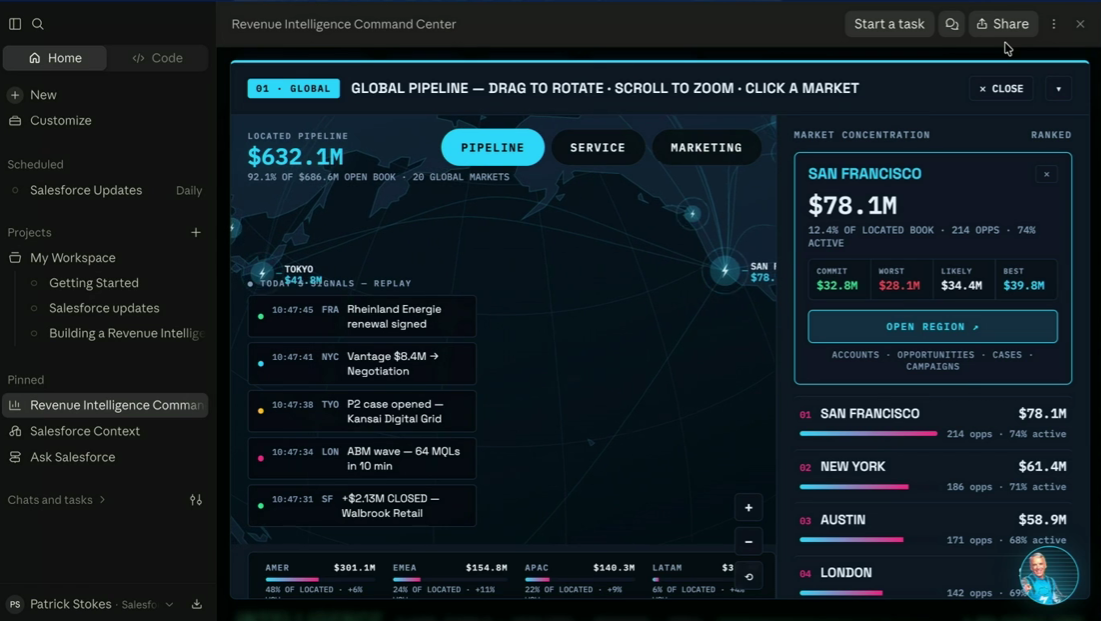
Of course, Slack itself can’t be left behind. Slackforce is the platform on which Slackbot, among other things, runs, and it now offers even more capabilities. With Slackbot, you could already analyze data within Slack and connect to Salesforce’s semantic layer. Now you can take it a step further with Slackforce Surfaces. You can display data from Salesforce in an interactive Slack surface, allowing you to share, discuss, edit, and even filter directly within Slack with your team.
Slackforce ensures that you can constantly collaborate with your team on all your accounts in your Salesforce database.
Agentforce Coworker for all other applications
Finally, Salesforce has introduced Agentforce Coworker, an agent integrated into the Salesforce Lightning interface. Once Agentforce Coworker is enabled within your organization and on your account, you can call on Coworker’s assistance at any time within the Salesforce interface. Coworker also respects existing permissions and business rules, so you won’t suddenly have access to your manager’s data. However, it can utilize all available Agentforce agents to support you in your work.
Agentforce Coworker is already available and has surpassed 100,000 activated users in its first 35 days. During Dreamforce, Adecco announced that it would grant all 27,000 employees access to Agentforce Coworker.
Salesforce also plans to make Agentforce Coworker available in third-party applications; Microsoft Teams is high on the roadmap, as is OpenAI. We understand Teams could roll out and become available at any time.
Partners are adopting the headless toolkit
Salesforce renamed the old AppExchange to AgentExchange last year and has since merged the AppExchange, Slack Marketplace, and Agents into this platform. While it’s certainly smart of Salesforce to create a single, large marketplace for partners, the name AgentExchange doesn’t do the marketplace justice.
Slack had a huge number of partners who built great integrations and extensions for Slack, while Salesforce, through AppExchange, had a rich selection of applications running on the Salesforce platform and offering solutions that Salesforce itself doesn’t provide, whether it’s document management, digital signing, or ERP-like solutions. Everything is now coming together in AgentExchange. As far as we’re concerned, they should rename it again soon.
One positive development is that Salesforce partners have embraced the Headless Toolkit, which is also part of the Exchange. For example, Amazon Web Services, Google, Lovable, and Vercel have already built extensive integrations with Salesforce. Google’s Gemini Enterprise can communicate directly with Agentforce and load Salesforce data. With Lovable, you can build applications that integrate directly with Salesforce data, and we could go on and on.
Anyone can get started with the Headless Toolkit
Anyone can get started with the Headless Toolkit, even business professionals. An organization’s IT department remains in control, but the organization’s permissions and policies always apply. If the IT department grants a team permission to work with Lovable, for example, business users (i.e. non-technical users) can use AI to build their own applications in Lovable that query Salesforce data or even perform actions. However, that application is limited to the Salesforce user’s permissions. The same applies to other integrations like Gemini Enterprise, for example.
As a result, integration with external services is virtually seamless, and companies do not need to develop new permission layers.
There’s one thing still missing
Salesforce has a well-thought-out headless strategy. It’s tangible and visible to users, which means the possibilities quickly become clear. This isn’t unimportant, because for years we’ve heard that AI can do “everything”, but only few have made it visible or tangible. That’s exactly what Salesforce did during Dreamforce.
Still, one thing is missing. Clear, transparent pricing still isn’t in place. We raised this with various executives. No one had a clear answer. It appears that Salesforce wants to use multiple billing models, depending on the type of customer or their specific needs. This means more customization, but the downside is that it’s anything but transparent.
We predicted the end of per-seat pricing last month, and that has now suddenly become a reality. Salesforce still uses per-seat pricing for your cloud license, and on top you can get an Agentforce add-on for $125 per user per month. However, Agentforce user licenses are also available for $5 per user per month. In addition, there are Flex Credits ($500 per 100k), with a standard AI action costing 20 credits. But no one could tell us how much a simple API call would cost, you’d think it would be less than 20 credits? All these different licenses also don’t make things any clearer.
Furthermore, we learned from various executives that some organizations want outcome-based pricing. This is paying for a final result, something Salesforce doesn’t seem to be opposed to. This could potentially introduce yet another billing model. What they do agree on internally at Salesforce is that token-based pricing doesn’t work. That is not transparent enough, even though it’s currently an industry standard for AI models.
Ultimately, per-seat pricing is very transparent, and that’s what customers are used to, but in an era of high AI costs, that’s a difficult proposition. The major challenge is to still offer a similar level of transparency. It’s possible they might return to per-seat pricing in ten years once AI costs have fallen, but for now, Salesforce needs to quickly clarify the price tag for AIforce and the Headless Toolkit.