
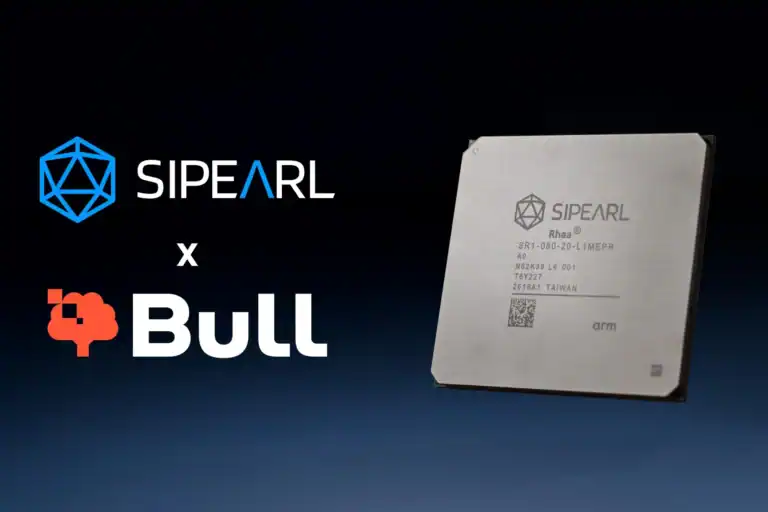
SiPearl has delivered the first Rhea1 processor units to Bull. The chips will be integrated into JUPITER, Europe’s first exascale supercomputer. This marks the first time a European-designed server processor will actually be used in a European supercomputer system.
Bull has now begun integrating the Rhea1 into its BullSequana XH3000 platform. JUPITER is located at the Jülich Supercomputing Center in Germany and was acquired by the EuroHPC Joint Undertaking.
The Rhea1 processors will be deployed in a separate CPU partition that will ultimately consist of 1,300 nodes and 2,600 processors. JUPITER achieves its current exascale performance using the so-called Booster, which consists of 24,000 Nvidia GH200 superchips. The European processors will not replace those American chips, but are intended for HPC workloads that are less suitable for GPUs.
According to The Register, the CPU partition is expected to ultimately deliver approximately 5 petaflops of computing power. That is relatively modest compared to the much more powerful Booster, but CPUs remain important for scientific applications that cannot be efficiently migrated to GPUs.
High memory bandwidth
Rhea1 contains 80 Arm Neoverse V1 cores and a total of 61 billion transistors. Each core features two 256-bit Scalable Vector Extensions. Each processor also has 64 GB of HBM2e memory, distributed across four stacks, with a total memory bandwidth of 1.8 TB per second. It also has four DDR5 memory channels.
This combination is primarily intended for scientific and other HPC workloads that require the rapid transfer of large amounts of data between the processor and memory. Jülich Director Thomas Lippert therefore cites the high memory bandwidth as a key advantage for data-intensive applications.
The Neoverse V1 architecture on which Rhea1 is based is no longer Arm’s latest generation. For example, the Grace processors in Nvidia’s GH200 superchips already use Neoverse V2 cores. Rhea1, however, is specifically designed for HPC applications where not only raw computing power but also available memory bandwidth determines performance.
SiPearl is currently benchmarking the processor. According to the company, the initial results are positive, and in some tests, performance has exceeded expectations. Specific performance figures have not yet been published; they are expected to follow this fall.
European processor
The delivery is also commercially significant for SiPearl. It marks the first order for Rhea1 and, consequently, the first substantial revenue the French chip company has generated from the processor.
In addition, the launch aligns with Europe’s ambition to reduce its dependence on non-European technology for strategic computing infrastructure. EuroHPC supported the development through the European Processor Initiative. SiPearl also emphasizes that Rhea1 contains no backdoors or kill switches.
“Through the European Processor Initiative, EuroHPC JU has supported the development of a European processor that is now moving from innovation to application in JUPITER,” says EuroHPC Director Anders Dam Jensen.
Rhea1 is scheduled to officially launch at the end of this year. Meanwhile, SiPearl is working on its successor, Rhea2. That processor is intended for the CPU partition of Alice Recoque, the planned French exascale supercomputer. AMD MI430X accelerators are planned for the GPU portion of that system.