
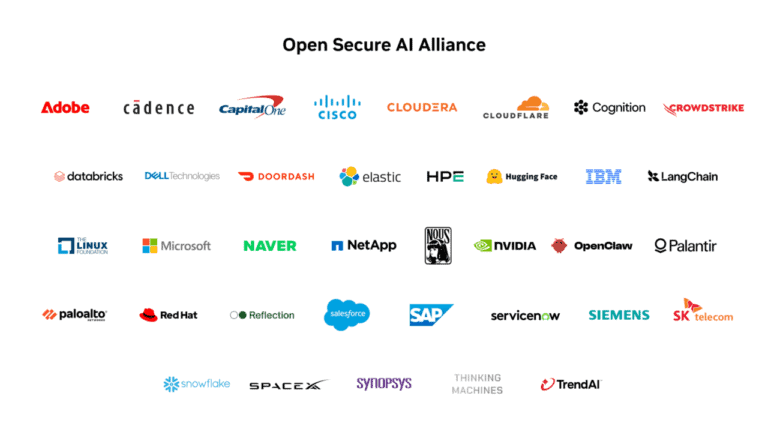
Nvidia, together with dozens of tech and security companies, is launching the Open Secure AI Alliance. The initiative aims to share open models, tools, and techniques that will enable security professionals to build their own AI security solutions. Last week, an incident at Hugging Face sparked widespread concern about the dangers of autonomous AI agents.
The alliance centers on a choice that participants say is becoming increasingly urgent: Will the defenses that protect our infrastructure eventually run on a handful of closed systems, or on open models and tools that any defender can study, adapt, and run themselves? Nvidia and the founders are opting for the latter.
The initiative builds on the Linux Foundation’s Akrites initiative and the work of the OpenSSF community. According to the participants, the world needs both closed and open models, but open models are essential for cybersecurity because they democratize defensive capabilities and enable a distributed defense without a single point of failure.
Why the incident at Hugging Face is receiving so much attention
The alliance directly references the recent security incident at Hugging Face. When commercial, closed-source AI tools were unable to distinguish between attackers and defenders and blocked essential forensic investigations, Hugging Face ran the open-weight model GLM 5.2 on its own infrastructure to analyze more than 17,000 actions and contain the breach.
That incident was described as a fully AI-driven attack. After a joint investigation, it was determined that the attacking AI agent originated in an internal test environment at OpenAI, where the usual security measures had been deliberately disabled. It was precisely those guardrails of proprietary models that forced Hugging Face to switch to an open model.
What members contribute
Nvidia is contributing open models, model weights, data, and new research on agent harnesses. The new open-source project, Nvidia Labs Object-Oriented Agent (NOOA), is available on GitHub and aims to make agent behavior more testable, traceable, and controllable.
Other members are also contributing building blocks. HPE is contributing to SPIFFE/SPIRE for zero-trust identity, which enables AI agents to be cryptographically verified. Hugging Face donated Safetensors to the PyTorch Foundation, a secure format for model weights that prevents remote code execution. IBM and Red Hat are expanding the security of the open-source supply chain with Lightwell through digitally signed patches. Microsoft is introducing MDASH, a harness that enables AI agents to collaborate to detect exploitable bugs. And SpaceXAI has open-sourced the terminal agent Grok Build.
The alliance is also reaching out to regulators. Open models, harnesses, and security tooling should be recognized as defensive tools, not as risks, the participants argue. Broad restrictions on open frontier AI would weaken defensive capabilities and concentrate power in the hands of a few closed providers. The founders are calling on governments, industry, and researchers to join the alliance.