
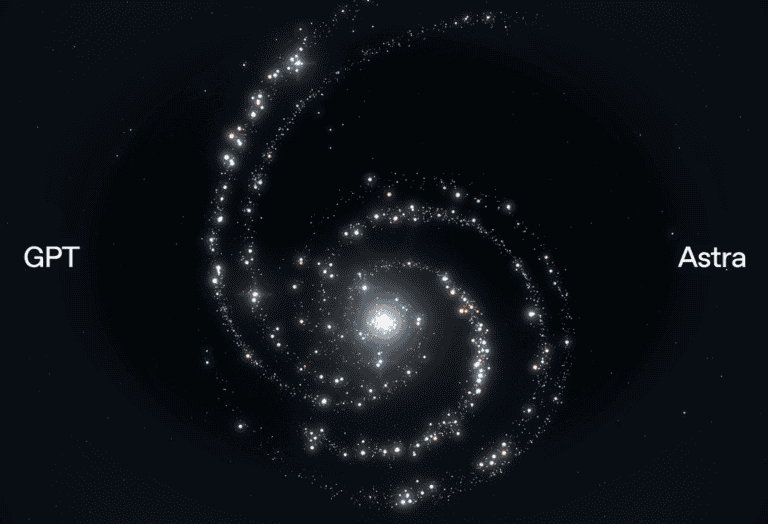
OpenAI is very bullish on its latest model, GPT-6 Astra. It has rolled out to a select group of organizations before access is gradually expanded to Plus, Pro and Team users. Despite shouts of ‘AGI’, other data suggests we’re looking at a close rival to Anthropic’s Claude Fable.
Calling the new LLM ‘a new generation of intelligence’, OpenAI highlights key advancements behind Astra. The clearest gap to predecessor GPT-5.6 Sol is ExploitBench with a perfect 100% score where Sol reached 78.5%. Another ‘solved’ benchmark is ARC-AGI-3, where Sol got 7.8% and Astra scores 99.9%.
Among the first neutral benchmarks is Artificial Analysis’ suite, which surprisingly puts Astra’s overall intelligence level equal to Sol (61). Inside Codex as a coding agent, performance is also the same (67), and in both cases meaningfully behind Anthropic’s Claude Opus 5 (63, 68) and Fable 5.1 (65, 70). It seems that at a surface level, the metrics don’t quite justify the language. Subjectively, there are some pretty big claims backed up by some evidence.
Two major benefits
OpenAI has built up a reputation for being the most efficient of the AI labs, offering far more token efficiency per answer and lower overall prices for both API calls and broader subscription-based access compared to Anthropic and open-weight rivals. Critically, Astra can be used exclusively and take advantage of the entire token budget in regular plans, unlike Fable’s 50% cut of Claude Max subscriptions. Nevertheless, pricing at 10 dollars per million input tokens and 50 dollars per million output tokens is substantially higher than the respective 4 dollars and 20 dollars that Sol is available for.
Another key advantage, especially versus Claude Fable, is the relative lack of constraints for users. Only activities that quite actively imply malicious intent are blocked, whereas code review and patching is available. There’s also no mention of any blocking of biological topics.
“AGI”, once again
One major breakthrough that OpenAI succinctly communicates is the fact that computer use is now beyond what a human can do. Anything one could accomplish on a PC, could in theory be done by Astra at a higher speed. Of course, the focus is primarily on rote, routine and tedious tasks, where a human can send off Astra to do their bidding.
Of course, we should be extremely wary of the way in which OpenAI communicates its developments. The company’s president Greg Brockman suggested during a press briefing that the industry has now entered its “AGI era” with Astra. The question, as is always the case with AGI claims, is what exactly that means. Apparently, being able to book an appointment for a haircut in ChatGPT Work qualifies for being a ‘personal AGI’. We’re rather skeptical about Astra actually being a breakthrough beyond Fable in general terms. That’s no insult, as the examples seen so far present generalized Fable-esque performance that only Kimi K3 and GLM-5.3 Flash have hinted at in spots.
3D excellence
Examples of this kind of performance actually often go beyond Fable 5 and 5.1’s capabilities. 3D behavior especially is excellent, with Astra apparently being able to go street-by-street in a full-scale representation of Manhattan and building out an Unreal Engine 5-based home according to rigid specifications.
We’ll have to wait and see how GPT-6 Astra is received when it is more broadly available. For now, it seems OpenAI has at least avoided the trap GPT-5 fell into last year when it failed to truly impress beyond, say, o3’s reasoning capabilities or GPT-4.1’s creative writing.