
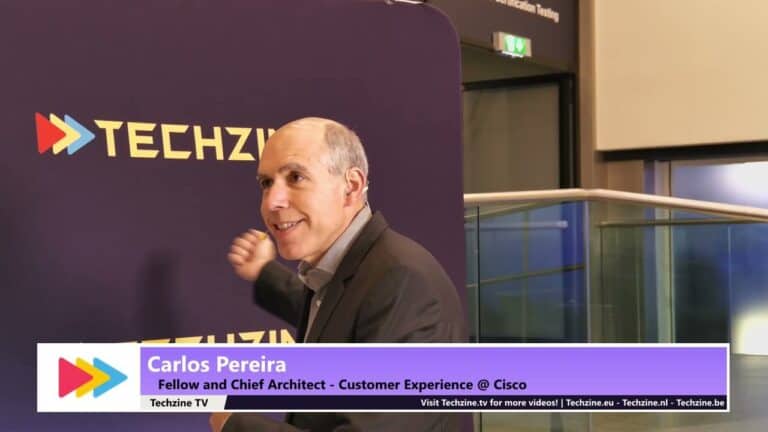
Cisco’s customer experience organization represents far more than traditional support or contact center operations. At Cisco Live Amsterdam, we had a conversation with Carlos Pereira, Fellow and Chief Architect of CX at Cisco. During our discussion, we talked about how Cisco CX manages the entire customer lifecycle while leveraging AI to optimize outcomes at scale.
Cisco CX covers every phase of the customer journey, from initial product deployment through ongoing optimization and renewal. According to Pereira, this encompasses landing (initial licensing and authentication for SaaS or physical installation for hardware). It also includes adoption (maximizing value from purchased functionality), expansion (adding use cases), and renewal (preventing churn and ensuring continued value).
The organization includes customer success teams focused on adoption, professional services for implementation, support for troubleshooting and hardware replacement, and renewal teams managing the recurring revenue business. This comprehensive approach ensures customers extract maximum value from their Cisco investments throughout the entire lifecycle.
Data-driven feedback loops to engineering
Cisco CX maintains close collaboration with product development teams through systematic feedback mechanisms. When support teams identify patterns in product defects, or when adoption teams notice features that customers purchase but don’t use, this intelligence flows back to engineering for correction or calibration.
Pereira emphasizes that this feedback operates both pre-release and post-deployment. The CX organization participates in new product introductions to test and validate functionality before shipping. Then, the organization continues monitoring adoption patterns and support ticket trends after products reach customers.
Evolution from feature metrics to intent-based adoption
Traditional adoption measurement focuses on whether customers use specific product features. For example, whether they’ve activated four out of five available functionalities. According to Pereira, however, Cisco CX is evolving toward intent-based adoption metrics. These intent-based metrics align more closely with business outcomes customers actually seek.
For a financial services organization implementing network segmentation, the specific features used may vary across data centers, branches, and exchange connections. Intent-based metrics focus on whether the customer achieves their segmentation objectives across all environments. This is true regardless of which specific technical features enable that outcome.
Cisco IQ: unified AI-powered platform
Announced at the Cisco Partner Summit in October 2025 and reaching general availability soon after, Cisco IQ represents a fundamental shift in how Cisco delivers services. The platform provides a single unified interface for all support and professional services. It replaces the previous model of multiple tools serving different purposes.
Cisco IQ leverages AI for augmented insights and full automation, Pereira adds. Customers gain complete visibility with asset reconciliation, API access for feeding insights into other tools, and telemetry-driven recommendations. The more telemetry customers provide, the better insights the platform generates.
Sovereignty and deployment flexibility
Cisco IQ supports three deployment models to meet varying sovereignty requirements. The SaaS-based deployment serves most customers with cloud-managed functionality. An on-premises tethered model runs locally but maintains a control plane connection. For government, defense, and European sovereignty customers, a fully air-gapped on-premises deployment keeps all telemetry and analysis completely isolated.
In air-gapped environments, Cisco addresses AI model requirements through two approaches. The company ships small language models (SLMs) tuned specifically for relevant use cases rather than full-blown models. Alternatively, customers can leverage their own AI models through LLM proxy configurations. This allows Cisco IQ to utilize customer-specific fine-tuning and augmentation, according to Pereira.
AI as augmentation, not replacement
Pereira emphasizes that Cisco views AI as a means to an end rather than a complete solution. The organization’s philosophy combines AI, automation, and human intelligence to deliver optimal outcomes.
AI excels at repetitive mechanical tasks like correlating data across multiple systems or running predictive models to identify hardware likely to fail. These capabilities free human experts to focus on judgment calls requiring nuanced understanding of customer environments and business objectives. Since Cisco CX doesn’t have sufficient coverage to manually serve all customers, AI-powered automation enables scale. Partners extend reach for adoption and customer success work.
Regarding agentic AI systems that could automatically adopt unused features on behalf of customers, Pereira notes this depends on how agentic enterprises become over the next five years. If automatic adoption becomes pervasive, customer success teams will shift focus more heavily toward intent metrics. This will happen rather than focusing on feature enablement.
Measurable business impact
Since joining the CX organization approximately two years ago, the renewals team has leveraged AI to drive measurable efficiency gains. Cisco built an agentic system that considers renewals, adoption, and sentiment analysis together. This approach eliminates the manual correlation work that previously consumed about 40% of team capacity.
This efficiency gain directly impacts renewal rates. By removing mechanical data gathering tasks, team members gain capacity to pursue new renewals and build stronger customer relationships. Both of these actions increase renewal likelihood. The combination of improved time utilization and enhanced customer engagement delivers measurable improvements in renewal rates and churn prevention.
Partner ecosystem and coverage model
While every Cisco customer touches the CX organization through support, professional services and customer success adoption operate through different models. Cisco’s customer success teams focus on the largest strategic accounts, while partners deliver adoption services to the broader customer base.
This approach enables scale while maintaining quality, Pereira says. Partners resell and deliver CX services, leveraging the platforms, methodologies, and insights Cisco provides. The support organization maintains comprehensive coverage across the entire portfolio. This ensures all customers receive consistent service regardless of how they purchased their Cisco products.
Also read: Cisco IQ adds brains (and a face) to CX