
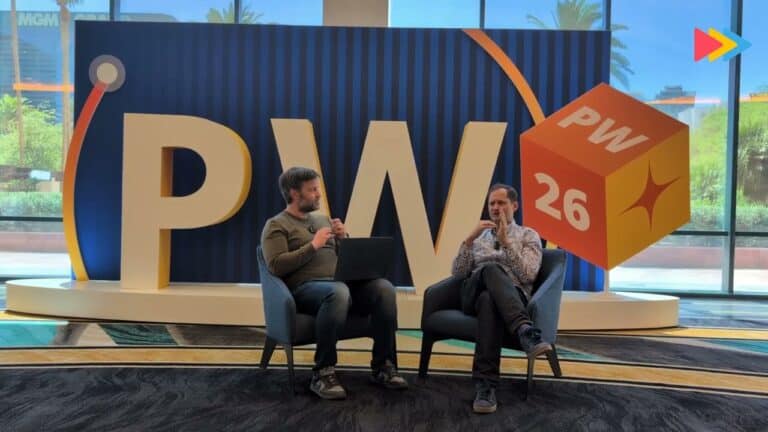
At PegaWorld in Las Vegas, we sat down with Pegasystems CTO and head of marketing Don Schuerman. He made the case that the enterprise AI conversation needs to move forward. We should not talk about tool adoption anymore, but need to reimagine how we think about workflows, architectures, and even applications. During the interview we had with him, we talk about Pega’s strategy for delivering predictable AI outcomes, controllable token costs, and a new breed of applications built on processes, agents, and knowledge rather than screens and databases.
Enterprises need to reimagine how they work in this increasingly AI-driven world, according to Schuerman: “You have to reimagine workflows. You have to reimagine processes. You have to reimagine how teams interact,” he says. That’s what a lot of what Pega develops at the moment focuses on. Another big topic of conversation, partly related to this is predictability. AI must be predictable, both in terms of outcomes and in terms of cost. Both are increasingly urgent as enterprises integrate AI agents more deeply into mission-critical workflows.
85% accuracy is actually 15% failure
Predictability depends for a large part on the accuracy of the AI organizations use. That is, it is impossible to predict the outcome correctly if you can’t depend on the accuracy of models. Also, cost goes up when accuracy falls behind. In other words, if organizations want to fundamentally reimagine their own environments because of what agentic AI systems have to offer, accuracy needs to be very high. According to Schuerman, it is good to assess this accuracy correctly. That is, an accuracy rate that sounds impressive in isolation becomes dangerous at scale. “If you’re a bank, 85% accuracy is a 15% failure rate,” he says. More critically, when multiple agents are chained together, errors compound: 85% of 85% of 85% leads to a dramatically lower effective reliability rate.
The solution Pega advocates is deterministic orchestration. This means wrapping AI agents in well-defined, predictable workflows so that individual agent tasks are kept narrow and their outputs are controlled. AI agents should guide customers through a known loan application process, for example, not reason out what that process should be on the fly.
The token cost problem
During our conversation, Schuerman also points to a growing disillusionment with token-based AI pricing. As AI vendors have shifted to consumption-based models and models themselves have become more token-hungry, some enterprises are already reversing course.
Pega responds to this from an architectural ange. It confines non-deterministic AI reasoning to the design and build phases (of Blueprint). That is where long context windows and exploratory reasoning are acceptable. It uses narrow, targeted AI calls at runtime, which means Pega keeps token consumption predictable. This discipline is what enables the company to offer outcome-based pricing. Customers pay per workflow executed, per loan processed, per exception resolved, not per token burned.
Pega Blueprint grows up
Blueprint, originally launched at PegaWorld two years ago as an ideation and process design environment, has now extended its capabilities into the build phase. Schuerman acknowledges that the first version was compelling for process re-engineering but left a gap between design and live application.
The evolution of Blueprint was made possible by developments in agentic code generation. Agents that think and reason at build time, not runtime, can now generate meaningful, well-architected code. Blueprint applies this to compress both the design and build phases, taking enterprises from idea to agreed-upon process design to live process faster and with better quality.
Looking ahead, Schuerman hints at Blueprint expanding to cover the underlying data infrastructure, legacy system interpretation (in partnership with AWS Transform), and eventually enterprise strategy alignment. This should help organizations understand not just what processes to build, but how those processes result in overall enterprise architecture and goals.
Watch and listen to our conversation with Schuerman now to get more details on how Pega incorporates AI into its own solutions and what that means for organizations.
Also available as audio-only podcast
Also read: From token maxxing to tokenomics: Pega keeps AI real and pragmatic