Pragmatism and agentic AI rarely go hand in hand. We regularly hear stories of organizations seeing costs skyrocket while the profits AI is supposed to deliver fail to materialize. Pegasystems aims to change this for organizations and developers. It does so by firmly taking and maintaining control within its own Infinity platform, taking a pragmatic approach to AI deployment, and by giving greater prominence to Blueprint and its associated AI engine.
Developments in agentic AI are moving fast. Not so long ago, there was the (in our view, peculiar) trend that developers had to use as many AI tokens as possible. That was a good indicator of how well someone was doing, apparently. However, this so-called token maxxing seems to have had its day already. There seems to be a bit more realism now, and the focus has shifted to what is called tokenomics. In other words, how do you ensure that you actually derive value from the AI tokens you use?
Essentially, Pega aims to answer the above question this week at PegaWorld in Las Vegas. It’s doing so through a significant number of announcements. We’ve analyzed these announcements to paint a clear picture of what the company aims to achieve and what you can expect. There is certainly some interesting innovation, but pragmatism and predictability take center stage. A good thing in our view, because that’s what organizations can actually use.
“Biggest update to Infinity in a decade”
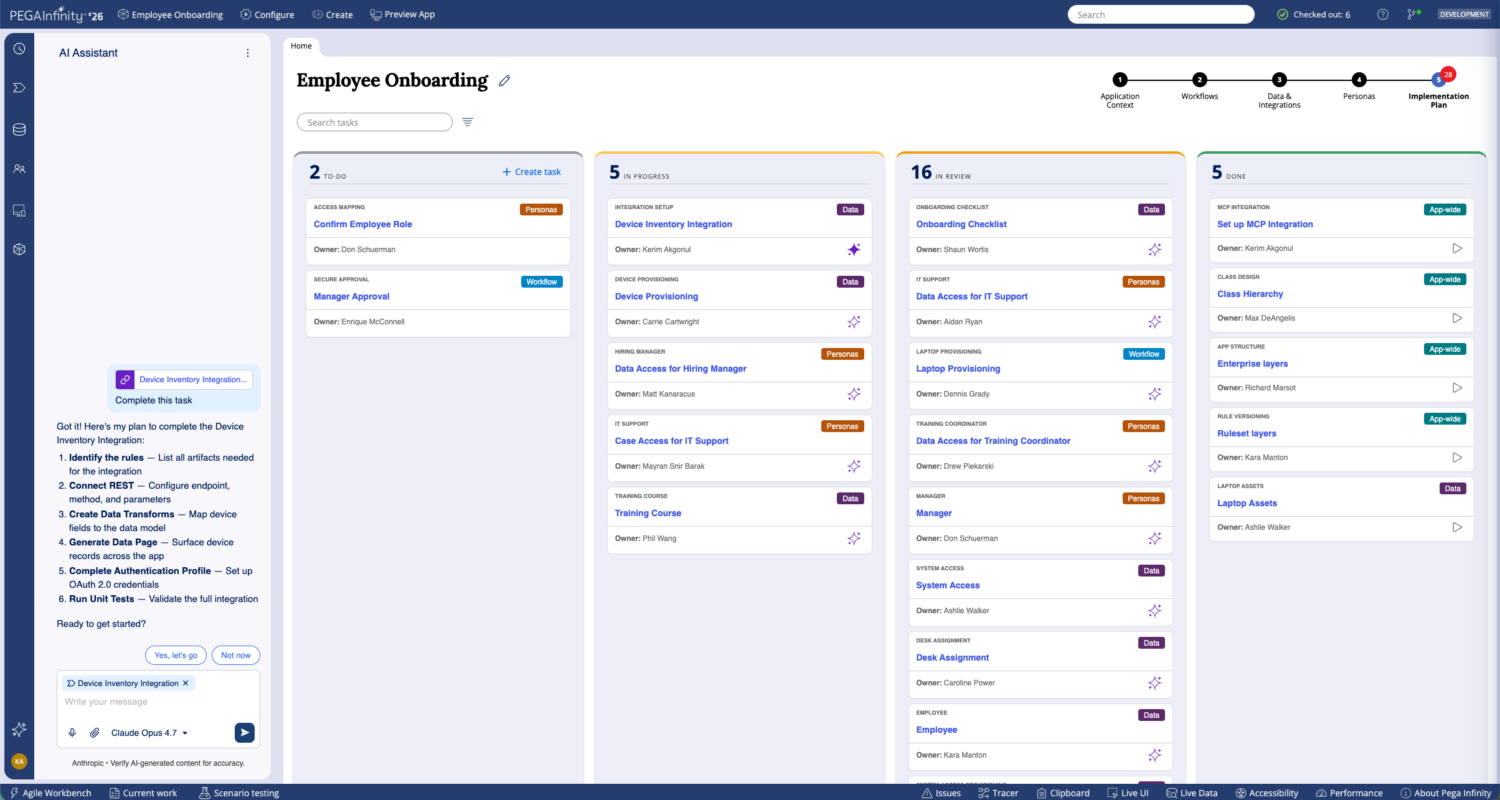
The foundation of Pega was, is, and remains the Infinity platform. Naturally, it’s getting an update. According to Chief Product Officer Kerim Akgonul, this isn’t just any update, but “the biggest update in a decade.” The main reason for this is that Pega has succeeded in integrating Pega Blueprint AI into Infinity. The result is Infinity Studio. With this, Pega intends, among other things, to bring “classic” and “modern” AI together in a single development environment.
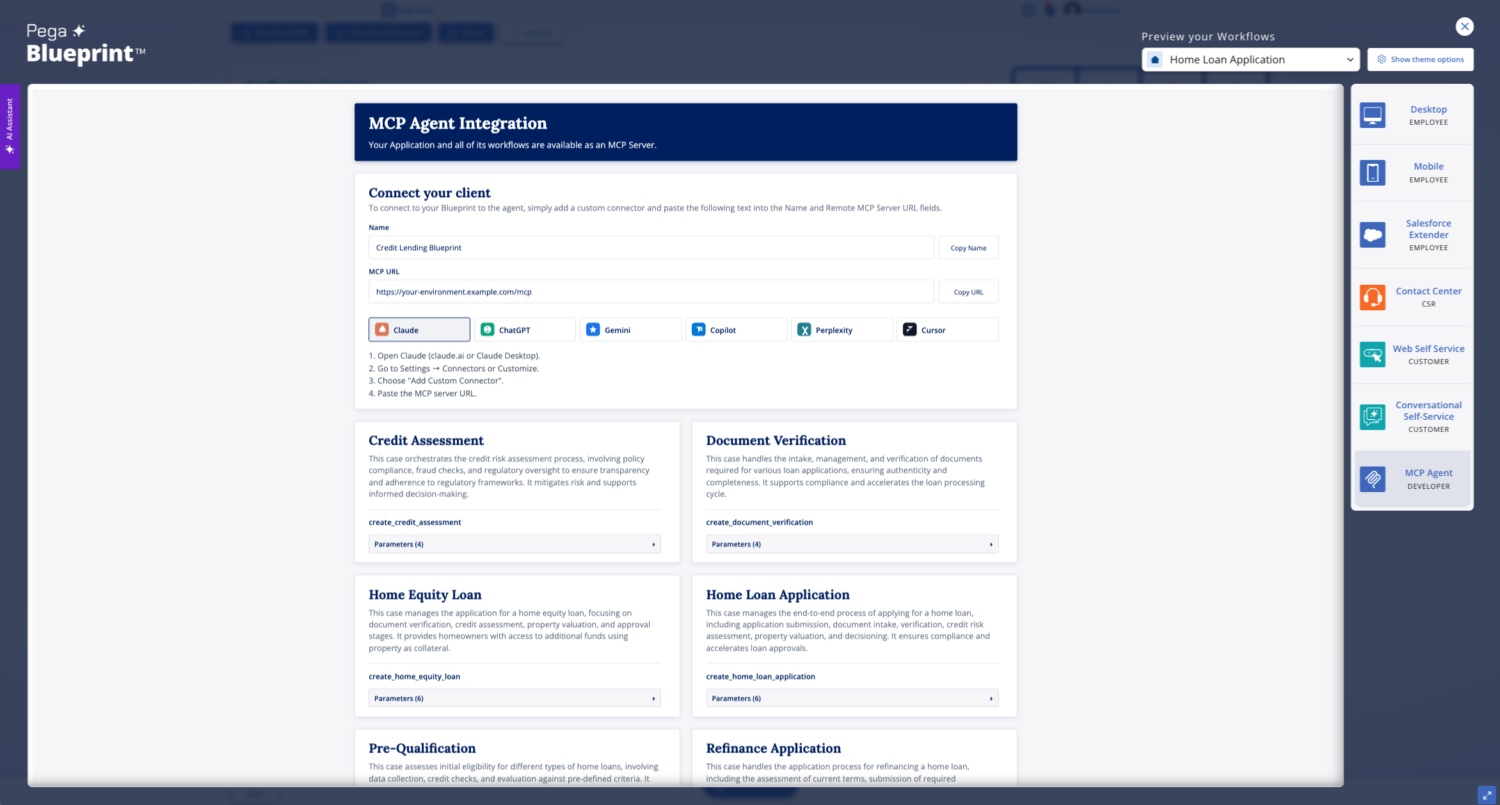
To understand why this integration is important for Pega and for customers, it’s helpful to clarify exactly what Pega Blueprint is. Blueprint is an agentic environment that enables the design of applications. Not building or running them, but designing them. It is, therefore, primarily an ideation environment. You don’t build anything there, but you see what you need to do to build the application you want to create. You can also get a preview of what the app will ultimately look like. Pega Blueprint AI is free to use on the company’s website.
Faster transition from design to development
Since its launch over two years ago, Pega has significantly enhanced Blueprint and its accompanying AI engine. For instance, Pega has added more granular context regarding how applications fit within a company. Pega is also announcing an integration with AWS Transform this week, which we wrote about during the latest edition of AWS re:Invent.
With Transform, AWS wants to bring mainframes into the modern era. The idea is to convert applications written in COBOL into newer versions. AWS Transform handles the analysis of the COBOL code and generates the necessary documentation. Pega Blueprint AI then designs a modern application based on this documentation, without leaving the AWS Transform environment.
Within the Pega ecosystem, however, Pega Blueprint AI remained a fairly standalone environment. As Akgonul puts it: “There was a gap between Blueprint and the development and authoring environment.” That gap no longer exists. With the announcement of Infinity Studio, Blueprint AI has become part of the development platform.
What does Blueprint add to Infinity Studio?
In practice, the integration of Blueprint into Infinity Studio means that Pega adds agentic AI to the Infinity platform, where many best practices, business rules, and other deterministic AI features are already present. You could call it a marriage between old and new, or established and emerging. Provided Pega executes this well (the release is in Q3), this will make the Infinity platform as a whole much more modern and powerful.
The integration of Blueprint into Infinity Studio also adds a sort of “easy button” to Infinity. That is to say, the designs coming from Blueprint immediately generate an implementation plan in Pega Infinity Studio. This should help developers build applications not only quickly but also efficiently, while paying attention to issues such as security and governance.
Pega Infinity Studio will (of course) also feature an AI assistant to help developers. Developers don’t have to use Pega’s own AI Assistant. They can also utilize tools like Claude Code, OpenAI Codex, GitHub Copilot, or AWS’s Kiro. Additionally, Pega is making a number of MCP tools and skills available to enable integration with Pega from external agents as well.
Smart use of different types of AI
By integrating Blueprint AI with Infinity, Pega is taking a step toward building applications more efficiently. However, agentic AI can still be a significant cost factor. Pega, however, only uses the most powerful variant of agentic AI during the design phase. That is, within Blueprint and the new Infinity Studio. At runtime, i.e. once the applications are deployed and running, the applications use a semantic model (rather than Blueprint’s reasoning model).
The advantage of the semantic model is that it invokes application control agents that are good at handling tasks efficiently and consistently. According to Pega, these agents do not start from scratch every time, which would lead to a lot of extra work and thus additional costs. The agents use a simple AI query to estimate what is expected. Based on that, an agent finds the best workflow and executes it step by step. If it becomes necessary to delve deeper into matters, it can always switch to a more advanced model.
Several Pega systems and apps come together in what is called the Agentic Process Fabric. That connects all of the processes and applications together and ask it to carry out specific workflows. This isn’t limited to Pega apps, you can also connect external (AI) tools to it.
Through the above approach, Pega aims to keep costs in check while also maintaining predictable outcomes. The latter is always a challenge with non-deterministic models. By keeping the semantic models strictly in line, and, crucially, not letting them start from scratch every time, Pega maintains a high level of predictability. In principle, the agents follow only pre-approved workflows.
Billing based on outcome, not tokens
Saying that costs are going down is one thing; actually being able to demonstrate that this is the case is quite another. With the AI Token Cost Calculator, organizations can gain more insight into this. This seems primarily to be a way to put their own offering in the spotlight. That is to say, it compares the costs of Pega AI with alternatives that bill based on tokens. According to Pega, many customers can achieve savings of up to 20x.
As already mentioned, in our view, this AI Token Cost Calculator is more of a marketing tool for Pega than anything else. There’s nothing inherently wrong with that, but it’s good to know. What it primarily demonstrates, in our view, is that Pega has a different approach to AI billing. With this company, you don’t pay per token, but per completed case. In other words, organizations pay based on the outcome of the AI deployment. As long as tokens are used but there is no actual result from their deployment, customers pay nothing.
Pega charges a flat rate per completed case, regardless of how much AI is used behind the scenes. That might sound a bit ill-conceived, because in theory this could end up costing Pega a fortune. According to CTO Don Schuerman, it won’t be that bad. The reason for this confidence lies in how Pega has the workflows executed by AI. It still relies heavily on deterministic, “old-school” AI. Those costs are easy to estimate and predict. It even tries and keep the costs for non-deterministic AI as predictable as possible by having agents use semantic models that don’t have to do a lot of reasoning and don’t have to start from scratch every time.
For customers, billing per case rather than per token means that metrics like ROI and TCO become much clearer. This allows them to keep agentic AI in check not only technically but also financially. It is important, however, that customers are and remain satisfied with these outcomes, but that goes without saying.
Pega stays in control
The way Pega handles agentic AI fits well with how the company has operated for a long time. It strives to make all new technologies part of its own platform. Partly because this allows it to offer a uniform experience for customers, but of course also because it keeps customers within its own platform as much as possible. For example, we recall the time when RPA (Robotic Process Automation) was all the rage. At Pega, it was never a specific goal to enter the market with this, but rather to make the platform as a whole more appealing.
We’re now seeing something similar happen with agentic AI. Pega recognizes its value but isn’t going all out on it. It integrates it into its own platform but also imposes restrictions where necessary. See the section above on the combination of reasoning AI and semantic AI in Infinity. By having it operate within clear boundaries, it is possible to minimize the non-deterministic aspects of AI agents as much as possible. This makes agentic AI more appealing to highly regulated industries, but also to customers who simply want predictability in costs and performance.
In other words, Pega delivers a software stack for agentic AI that is, as they say, highly opinionated. It has already made many decisions for customers, for example regarding how a specific agentic workflow performs tasks. This may not result in the the most interesting or dynamic applications of agentic AI. The question is whether this is a problem. We don’t think so. Agentic AI must be kept in check to be useful. That is what Pega is trying to do.