

This year, Oracle has already tried to placate fears about MySQL’s development and adoption, as its apparent stagnation has meant it is ill-positioned for the short-term future. Issues abound, meaning the MySQL community has drafted a written invitation to Oracle to set course for a brighter future.
The letter, now published, is seeking a thousand signatures. MySQL’s shortcomings are painted in no uncertain terms, stemming from both technical as well as cultural problems. Short term, falling adoption is highlighting the critical juncture at which the database engine finds itself. From technical gaps to poor community outreach, the letter addresses faults Oracle has failed to fix, leading to a stark drop in adoption.
The mighty can fall
MySQL once became the de facto standard for modern web development, being part of the famous LAMP stack (Linux, Apache, MySQL and Python, PHP or Perl) for a scalable, performant Web 2.0. It has powered Facebook, YouTube, Uber, GitHub and many more upstarts to this day. However, slow development, paywalled features and a seeming lack of engagement with the outside community have done significant damage. PostgreSQL, previously seen as overly complex and harder to scale compared to MySQL, is quickly catching up. Its pgvector extension is a clear advantage, too, given it allows the near-thirty year old database management system (DBMS) to take advantage of modern AI best practices to leverage enterprise data.
Oracle is feeling the heat. Last week, the company marked the 30-year anniversary of MySQL and declared a ‘new era’ of community engagement. Features long hidden behind commercial editions of the software are going to make it into the free-to-use Community Edition. Still, the current state of affairs is a far cry from the independent days of MySQL, prior to the 1 billion dollar-acquisition by Sun Microsystems in 2008 (which, in turn, was bought by Oracle for $5.6B a year later).
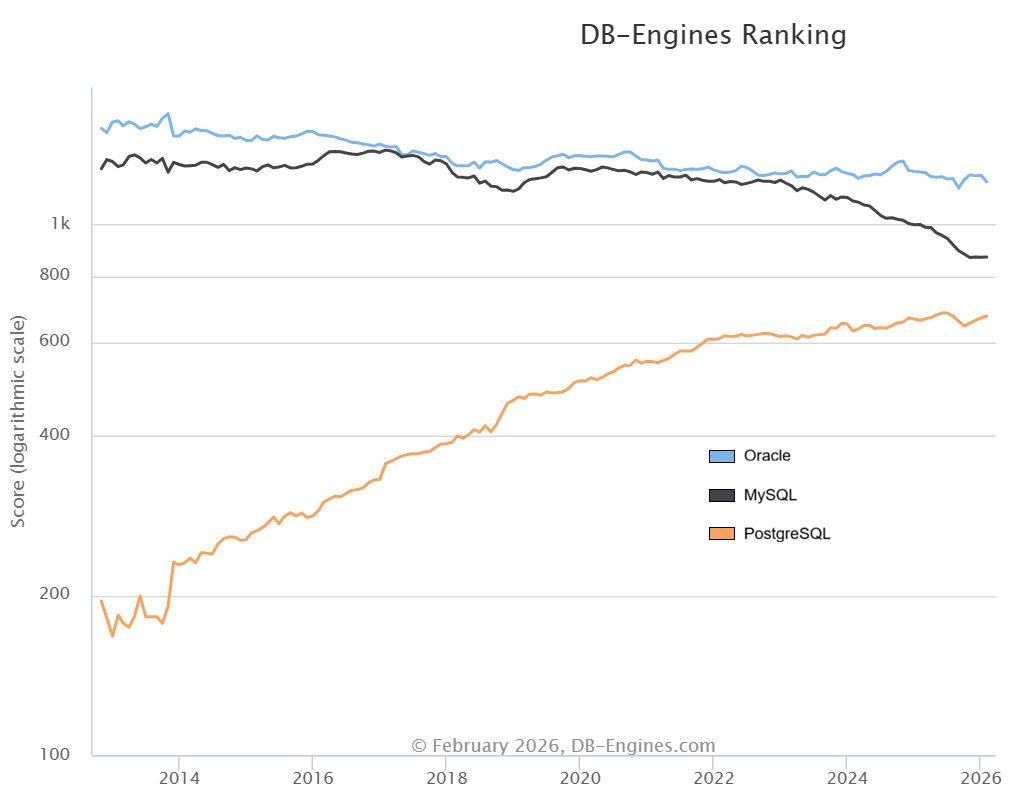
Although some staff has been retained in the near two-decade stretch from then to now, MySQL’s cofounder Michael ‘Monty’ Widenius jumped ship early. By 2009, he had set up an alternative in the form of the ‘drop-in replacement’ MariaDB. Nevertheless, PostgreSQL is far more likely to surpass MySQL as the second most popular DBMS behind Oracle itself.
Skeptic
The letter, while pointed in its criticism, is not offering a full-fledged solution. After all, how could it, given the fact it is merely an invitation to commence talks with Oracle? Three proposals pinpoint an OpenELA-style governance model, distributing the work for Oracle while maintaining control, a broader licensing model and independent development. None of these are likely to receive a resounding confirmation from Oracle, and no such response is expected. As the letter writers note, the company’s behavior has left the community with ‘deep skepticism’.
If any of the three proposals survive Oracle’s judgment, it’s most likely to be the OpenELA equivalent. Under this scheme, the company retains control but implements a system it is already familiar with to ensure collaborative gains. The OpenELA (Open Enterprise Linux Association) was ironically not only cofounded by Oracle, but also a direct reaction to highly similar issues. As Red Hat sought to close off access to the source code of its latest Enterprise Linux releases, Oracle, SUSE and CIQ stepped in to secure the community-driven success of downstream variants. There’s no clear reason this wouldn’t work for MySQL, even if the problems are more persistent than they are acute.
As things stand, we’re witnessing the typical technological changing of the guards. With AI-driven vector search complementing modern needs for general scalability and performance, MySQL isn’t as well-positioned as it once was. Nevertheless, the LAMP stack endures, giving the database engine time to maneuver.
Conclusion: towards a with or without MySQL
There’s value in being the incumbent. Making use of that value and turning it into an even greater success story is still hard. With engineers unlikely to volunteer a costly and error-prone DBMS migration, MySQL has time on its side. For now, it appears AI has to come to the data, the IT stacks and the general working models of white-collar workers everywhere. With that paradigm intact, MySQL may continue to stagnate, but Oracle will see returns in the continued adoption of premium offerings. Open-source, however, is key for any and all paradigm shifts. Open-source database management systems have gone level in popularity with commercial offerings by DB-Engines’ definition. This means MySQL is an option for both camps, but the trend is towards open systems. AI-driven systems such as vector databases point to a future Oracle may fear with its previous approach, as 86.2 percent of those are apparently based on open-source systems.
For now, Oracle’s stance and those of the MySQL community are clear. We have a rough idea of the DBMS’ stalling popularity and its current shortcomings. Both seem well-aware of the fluid nature of MySQL’s future, but only Oracle can decide what guiding principles will persist. Should it do essentially nothing, adoption will surely continue to decrease. Other technologies have proven they can retain their advantage as AI comes to the fore, one example being the Python programming language. It is only increasing in popularity and gaining from an ever-expanding toolset, documentation and expertise. In the DBMS domain, no such incumbent advantage has yet been realized. The letter signals Oracle would do well to begin doing so.
The OpenELA model, at any rate, is a realistic blueprint for improvement. Progress will take time as members sign up and become familiar with the methods used by Oracle’s MySQL team. It would seem drastic based on the actions the company has taken so far in thinning out the free offering, but it would match the words used so far.