
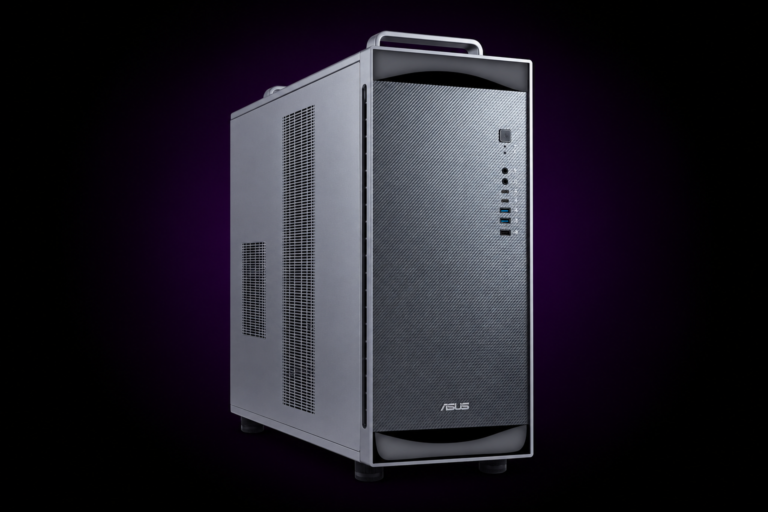
The costs associated with AI usage have led to a wide range of ideas surrounding “tokenomics.” The only way to maintain control over AI costs is by opting for on-premises computing power. ASUS offers its own AI supercomputer for this purpose, including full management of AI models and workloads. What is possible with the ASUS ExpertCenter Pro ET900N G3?
On-premises AI has made giant leaps in recent years through open-weight models. While ChatGPT, Gemini, and Claude are available behind closed doors via the API, the open-weight offerings from DeepSeek, Mistral, Moonshot AI, and many other providers are diverse. But for the best performance, it takes more than just a download and a chat window.
The ASUS ExpertCenter Pro ET900N G3 is based on the NVIDIA DGX Station architecture. At the heart of this system is the NVIDIA GB300 Grace Blackwell Ultra Superchip. It consists of a Grace CPU with 72 Arm Neoverse V2 cores and a Blackwell Ultra GPU. Together, these two chips provide a coherent memory pool of 748 GB. That capacity surpasses even the most advanced models, which rely on ultra-fast HBM3e memory (252 GB) and 496 GB of LPDDR5X memory for the CPU.
The computing power reaches a maximum of 20 petaFLOPS for FP4 calculations, the most common type for AI applications. If even more computing power is needed, two ASUS ExpertCenter Pro ET900N G3 systems can be linked via the built-in NVIDIA ConnectX-8 SuperNIC, which delivers up to 800 Gb/s of network bandwidth. This creates a setup with over 1.4 TB of coherent memory and up to 40 petaFLOPS of AI computing power.
Read also: ASUS to launch AI POD with Nvidia GB200 NVL72
An AI data center in a tower form factor
In many cases, on-premises AI involves compromises. At the scale of the ASUS ExpertCenter Pro ET900N G3, this is not the case. In fact, NVIDIA’s Grace Blackwell Superchip is a data center-grade product, as is its RAM capacity. Running large models at full precision and high speed makes it possible to achieve a cloud-like experience for complex agentic workflows without requiring an API call.
In this process, the CPU should not be underestimated. In agentic loops, tool calls and inference alternate constantly, continuously accessing memory. NVLink-C2C connects the CPU and GPU with a throughput of 900 GB/s, allowing both to operate within the same coherent memory pool without having to copy data. In internal tests with a large Qwen model comprising hundreds of millions of parameters, the system achieved an output of 864 tokens per second, with a combined input and output of 1,600 tokens per second.
None of this is housed in a server rack, but rather in a standard-looking tower. Closed-loop liquid cooling and a 1,600-watt Titanium power supply are designed to keep the system stable even during prolonged workloads. This means no screeching fans in a separate room are needed for cooling. The ASUS ExpertCenter Pro ET900N G3 can therefore be placed right next to a desk.
The AI stack in a single package
The right hardware can only be used to its full potential with the right software. This consists of a mix of ASUS, NVIDIA, and open-source software. NVIDIA DGX OS runs on Ubuntu 24.04 LTS with the NVIDIA AI Developer Tools. Drivers, CUDA, and the most important CUDA-X libraries are pre-installed and optimized to work together, including cuDNN, TensorRT, NCCL, and the data science libraries cuDF and cuML. With this configuration, ASUS aims to eliminate time-consuming tasks where developers or system administrators have to match various versions and resolve dependency conflicts.
The stack also consists of a series of building blocks. One example is Multi-Instance GPU (MIG), designed to split AI computing power into up to seven isolated instances. This enables developers to run workloads side by side on the same hardware. Kubernetes and Run:ai form the orchestration layer, while NVIDIA Sync and Brew enable remote interaction with the system. NVIDIA also supports NIM microservices and Blueprints: ready-to-use model containers and reference workflows for agents and other AI systems.
Security plays a key role in AI agents. If security isn’t in place, a business deployment cannot take place. The ExpertCenter Pro ET900N G3 system supports NVIDIA NemoClaw, an open-source stack that installs NVIDIA’s OpenShell runtime. This allows organizations to define, via policy rules, how agents behave and handle data. As mentioned, the open models run locally and function just like any other workload on the organization’s own hardware. For companies that want to run production workloads with enterprise support, NVIDIA AI Enterprise can be licensed separately. ASUS indicates that it will also enable Windows-based AI development in the future.
Conclusion
The ASUS ExpertCenter Pro ET900N G3 is an example of an AI system that delivers data center-class capacity in a compact form factor. It is based on the same standards and best practices we see in cloud-based open-weight options. This also means that if an AI development team builds a model locally and wants to deploy it to the cloud, the rollout can take place without any issues.
ASUS emphasizes the system’s functional usability in a business environment. The system is explicitly aimed at enterprise customers and comes with on-site hardware support.
This brings us back to tokenomics. Owning an AI supercomputer requires an upfront investment, but it makes the costs of intensive AI use predictable and keeps sensitive data within the organization’s own walls. For organizations that want to seriously deploy on-premises AI, the ExpertCenter Pro ET900N G3 offers both the hardware and software in a single package.
Want to learn more about the ASUS ExpertCenter Pro ET900N G3? Check out all the specifications and features here.