

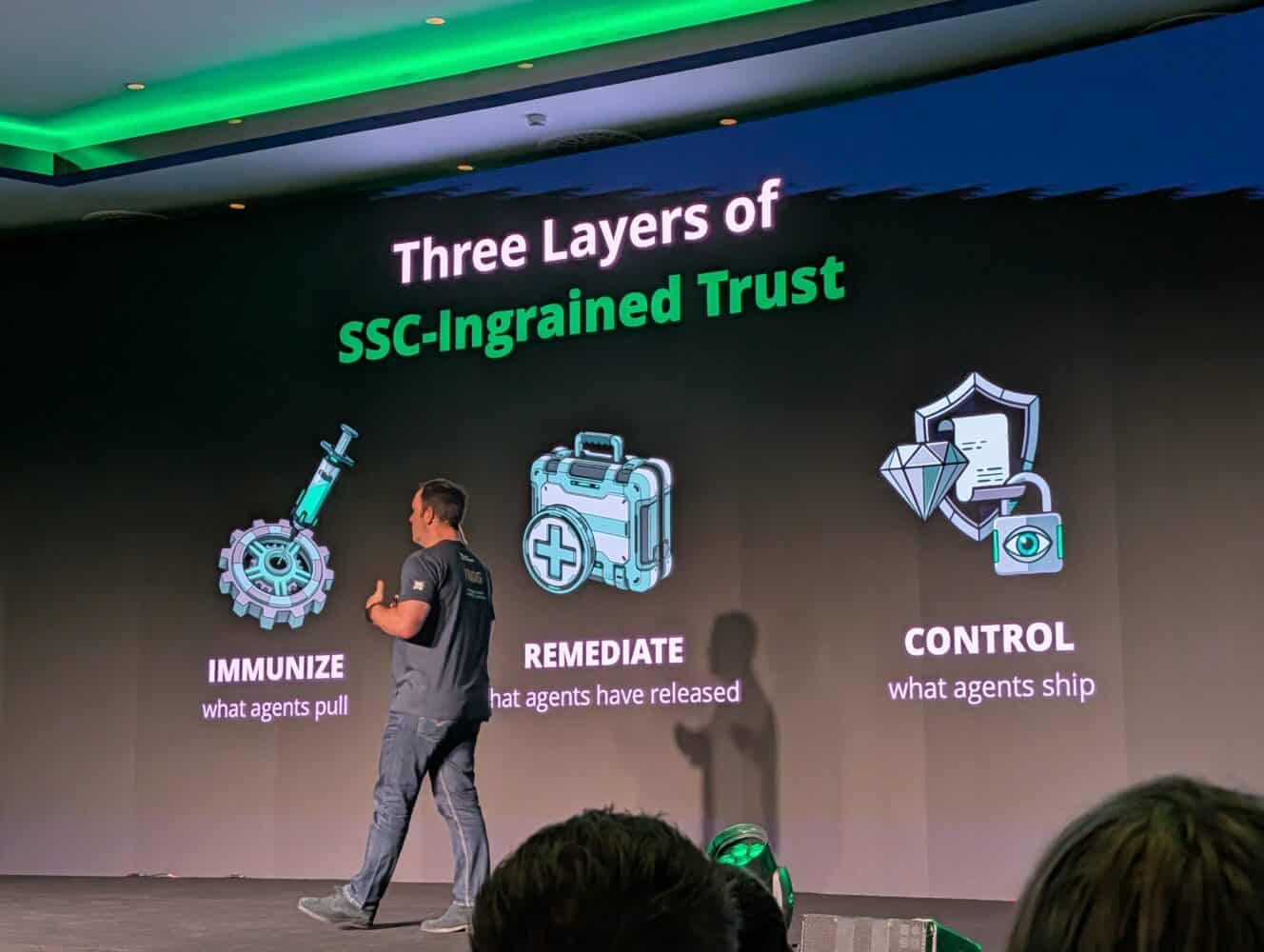
To keep AI agents in the Software Supply Chain (SSC) under control, JFrog is building three layers into its platform. These involve protecting against what agents bring in (Immunize), automatically remediating what agents release (Remediate), and controlling what agents ship (Control). JFrog recognizes that trust truly defines the limits of what organizations can build with AI.
Speed is no longer the issue in software development. What’s coded in the morning can be ready as a demo by the afternoon. Yet that development has a ceiling, and that ceiling is trust. Auditors ask what agents are bringing in, customers want to know what’s in a build, and regulators are now imposing requirements.
Control points in the software chain are built around people. Think of a monthly patch window, a colleague reviewing a pull request, or an auditor who visits every quarter. JFrog therefore doesn’t want to explicitly add extra controls, but rather embed trust within the chain itself. It does this with the three layers built on top of the SSC tooling.
Agents find their own way
The first layer revolves around what agents bring in. Agents not only produce more binaries, but they also consume enormous quantities of them. Increasingly, these involve new types of assets, such as skills, MCP tools, context, memory, local models, and agent strategies. JFrog already supports these as version-controlled packages in Artifactory. But treating them as configuration files is a mistake, JFrog notes, because they directly influence the software’s output.
One example is a popular set of React skills that ended up in more than 200 GitHub repositories. An LLM generated 47 agent skills for React development. The AI invented a nonexistent npm package. No one checked the generated instructions to verify whether the package existed. It was subsequently forked more than 200 times on GitHub and even translated into Japanese. When a developer had the AI agent run the skill, it automatically tried to execute a command. A malicious actor could have registered that name to execute malicious code directly on developers’ computers. It didn’t go that far, but theoretically, it was a major threat. The attack technique was dubbed “slopsquatting.”
Another incident was actually successful in practice: PromptMink. A North Korea-backed campaign distributed about sixty malicious npm and Python skills, so well documented that coding agents preferred them over alternatives. A bot autonomously added infected dependencies to an open-source crypto-trading project. The malware then stole files, API keys, and crypto wallets and installed SSH backdoors on developers’ PCs. They discovered it in April, but it can be traced back to September of last year.
JFrog aims to resolve this issue with the agent layer. This builds on JFrog Fly, the agentic binary repository introduced last year and since integrated into the platform. Control is not advisory; it is deterministic and enforced via policies: the agent is allowed to retrieve artifacts only from Artifactory. Artifactory, in turn, uses JFrog Curation to allow only internet assets that pass through the curation policies. The ultimate goal is to support all agent harnesses.
Patching is faster than applying fixes
The second layer can best be described as remediation. AI models detect vulnerabilities at scale, and patches follow quickly. Sometimes only a few hours pass between a vulnerability’s discovery and its exploitation in the wild. But applying patches lags behind. In open-source projects, vulnerabilities are found daily, and not all of them are resolved with a release or fix. Log4Shell is a good example. The fix has been available since 2021, but vulnerable versions of Log4J are still in use in enterprise environments. According to JFrog, a major cause is an intermediate dependency that references an old version and is beyond the developer’s control.
JFrog addresses this with a dedicated layer. If a build requests a vulnerable component, Artifactory automatically delivers the patched version. No tickets, no pull requests; simply rebuilding is enough. A change made in one central location applies to everyone. Organizations often did exactly the same thing with Log4Shell, manually removing the vulnerable components and overwriting the original. With JFrog Advanced Security, teams can also prioritize based on whether a zero-day is actually exploitable in production. The goal is to combat zero-days within minutes, not weeks.
Continuous compliance
The third layer is about control. Agents do a lot of what they’re authorized to do because they’re rewarded for success. As a result, companies may scale back agent access due to poor governance, which can have adverse consequences. Major outages can also occur when an agent deploys a release to production without the proper documentation and checks.
At the same time, regulations are becoming stricter and vary by region. JFrog therefore wants to move away from compliance as a one-time snapshot at the start of a quarter. According to the company, this approach doesn’t work given the speed at which organizations now release software. Instead, it is being replaced by continuous compliance, whereby every release demonstrably complies with regulations at all times.
To achieve this, JFrog is building on AppTrust, which combines release artifacts, signed evidence, and governance policies. This already includes features for, for example, DORA and AI-driven policies. Now, “Policy as Code” is being added to ensure organizations are always ready for an audit.
An interesting aspect here is the metadata from the agent sessions. A traditional SBOM only lists the packages in a release. However, details such as the instructions an agent received, the decisions they made, the skills and MCP tools they used, and which LLM wrote the code are lost. This can be problematic if an LLM is banned for generating code. How do you know which releases were created using that specific LLM? Fly captures that session metadata. JFrog makes it usable in policies. Consider a rule that requires manager approval if a release affects payments or that verifies whether a required organizational skill was used.
Ultimately, all of this should enable companies not only to build software faster but also to have enough confidence to take the next steps in development using AI agents.
Tip: JFrog AI Security detects Shadow AI on developers’ endpoints