
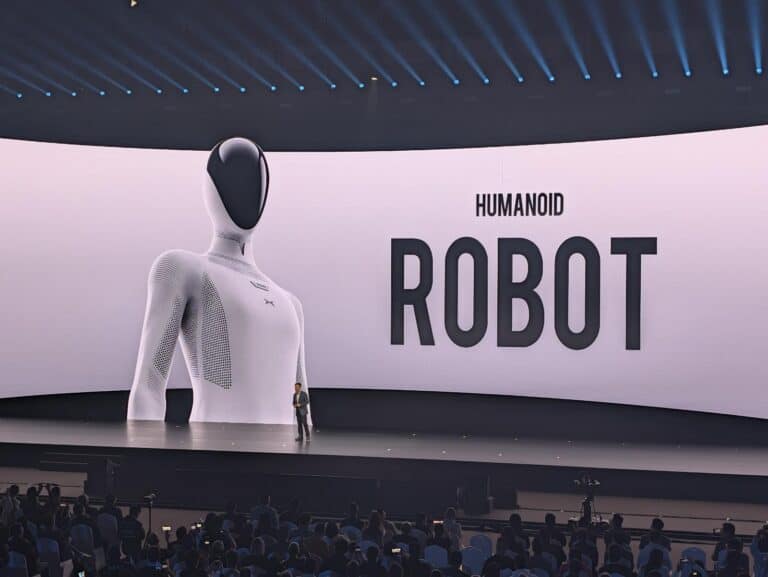
During XPENG AI Day in Guangzhou, the Chinese manufacturer unveiled the third generation of its humanoid robot IRON, along with a concrete timeline leading to mass production in January 2027. More striking than the on-stage demonstration itself is the underlying architectural choice. XPENG uses exactly the same in-house-developed Turing chips and VLA 3.0 models for both its electric cars and its robots. This delivers economies of scale and local edge processing, but also raises questions for enterprise IT environments regarding vendor lock-in and European regulations.
In July in Munich, CEO He Xiaopeng explained that the company no longer sees itself as a car manufacturer, but as a developer of Physical AI. A single shared technology platform underpins four pillars: self-driving cars, robotaxis, flying vehicles, and humanoid robots. XPENG’s serious commitment to funding this ambition became clear earlier this year when its robotics division raised over $900 million in growth capital at a valuation of more than $6.3 billion, followed by the launch of its own automated assembly line in Guangzhou.
A shared silicon foundation that goes against the grain
While most automakers rely on external chip designers, XPENG, like Tesla and BYD, develops its own AI silicon. IRON contains three Turing chips that together deliver 2,250 TOPS of local computing power, comparable to the latest top-of-the-line models in XPENG’s own vehicle portfolio. By aligning the hardware and software stack down to the silicon level, the company avoids waiting in line behind external suppliers and can reuse training data and models from its automotive division.
With this approach, XPENG is emphatically charting its own course in a rapidly evolving market. While competitor Tesla recently split its AI hardware roadmap, reserving the upcoming AI5 computer for Optimus and keeping cars on AI4, XPENG remains committed to maximizing synergy between the road and the factory floor. The major advantage of those 2,250 TOPS is that the new VLA 3.0 (Vision-Language-Action) architecture runs entirely locally on the device. As a result, IRON doesn’t rely on a continuous cloud connection for perception and motor control.

Data privacy at the edge, but how open is the ecosystem?
For European organizations, this local edge processing is a key principle. A humanoid robot standing 1.70 meters tall and weighing 62 kilograms, walking through an office building or reception area, continuously collects camera footage, spatial scans, and voice data. Because the robot processes this data locally and shares the floor plans it builds with other robots at the same location, sensitive images and conversations do not need to be sent to external servers by default.
At the same time, this extensive vertical integration presents a familiar enterprise dilemma. XPENG builds virtually the entire stack itself: from the Turing chips and more than 1,500 tactile sensors to the language and motion models. For the business market, the company is introducing a development environment that allows organizations to roll out a new business-specific task within 48 hours using off-the-shelf or custom-built skill packs. However, XPENG has yet to clarify whether customers will eventually be able to run their own AI models or third-party software on that local computing power. Without clear open standards and API integrations, IT departments risk significant vendor lock-in.
Customer interaction instead of the factory floor
XPENG’s choice of market segmentation is also noteworthy. In the current wave of commercial humanoid robots, Western frontrunners such as Figure AI and Agility Robotics are opting for strictly defined logistical and industrial tasks, such as moving pallets in warehouses or feeding parts to assembly lines. Unitree, on the other hand, focuses heavily on researchers and developers with its more affordable models. XPENG is skipping that heavy industry sector for now and will begin deploying robots in its own stores in the first quarter of 2027, followed by a commercial launch in Q2 2027 focused on applications such as customer interaction and guided tours.
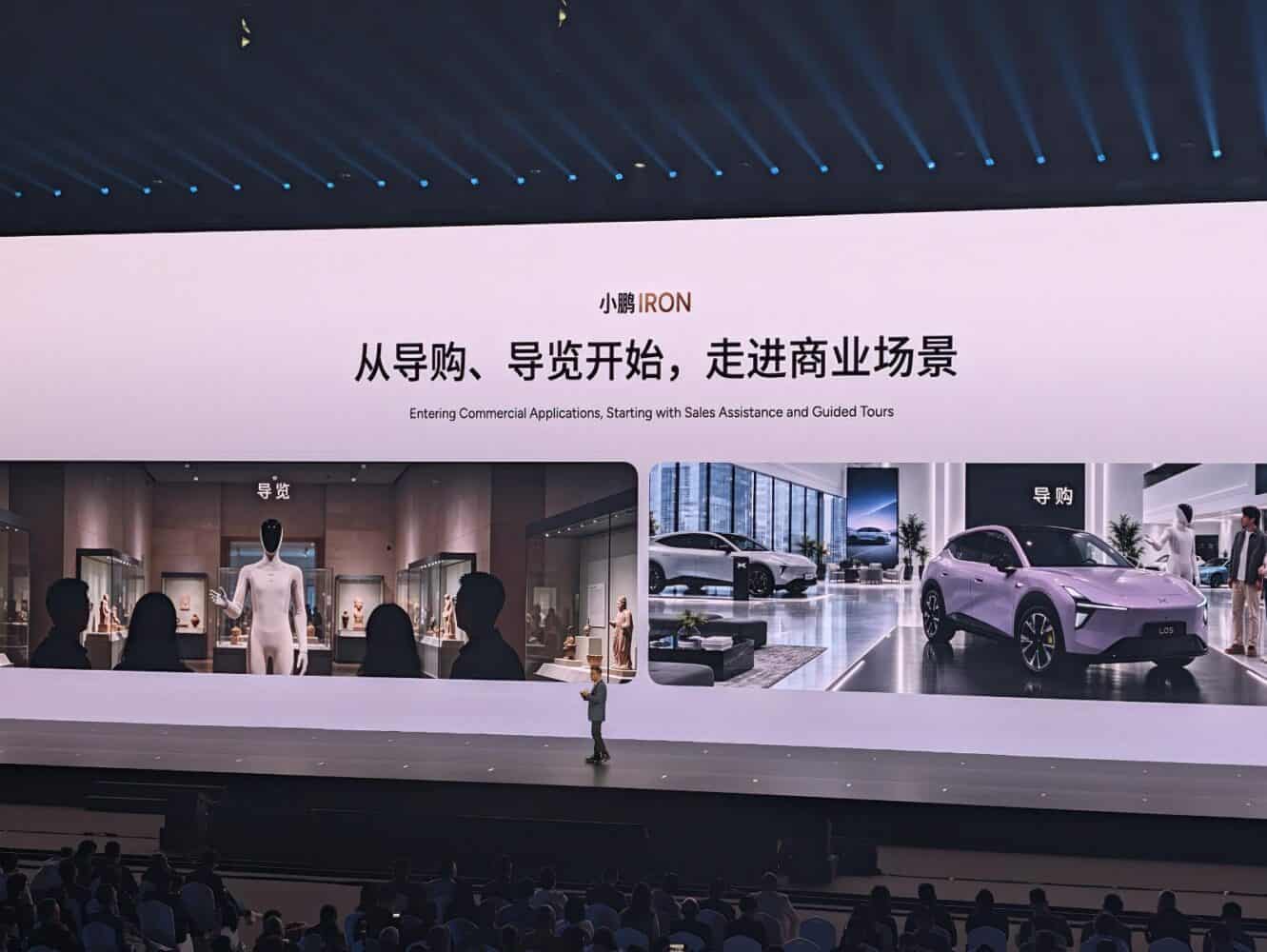
This choice sets a high bar for reliability, as public spaces are far less predictable than a secure factory floor. During the presentation in Guangzhou, XPENG therefore kept the live demonstration straightforward: IRON walked autonomously across the stage and engaged in conversations with CEO He Xiaopeng and the audience, while omitting more strenuous physical tasks. XPENG representatives on site also tempered expectations regarding its use in households. A robot weighing over sixty kilograms still lacks the human reflex to turn away in a fall, meaning its use in a cluttered living room is still years away.
European regulators set the pace
Furthermore, XPENG’s plan to roll out the hardware commercially in China starting in early 2027 does not mean European organizations will see the robot in the workplace that same year. To be allowed to operate among people without physical barriers, each unit undergoes more than a thousand vehicle-level tests, its drive system stops within milliseconds if contact force exceeds 50 newtons, and the robot operates with an 8-millimeter-thick solid-state battery that can withstand temperatures up to 200 degrees Celsius.
In Europe, however, internal factory tests are not sufficient. XPENG is already experiencing how cumbersome European approval processes are for its electric cars. While Tesla is already gradually rolling out autonomous driving features in countries like the Netherlands, XPENG is not yet permitted to activate its autonomous driving technology there. According to a spokesperson, the company is deliberately choosing a longer route to secure approval for the entire European Union at once rather than on a country-by-country basis. As soon as XPENG wants to bring IRON to Europe, the system will face a similar process involving CE certification, the European Machinery Directive, and the requirements for high-risk systems under the EU AI Act. Only then will it become clear whether XPENG’s shared AI platform can gain a foothold outside of China.