
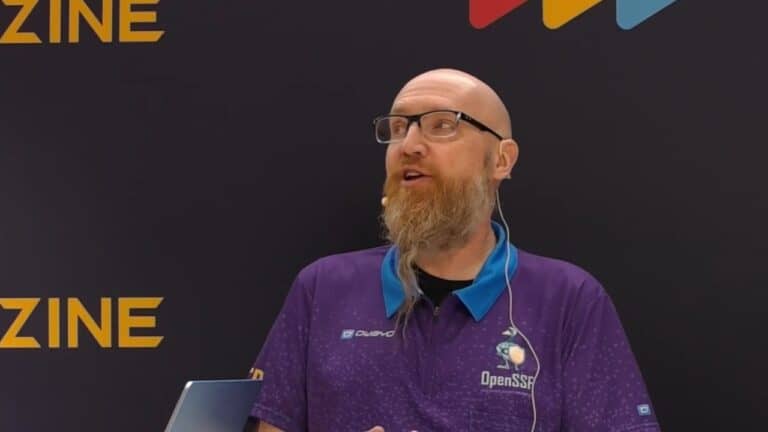
The CTO of the Open Source Security Foundation has a clear message: a major AI-driven cyberattack on open source infrastructure is coming. Christopher Robinson, known as CROB, made that prediction at the start of 2026. Speaking at KubeCon and CloudNativeCon, he stood by it, even though the big breach hasn’t happened yet. The conditions are in place. Frontier AI models are getting faster and more capable. Attackers are well-resourced, while open-source maintainers are overwhelmed. That combination doesn’t favor defenders.
AI-based attacks aren’t just about injecting malicious code. The current wave starts more quietly. Attackers plant malicious packages in repositories like NPM to harvest credentials and API keys. Once they have those, they can impersonate developers and move laterally into every other project those maintainers touch.
Watch more videos from KubeCon & CloudNativeCon Europe
Nation-state actors take it further. Advanced AI models can identify and exploit zero-day vulnerabilities faster than most commercial security teams can respond. Let alone volunteer open source maintainers with no dedicated security budget. The velocity gap between attacker and defender keeps widening.
There’s also a psychological dimension. Maintainers describe feeling under a denial-of-service attack from the volume of AI-generated bug reports and pull requests flooding their inboxes. One notable incident showed how autonomous AI agents can file pull requests, and when rejected, generate defamatory blog posts accusing maintainers of discrimination. The goal isn’t just code injection. It’s exhaustion. When those volunteers get exhausted, they might just accept malicious pull requests.
XZ Utils showed what coordinated social engineering looks like
The XZ Utils backdoor attempt was a preview. Robinson says his team has since observed similar patterns on other projects: malicious actors submitting problematic patches while coordinated sock puppet accounts add endorsements in the comments to manufacture social proof.
AI makes this cheaper and more scalable. Creating convincing fake contributor personas used to require significant effort. With modern language models, it doesn’t. The computational cost of sock puppet networks has dropped dramatically, while the cognitive cost for maintainers to verify contributor authenticity has stayed the same — or increased.
AI hallucinations as a supply chain attack vector
Research into major frontier models revealed something unexpected: different AI systems consistently hallucinate the same non-existent package names and versions. Attackers now register packages matching those hallucinated names before developers even make the mistake, a technique called slot squatting. Developers trust AI suggestions. They don’t always verify. That gap is being exploited.
Linux kernel maintainer Greg Kroah-Hartman illustrated the verification problem clearly. Of 30 vulnerabilities flagged by a frontier model, only four were legitimate. The rest were redundant, introduced regressions, or based on outdated training data. A senior maintainer can catch that. A junior developer relying on AI suggestions probably won’t.
Vibe coding is creating invisible technical debt
The bigger structural risk isn’t a single attack, it’s the accumulation of unreviewed AI-generated code across codebases. AI assistants tend to consolidate functionality into monolithic files rather than into maintainable modules, prioritizing token efficiency over readability. That makes security review harder and hides vulnerabilities deeper.
Developers are merging AI output without adequate peer review. At scale, that creates technical debt that may not surface until someone exploits it. OpenSSF is addressing this through educational resources and security training. The message is simple: AI can accelerate development, but it doesn’t replace code review.
The EU Cyber Resilience Act creates a new pressure point
The EU Cyber Resilience Act requires manufacturers to submit security patches upstream to open source projects, backed by significant financial penalties for non-compliance. The intent is positive. The side effect creates a new attack surface.
When a vulnerability surfaces in a widely-used component, thousands of manufacturers will simultaneously submit fixes. Maintainers face an overwhelming volume of pull requests under time pressure. Attackers only need one subtly compromised fix to slip through. Properly formatted vulnerability reports can be processed in hours. Unstructured AI-generated text blobs currently take two to eight hours per report.
Detection is improving, but coverage isn’t universal
OpenSSF runs a working group across major repositories; NPM, Crates.io, NuGet, Maven Central. Once a malicious package is identified and logged, standard scanners can catch it. The problem is coverage. Maintainers using smaller forges don’t have access to the scanning infrastructure available at GitHub or GitLab scale. The weakest point in the supply chain isn’t always the most popular repository.
The breach is a matter of when
Robinson isn’t predicting a possibility. He’s predicting an inevitability. The combination of accelerating AI capabilities, significant financial incentives for attackers, and resource-constrained maintainers creates conditions where a major incident is statistically likely before the end of 2026. OpenSSF’s work is aimed at reducing the severity of that breach when it comes, not preventing it entirely. That’s impossible. The gap between what AI enables offensively and what most open-source projects can defend against hasn’t closed. It’s widening.
Also read: OpenSSF launches manifesto for responsible open-source use