
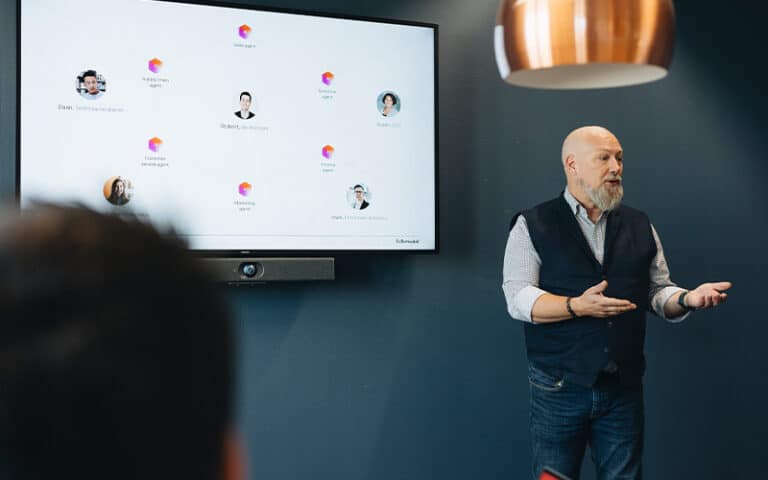
Microsoft has declared 2026 to be the year of the agent. This is not because the technology is only now becoming good enough. That threshold was crossed in 2025. Instead, Microsoft predicts that organizations will be forced to confront something more fundamental: whether they can embrace the change that AI agents bring as they take on increasingly prominent roles in the workplace.
It’s not about accepting or understanding technological progress anymore. It is about our willingness, as humans, to accept and make use of the capabilities that AI agents offer. That makes the shift not primarily technical, but human. Are we ready to be helped by, and eventually enhanced by, our digital colleagues?
2025 was the year of experimentation and technology-driven pilots. In 2026, agents must demonstrate real value: can they improve decision-making, accelerate execution, and meaningfully shape how we work? The question is no longer if the technology works, but whether we are willing to let agents transform our workplace.
Also read: Microsoft Agent Framework: multi-agent systems take shape
Why 2026 will be different
In 2025, we were introduced to the term agent. It represented something new: AI software with agency – the ability to perform tasks independently, make decisions, and interact with systems in ways beyond just answering questions. AI achieved a key technological milestone: it became able to execute business processes and perform actions in existing business systems, with or without human guidance. Organizations could now move past simple data retrieval-based agents and start experimenting with AI companions that could enhance human capabilities.
This potential transformed the conversation. While organizations were initially experimenting, the focus was on technical capabilities. But over time, this shifted to: ‘We need to understand and manage this in the long run.’ Isolated experiments were no longer enough. The question became: How do we own this over time? In 2026 and beyond, agents must transition from cool demos into true business partners.
Three shifts organizations must make
To harness the value of agents, organizations, including yours, must make three key changes:
1. From IT project to business ownership
IT traditionally manages software deployment and monitoring. AI agents change that. Agents are becoming partners in decision-making, working alongside human professionals to make business decisions. This shifts ownership. While IT professionals can assess whether agents work in a technical sense and are able to communicate, only the business can judge whether an agent took the right actions or provided the correct data to improve real-world tasks. This is why it’s crucial for business leaders to take ownership of agents and learn how to manage them rather than leaving it to IT as they might typically do with technology.
2. From tool to colleague
The core task of an agent is to make decisions and take action. This makes them fundamentally different from traditional software. You don’t just deploy them and forget about them. Agents require continuous supervision and guidance, just like human colleagues. They are not infallible or all-knowing, so how do you make them successful in your organization? Provide clear expectations, success criteria, and behavioral boundaries. This also means implementing systems and HR processes similar to those for managing human employees. Think of governance frameworks for acceptable behavior, but also ways to measure performance and processes to continuously improve agents. Managers who are used to managing human colleagues will need to learn how to manage agents as well.
3. From silos to organizational glue
People naturally form groups, which is a major reason organizations work in silos. Agents, however, don’t care which department or team they belong to. To be effective, agents just need access to information from different parts of the organization. This highlights the need for a more integrated approach to knowledge sharing.
Consider customer service and sales, traditionally two separate silos. An agent can handle both: solving customer problems and suggesting relevant upsells at the same time. It doesn’t face the same objections humans might. But for this to happen, knowledge needs to be easily accessible.
Therefore, organizations need to rethink how they structure and share knowledge. What should colleagues be able to access without having to ask via email? Moving knowledge from people’s heads, inboxes, or shared drives to accessible databases enables both humans and agents to easily find the information they need. This way, agents can act as glue that connects different parts of the organization, breaking down silos and creating shared infrastructure for both people and agents to access.
How to get started
These shifts are challenging to make, especially because AI knowledge varies widely within organizations, sometimes even within the same team. Ask around and you’ll find people at all points on the maturity scale. But that’s exactly why starting now matters: early movers will build that agent knowledge while competitors still experiment. So, where do you start?
Organizations often approach implementing AI agents in three ways. First, there are experimental approaches, trying ten things and keeping two that work – fast iteration, quick failures, focus on winners. Then there’s process optimization: targeting pain points. For example, processes that require manual labor, are error-prone, or rely on humans to integrate data between systems. Hand this integration work to an agent, and you free up a colleague to focus on their core responsibilities. Finally, there’s business model innovation. This is probably the hardest route to follow but potentially the most valuable. Think about new possibilities. What could we do that we couldn’t before?
Are you ready?
We believe 2026 will indeed be the year of the agent, in the sense that they will find their role in the workplace. This is not a question of technical maturity. It is a question of reaching the organizational maturity to start treating AI agents as collaborative partners to human teams. This means treating AI agents as digital colleagues, taking business ownership, and setting realistic expectations. Organizations that get this right will have a significant advantage in coming years. Those that don’t will risk falling behind as competitors start seeing real ROI from their AI agents. The question is not: are agents ready? The question is: are you?
Looking to accelerate your AI journey? Fellowmind helps organizations navigate this transition with HiveAI, designed to help you onboard and manage AI agents as digital colleagues. Learn more about HiveAI.