
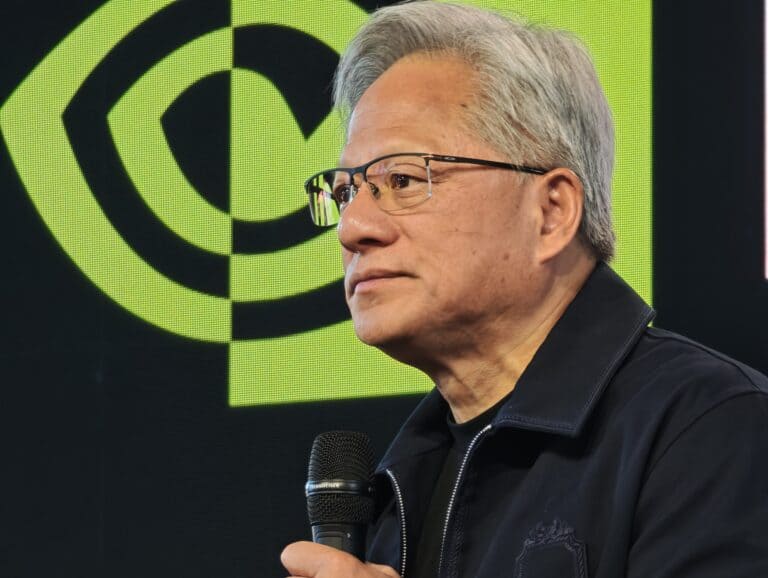
If an affair with an alleged Chinese spy wasn’t reason enough for Nvidia CEO Jensen Huang to fear for his job, then news of a second affair may be the deciding factor. According to sources cited by The New York Times, Huang reportedly had a relationship with Kimberly Powell, Nvidia’s Chief of Health Care, who has been with the GPU giant since 2008.
At the time of writing, the board of directors is reportedly meeting to decide Huang’s fate. The stock price is fluctuating wildly in after-hours trading, with the deepest drop exceeding 8 percent below Nvidia’s closing price at the end of the trading day. On a monthly basis, the stock has lost nearly 25 percent of its value.
Huang may leave the board with no choice
The board already had plenty to discuss. The affair with Alice Huang, a top executive at Singapore-based Megaspeed but of Chinese descent, has raised concerns at Nvidia and among investors for three main reasons. First, the affair itself, which Jensen Huang has since admitted to and which constitutes a breach of trust that has led to a class-action lawsuit over the plummeting market value. Second, there is the alleged espionage by Alice Huang, which China denies but which U.S. intelligence agencies firmly assert. A third issue, however, revolves around the implications for national security: if the relationship facilitated the smuggling of GPUs to China, this constitutes a more serious violation than it initially appears.
Through Megaspeed and affiliated companies, Nvidia chips worth at least $7.5 billion are said to have ended up in China, some of which were subject to U.S. export restrictions.
Nvidia’s products are classified as dual-use hardware, which means they can be used for both civilian and military purposes. If the Nvidia CEO collaborated in shipping systems that should not have fallen into Chinese hands due to export restrictions, this could be characterized as jeopardizing national security.
Jensen Huang himself has long been an opponent of the restrictions. China once accounted for 20 percent of Nvidia’s total revenue, but that figure has declined sharply since the U.S. government, under both President Trump and President Biden, imposed export restrictions on advanced chips and chip manufacturing equipment.
The second affair
The relationship with Powell, who, like 60 others, reports directly to the Nvidia CEO, had not previously been made public. The sources spoke on condition of anonymity. Both Huang and Powell are married to other people. According to the five sources, the relationship was already being discussed within Nvidia.
When The New York Times reached out to Jensen Huang by phone on Wednesday, he responded, “I don’t think you should be speaking to me directly.” He then hung up. Nvidia declined to comment, and Powell did not immediately respond to questions.
According to two sources, the two were caught on video in March acting affectionately toward each other at a hotel in San Jose. This occurred during GTC in the U.S. A bystander filmed the scene with a phone. Huang’s security guards took the person aside and had them sign a non-disclosure agreement.
Code of conduct and rapid career advancement
Nvidia’s code of conduct instructs employees to avoid situations in which their actions could create a conflict of interest, including personal relationships. The company states that it investigates reports of misconduct immediately. Many companies prohibit relationships between managers and subordinates.
Powell has worked at Nvidia since 2008 and rose quickly through the ranks. In 2016, she became senior director of AI business development, followed by the role of vice president of healthcare in late 2017. She focuses on applications of Nvidia chips in healthcare and higher education, particularly medical imaging.
Huang is far from the first top U.S. tech executive to have a workplace relationship. Intel CEO Brian Krzanich stepped down in 2018 following a previous relationship with an employee.