
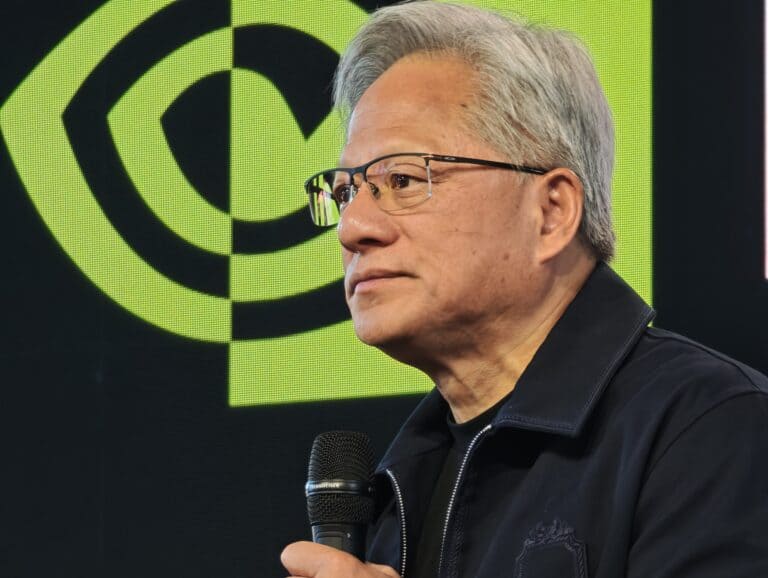
Since 1993, Jensen Huang had been at the helm of Nvidia, the chip company he founded with three others. What remained an adventure in the gaming industry for decades grew into a data center and ultimately AI build-out on an astronomical scale. That chapter is now coming to an abrupt end, seemingly entirely because the CEO cheated with two women: an alleged spy for China and a subordinate.
Chief Financial Officer Colette Kress is temporarily taking over. In the official press release, Nvidia states that Huang has given up his role as president, CEO and member of the board of directors. That does not mean his position was tenable. The board met last night to discuss his position, with the last-minute revelation of a second affair between Huang and Head of Health Care Kimberly Powell. The first revelation had already provided more than enough to talk about.
Megaspeed affair
The affair with Alice Huang, a top executive at Singapore-based Megaspeed but herself Chinese, has raised concerns at Nvidia and among investors for three reasons. First, the affair itself, since admitted by Jensen Huang and a breach of trust that has led to a class-action lawsuit over the plummeting market value. Second, the alleged espionage by Alice Huang, denied by China but firmly asserted by U.S. intelligence agencies. But a third point concerns the implications for national security: if the relationship facilitated GPU smuggling to China, this is a more serious offense than it initially appears.
Through Megaspeed and affiliated companies, Nvidia chips worth at least $7.5 billion are said to have ended up in China, some of them subject to U.S. export restrictions.
Nvidia’s products qualify as dual-use hardware. That means they can be used for both civilian and military purposes. If the Nvidia CEO helped ship systems that should not have fallen into Chinese hands due to export restrictions, that can be characterized as endangering national security.
As CEO, Jensen Huang had long been an opponent of the restrictions. China once accounted for 20 percent of Nvidia’s total revenue, but that share has fallen sharply since the U.S. government, under both President Trump and President Biden, opted for export restrictions on advanced chips and chipmaking equipment.
Read more: Nvidia CEO Jensen Huang possibly ousted as second affair is revealed
Curtain falls for Huang, with a highly uncertain future
By his own account, Huang has 60 direct reports. That is, to put it mildly, hard to believe in any practical, traditional sense. Although Huang reportedly works 80 hours a week, he has spent recent years in particular continuously traveling the world, with little time to run the company day to day. That means Nvidia should be able to get by just fine operationally in the coming days and weeks. With the CFO at the helm as interim chief, there is a figurehead again, but the media attention can be expected to be too much of a distraction for her to take the stage at tech conferences all that often.
Without Huang, Nvidia will have to present an entirely new identity to the outside world in the longer term. He was the face of the company, found a willing listener in President Donald Trump and rarely shared the stage with other Nvidia executives.
AI growth depended on Nvidia, but no longer does
The AI build-out is driving the growth of the U.S. economy, and Nvidia in turn is the engine block behind that build-out. It is hard to imagine what the current drive for expansion would have looked like without the company’s GPUs, which are only alternated with Google TPUs, far less ubiquitous AMD GPUs and other AI-specific accelerators.
That position, too, does not depend on Huang from day to day, but it was built under him. Nvidia’s next chapter was always going to be a defensive one: holding on to its colossal market value, margins and market position. The same now applies to the top of the company. If Nvidia loses influence for whatever reason, AI growth is now at a stage where the baton can be passed to other parties that are all too eager to gobble up TSMC’s capacity, alongside the available memory chips from the three memory vendors Micron, SK hynix and Samsung.