
Companies currently spend 11 percent of their R&D budget on quantum computing, an increase of 7 percent compared to 2023. However, preparedness remains limited, with an average Quantum Readiness Index score of only 28 out of 100. The biggest stumbling block? A shortage of qualified personnel.
IBM has published the second edition of its Quantum Readiness study. The report shows that companies worldwide are significantly increasing their investments in quantum technology. However, the technology itself and the available expertise are still lagging behind.
Europe is catching up
The new index measures how well organizations are prepared for quantum computing. That score rose from 22 in 2023 to 28 this year. Petra Florizoone, Director of Global Partnerships & Business Development for IBM Quantum and co-author of the study, explains the figures during a media roundtable in Brussels. “We are seeing momentum, which is positive. Companies are beginning to recognize the value. However, there are still major gaps.”
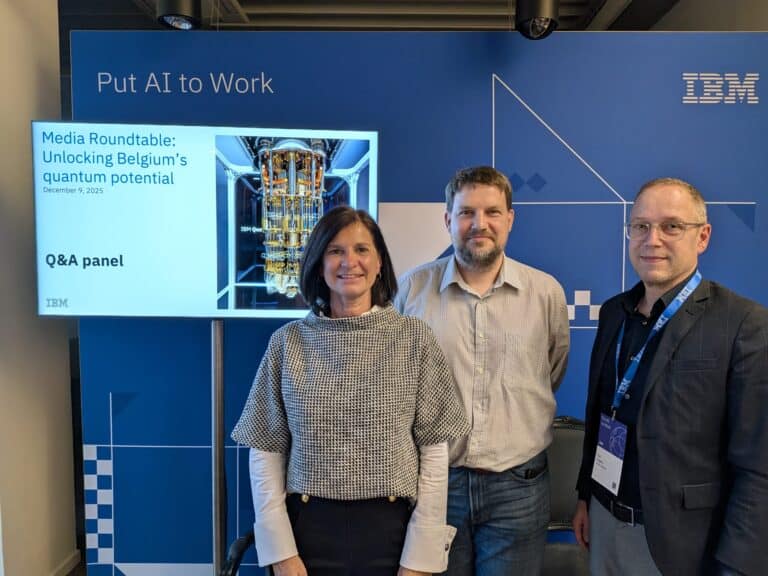
The photo above this article shows the panel members of the roundtable discussion. From left to right: Petra Florizoone, Director of Global Partnerships & Business Development for IBM Quantum, Thomas Rotté, Software Engineer Quantum Computing at KBC, and Raf Degens, CEO of Corda Campus.
Europe is performing roughly in line with the global average, with a score of 28. “That percentage remains on the low side, but according to Florizoone, it is still a positive sign that the quantum computing story is now also gaining traction in Europe. “Europe has caught up. The US and Japan took the lead, but now we are also seeing Europe really take off.” However, the low score shows that there is still a long way to go.
Of all the companies surveyed, 61 percent cite a lack of qualified talent as the biggest obstacle. This problem is more acute in Europe, where two-thirds of quantum-related vacancies worldwide remain unfilled due to a shortage of candidates. Other barriers include the immaturity of the technology (56 percent), unclear timelines for use cases (46 percent), and expensive hardware (41 percent).
Interaction with AI investments
The combination of AI and quantum technology appears to be an important catalyst. Companies that position quantum as a complement to AI invest 33 percent more. Companies that are already developing a quantum strategy expect a 53 percent higher ROI than their competitors by 2030. The top 10 percent of the organizations surveyed, the so-called quantum-ready organizations (QROs), distinguish themselves not only through technology but also through attitude. Of these, 83 percent are motivated to accelerate innovation, 83 percent want to solve persistent business problems, and 88 percent are focused on future-proofing their computing strategy.
Estimating when these investments will actually pay off remains an estimate for the time being. Florizoone does provide IBM’s estimated timeline to give companies an idea: “We expect to have a fault-tolerant quantum computer by 2029. You should know that quantum computers still contain a lot of noise. They are very sensitive to vibrations and the like. And that’s what we’re working on now.”
Responsible use still underexposed
It is striking that only 2 percent of quantum-ready organizations consider responsible practices a priority when selecting providers. This is despite widespread concern about quantum risks. It shows that dangerous governance gaps remain.
Read also: IBM builds first fault-tolerant quantum computer Starling