
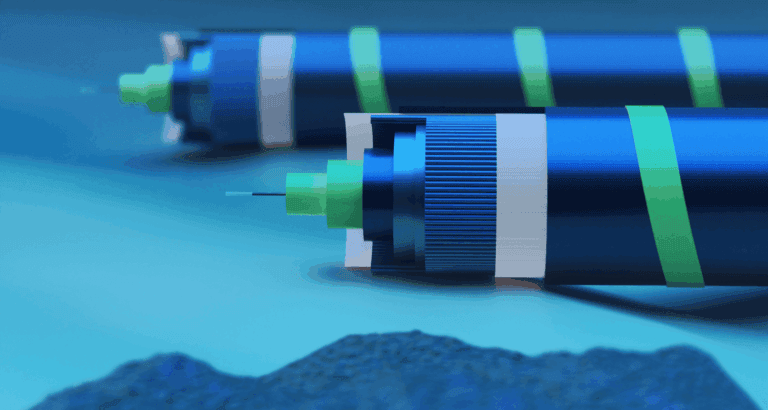
Governments and technology companies are accelerating their use of drones, autonomous vessels, and sensor technology to better secure undersea data cables. This shift toward active monitoring follows growing concerns about sabotage and disruptions to this critical infrastructure, which handles the majority of global internet traffic.
The focus is increasingly shifting from physical protection to technological monitoring and rapid detection, writes The Wall Street Journal. In Northern Europe, NATO has stepped up its maritime surveillance operations in recent years. In addition to ships and aircraft, unmanned systems are playing an increasingly significant role. Autonomous vessels and drones are being deployed to detect suspicious movements near cable routes. According to those involved, the emphasis is not only on presence but primarily on the ability to recognize and interpret anomalous behavior at an early stage.
In parallel, the technology sector is developing new methods to use cables themselves as sensors. One of the most promising techniques is distributed acoustic sensing, in which laser pulses are sent through fiber-optic cables. Small vibrations in the cable alter the reflected light signal, allowing for precise determination of what is happening in the immediate vicinity. Operators can thus distinguish, for example, between fishing vessels, tankers, and other ships. This data is increasingly combined with algorithms that analyze patterns and automatically generate alerts when anomalies occur.
Experiments with sensor networks are also underway on the seabed itself. Companies are developing systems that can remain underwater for extended periods and record movements using sonar or other detection techniques. These platforms are designed to continuously monitor and secure strategic nodes, such as cable crossings or port entrances, without human intervention.
Vulnerability Remains
Nevertheless, the physical protection of cables has clear limitations. Even reinforced cables can be damaged when heavy anchors or trawl nets come into contact with them. Especially in coastal areas, where cables lie in relatively shallow waters, the risk of intentional or unintentional damage remains. Experts emphasize that complete prevention is practically unfeasible and that the focus is therefore shifting toward resilience and recovery capacity.
This shift is evident in how new cable projects are designed. Network operators are increasingly opting for routes that are less geopolitically sensitive and avoiding heavily trafficked or disputed waters. At the same time, investments are being made in redundancy by creating multiple connections and landing points. This allows data traffic to be automatically rerouted in the event of a failure, thereby limiting the impact.
Technological developments are further accelerated by the growing demand for data capacity, driven in part by applications involving artificial intelligence. New cable projects are being rolled out on a larger scale and with higher capacity, which further increases reliance on this infrastructure. Consequently, the need to make security an integral part of network design and management is also growing.
Origin of damage often unclear
A complicating factor remains the question of liability in the event of incidents. It is often difficult to determine whether damage is the result of an accident or deliberate action. Ships regularly operate under the flags of third countries and leave limited traces. Analysts note that this lack of clear attribution makes it difficult to take international action against potential sabotage.
The combination of increasing threats and technological innovation means that undersea cables are no longer viewed solely as passive infrastructure. They are evolving into active, monitored systems centered on detection, data analysis, and rapid response. Consequently, the protection of the global internet is shifting from physical shielding to a model in which technology forms the first line of defense.