
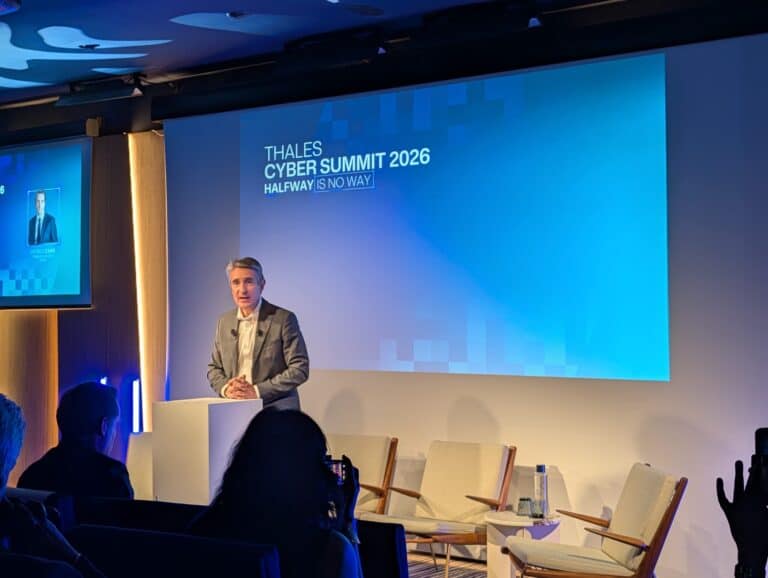
Thales announces five new security solutions. These include the post-quantum HSM Luna 8, an AI-driven DSPM solution, and a partnership with Google Cloud to secure AI agents.
The new Luna 8 hardware security module (HSM) uses post-quantum cryptography to protect critical data from the threat posed by quantum computers. The hardware protects cryptographic keys, identities, applications, and digital transactions. According to Thales, Luna 8 is the fastest HSM the company has ever built.
Thales’s in-house cryptographic processor drives this performance. The chip accelerates both traditional and post-quantum workloads, delivering high throughput and low latency. Thales is targeting high-volume applications, such as the protection of SSL/TLS keys, code signing, and digital identities. Notably, the company also claims significant energy savings: per transaction, Luna 8 is said to be twenty times more efficient than previous-generation HSMs.
It includes protection against side-channel attacks on the processor. Keys never leave the tamper-evident hardware. The device also offers secure audit logging, device attestation, quorum authorization, and multi-factor authentication.
The platform is also designed to be crypto-agile. According to Thales, the architecture can incorporate new algorithms, standards, and capabilities as soon as requirements change. Updates, protocols, and internal security mechanisms have also been made quantum-safe.
Up to thirty HSM instances per appliance
For enterprise and hyperscale environments, Luna 8 employs a multi-tenant architecture. An appliance contains one or two crypto modules, which operate independently of one another. This provides double the density within the same rack space. Each module can host up to fifteen isolated HSM instances; with two modules, a single appliance can therefore host up to thirty.
For compliance, the hardware is designed for FIPS 140-3 Level 3 and Common Criteria certification. Thales also notes support for requirements from, among others, GDPR, eIDAS, HIPAA, and PCI DSS, supplemented by separation of duties and flexible security policies.
Four responses to AI threats
The other announcements revolve around AI, both as a tool and as an attack vector. CipherTrust Data Security Posture Management (DSPM) uses AI to detect and protect sensitive data, including immediate and automated mitigations. Sentinel Envelope+ is software designed to protect applications against new attacks that leverage AI.
Thales is also collaborating with Google Cloud. Organizations can secure their agent-based AI operations with Thales’ AI Security Fabric, an overarching approach to protecting AI agents, data, and interactions throughout the entire AI lifecycle. Finally, the company is introducing a global security approach designed to respond at machine speed. It combines technology, real-time threat intelligence, and expertise to anticipate, detect, and thwart automated attacks.
Tip: Thales and Google Cloud secure AI agents on the Gemini platform