
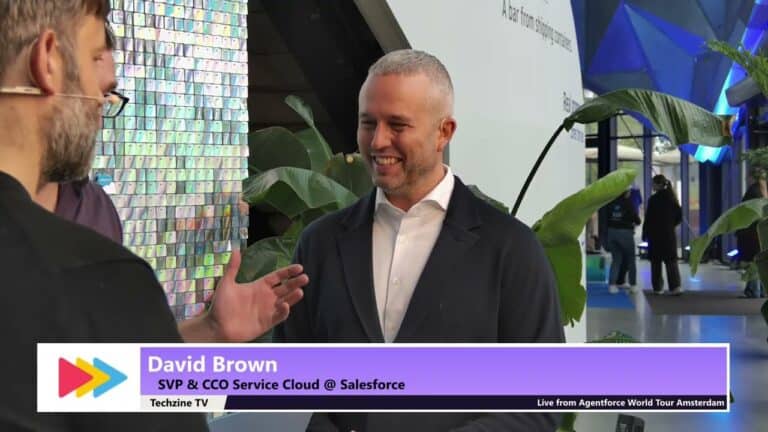
How is Salesforce’s Agentforce transforming customer service, and why are 90% of deployments starting with Service Cloud? David Brown, Chief Customer Officer for Service Cloud at Salesforce, shares insights on autonomous agents, multilingual support, and the future of service teams.
In this interview from the Agentforce World Tour in Amsterdam, David Brown discusses real-world implementations, from Heathrow Airport’s WhatsApp agent to Simply Health’s strategic email automation. Learn about the dramatic channel shift happening in customer service, how AI-assisted agents can easily take the burden off your customer service team, and how to implement Agentforce successfully in your organization.
Discover the practical strategies companies are using to achieve measurable ROI, the critical importance of trust and accuracy in AI deployments, and why service teams are evolving from cost centers to revenue generators.
Also read: Salesforce unveils Agentforce 360: AI agents support employees
Some insights on why AI dominates customer service in Agentforce deployments
Question: Why is service the area where we see most AI agent implementations, with almost all customer references being service-oriented?
David Brown: In Salesforce, if you look at our Agentforce deployments globally, depending on what month you look at, around 90% of the go-lives of Agentforce use cases start with Service Cloud. It’s so tangible, isn’t it? People can tend to prove the cost savings quite quickly with service use cases, so we’ve tended to sign off on way more projects and get more go-lives in the area of service than anywhere else.
Question: Are there specific types of service use cases that stand out in terms of adoption?
David Brown: Most people try an agent in a chatbot to start with, within the chat channel. Most people try it as well, with fairly basic requirements, like an FAQ knowledge article being exposed to an agent. But there are many more advanced and exciting use cases now where agents are taking real actions, completing processes, and doing more complex work.
Moving beyond traditional chatbots
Question: How do modern conversational AI agents differ from the earlier chatbots that people generally disliked?
David Brown: I think the only thing disliked more than a chatbot is IVR (Interactive Voice Response). If you were pushed into an IVR channel, it’s probably the worst of all. But these conversational experiences you can drive now through agents, it’s a dramatic difference to a static “if yes, no, go here.” Those kind of static chatbot experiences are becoming a thing of the past and very obsolete.
Question: Salesforce put help.salesforce.com entirely on Agentforce. What were the results?
David Brown: Help.salesforce.com. I think the stat now is that 86% of cases created are resolved with an autonomous agent. Customer satisfaction has gone up as well because they’re getting answers faster. To resolve 86% without diverting to another channel or a human is pretty amazing, and it’s driven some incredible cost savings.
Productivity gains from basic AI capabilities
Question: Beyond autonomous agents, what productivity improvements are companies seeing from basic AI features?
David Brown: Just the most basic of AI deployments in service, like a summarization of a call, can save companies minutes after a call finishes with note-taking. The Service Reply capability we’ve got, where you just take in your knowledge base and recommend things for the service agent to say, is improving average handling time for some customers by 45%. So, transcripts being summarized and recommendations being prompted during a call, which are just generative AI capabilities, are really supercharging service agents today.
Multilingual support and translation
Question: What’s the status of language support for Agentforce across Europe’s diverse markets?
David Brown: Unfortunately, the Dutch language support comes a little bit after Spanish, French, and Portuguese support. English clearly is the first language we support; we GA’d (general available) that at Dreamforce. But French, Spanish, German, and Portuguese will come in the next round of languages, and Dutch will come very soon after.
Question: How will translation capabilities impact the service industry?
David Brown: We’re excited about the translation capability and the impact that’s going to have on the service industry. With outsourced contact centers, if I can now handle a customer conversation with an agent where you can speak in any language, then the days of me having to take up my contact centers to South Africa, Manila or India have changed. I think it’s going to have a bigger impact on interpersonal communication than we now think.
Real-world example: Heathrow Airport’s Haley
Question: Can you share an example of an autonomous agent already live?
David Brown: I flew here through Heathrow Airport, and they have an autonomous agent called Haley. She can do wayfinding, find the route to your gate, the gate number, and how to get there. Obviously, the most important use case for me was finding out what’s on the British Airways menu. She handles menus, lounges, and routes. Haley sits within WhatsApp, which is an autonomous agent powered by Agentforce.
Question: What impact has Haley had on Heathrow’s operations?
David Brown: It’s only been live for a few months, but it’s taken the number of chats that a human now has to interact with to answer the same questions down by 40%. High-volume, low-value use cases. I think they’re trying to do two things, which are to improve the experience of me as a customer coming through Heathrow and also to take away high-volume, low-value work from service agents.
The dramatic channel shift in customer service
Question: What changes are you seeing in how customers prefer to communicate with service teams?
David Brown: We did the seventh edition of the State of Service report, which interviewed 6,500 customers. Less than 10% of customers have a channel strategy. Most customers just think it’s great to provide support via all channels; they think the more channels the better. But what we found is that the customers who are delivering the highest customer satisfaction statistics tend to focus on the channel that’s right for the use case.
Question: Can you give an example of this strategic channel shift?
David Brown: Simply Health has this strategy to move from 70% of their inbound contact being on a phone to about 10% over the next three years, with WhatsApp going from 5% to maybe 50% of interactions. I think that’s having the biggest impact. Channel shift is one of the biggest things that’s happening now because of the advent of AI.
From cost center to revenue generator
Question: Where do you think customers are moving next after implementing service agents?
David Brown: I met an electronics retailer in Germany who are using Marketing Cloud with Salesforce to send campaigns out. What they used to send at the beginning of every email is “do not reply.” But what they’ve done is they’ve put their service agent, a product expert, at the front of a marketing campaign. So if you wanted to talk about features and functions, and do some more due diligence on a product, use the product knowledge base and a support agent at the front of a marketing campaign.
Question: How does that change the role of service teams?
David Brown: That is turning your service team into a lead-nurturing role. And that’s the way service teams start to become revenue generators rather than just cost centers. So I think the promise of service centers not just being about cost, but being about profit.