
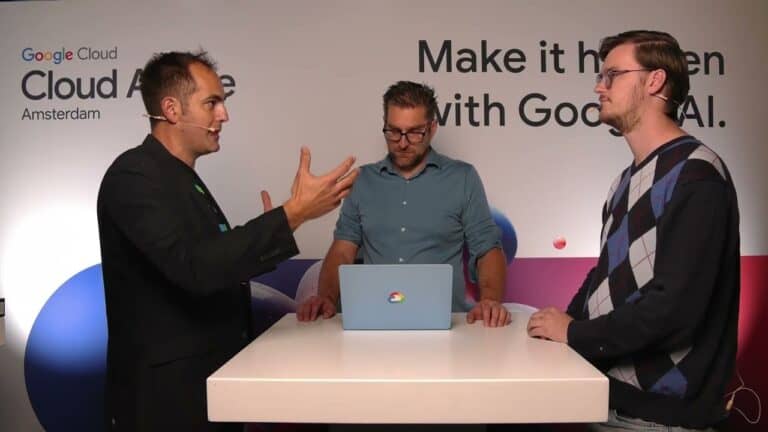
At Google Cloud AI Live in Amsterdam, Techzine spoke with Simon LeBrun, product manager Cloud AI at Google Cloud, he explained how Gemini Enterprise brings AI to every employee by connecting enterprise applications through APIs, MCP, A2A, and a governance layer powered by Apigee.
The promise of enterprise AI is that every employee, with or without a technical background, can access intelligent tools that surface the right information at the right time. Delivering on that promise is not that easy, because it means connecting a fragmented landscape of enterprise applications, legacy systems, and data sources in a secure way that is governable and optimized for AI consumption.
APIs: the non-negotiable foundation of enterprise AI
Lebrun is clear about the role of APIs. Without them, AI is not useful. Agents need to access internal databases, Salesforce data, Microsoft 365 APIs, and a long list of other enterprise systems. APIs, both inside and outside the company, are the connective tissue that makes any of that possible.
Google has been building on this foundation for over a decade. The company has held the number one position in the Gartner API management Magic Quadrant for ten years, with Apigee as its core API management platform. That same platform is now becoming a critical layer in Google’s enterprise AI strategy.
Also read: Google Cloud AI: from pilot to production at scale
API management and iPaaS: two different disciplines
One of the clearest distinctions Lebrun makes is between API management and integration platform as a service (iPaaS). These are not the same thing, and Google treats them as decoupled platforms for good reason. iPaaS handles technical integration between systems. API management, the role Apigee plays, is about exposing APIs securely and distributing them to consumers inside and outside the organization, from a business perspective. Both exist within Google Cloud, but they serve distinct purposes and should not be confused.
Gemini Enterprise app: a single pane of glass
Gemini Enterprise is Google’s answer to the fragmented enterprise application landscape. Employees sign in once and get access to all their agents and tools from a single interface, this is regardless of whether those tools live in Microsoft 365, Google Workspace, Salesforce, Workday, Slack, or any other enterprise system.
This is particularly relevant for organizations heavily invested in the Microsoft ecosystem. Lebrun confirms that customers running fully on Microsoft 365 are using Gemini Enterprise to surface both Microsoft and third-party agents in one place. Behind the scenes, the platform connects to Microsoft Flow, Salesforce, Workday, Slack, and any system that exposes an MCP server.
Open ecosystems vs walled gardens
Not every vendor is embracing openness. While some are going headless and encouraging external AI agents to access their APIs, others are placing restrictions on what external agents can do with their data. Lebrun acknowledges this makes Google’s job harder, but frames it as a navigable challenge rather than a blocker.
Google’s strategy is to build out-of-the-box connectors for as many vendors as possible and to support open standards like MCP and A2A. Where vendors restrict direct data access, Google can still support agent-to-agent (A2A) interaction, meaning that if a vendor like Workday or SAP chooses to expose their own agents rather than raw data, Gemini Enterprise can connect to those agents directly.
MCP, A2A, and skills: three distinct but related protocols
Lebrun clearly breaks down the current protocol landscape. MCP (Model Context Protocol) is for tools, it gives agents access to capabilities and data through a standardized interface. A2A (Agent-to-Agent) is for agent-to-agent interaction. Skills represent a third category: company-specific ways of using a tool that may already exist in processes or institutional knowledge.
These three types are functionally different, but they share the same governance requirements around security, distribution, and observability. Lebrun expects all three to be broadly adopted, with MCP already gaining significant traction and A2A following closely behind.
Apigee as the governance layer for MCP servers
One of the most concrete use cases LeBrun describes is Apigee’s role in managing and distributing MCP servers. If you give an agent too many tools it degrades performance, increases latency, and reduces accuracy. Even Anthropic, the company that created MCP, agrees that agents should not be overloaded with tools.
Apigee addresses this by allowing organizations to take a large MCP server, say, one with 100 tools, and distribute it in optimized subsets. An HR use case might expose only 10 tools. A supply chain use case might expose 20. This is not just about access control; it is about making MCP servers fit for purpose for the specific agent consuming them.
Managing data at scale: search, grounding, and orchestration
The same principle applies to managing data sources. More is not always better; if you give an AI too much data, it will take a lot longer to find the right information. For a general question, it doesn’t matter that much. For complex tasks and information retrieval, agent orchestration is better. Rather than querying every data source, the main assistant identifies the best specialized agent for the task and delegates to it. NotebookLM is cited as a compelling analogy: its power comes precisely from being grounded on a specific, defined set of sources rather than everything at once.
Spark: the personal 24/7 AI assistant
The latest evolution of this orchestration capability is Spark. Spark acts as a personal assistant that understands user intent, proposes a plan, including which other agents to call, and executes that plan on the user’s behalf. Users do not need to specify which agent to use; Spark handles that automatically.
Lebrun sees the broader industry at a pivotal moment. Most enterprise organizations are transitioning from a conversational chatbot to something more structured and capable. Google brings together all things discussed as it’s answer; Gemini Enterprise, Apigee, Spark, and the MCP and A2A protocol stack. Enterprises will need a platform like this to deliver a new intelligent chatbot experience.
Tip: Google Gemini Enterprise to become the AI platform for everyone