
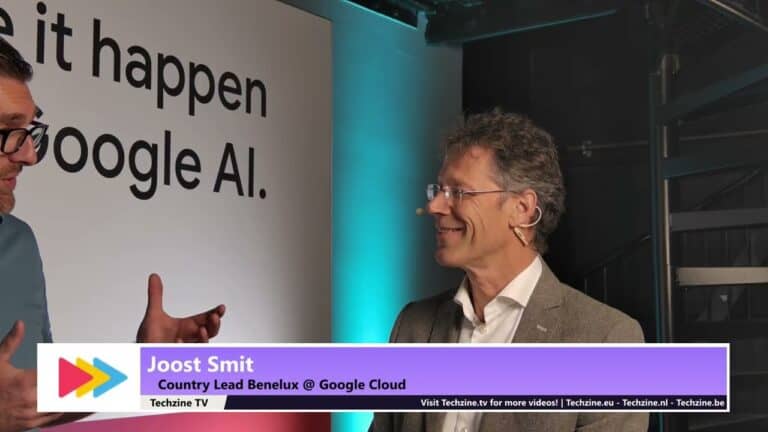
At Google Cloud AI Live in Amsterdam, we spoke with Joost Smit, Google Cloud’s country lead for the Benelux region. He shares how enterprises are moving beyond AI experimentation and into real production deployments, and what Google Cloud is doing to help them get there faster.
Joost Smit oversees Google Cloud’s business across the Netherlands, Belgium, and Luxembourg, a region that may be geographically compact but carries significant enterprise weight. When asked what the hardest part of his job is, Smit’s answer is telling: it’s the same thing that makes it exciting.
“Navigating through all those changes, which are at speed and at a massive volume, that’s the fun part, but also the challenging part,” he explains. “Every day I need to take a zillion decisions and they all need to be right.”
The Google Cloud portfolio has grown substantially, and keeping pace with both product evolution and a rapidly expanding customer base requires more than just a strong sales motion. It requires a network-driven, community-oriented approach to market development, something Smit says is core to how the Benelux team operates.
Also read: Google Gemini Enterprise to become the AI platform for everyone
Customer education: beyond slides and into experience
One of the central challenges for any cloud provider selling AI is helping customers understand what they are actually buying. For Google Cloud, this means investing heavily in experiential education rather than traditional presentations. So while Google has it own Slides application, it’s not the tool they use to drive sales. Smit told us: “Sure, it starts with a couple of contextual slides, but in the end it’s really about experiencing AI. You apply AI in your job and whenever you use it, you use it more because you see the benefits.”
Google Cloud uses a combination of large and small hackathons, event-based experiences like Cloud AI Live, and direct hands-on sessions with executive teams. Smit is particularly emphatic about the importance of reaching leadership directly. “If the leaders and the leadership don’t really feel, understand and experience what AI is about, then it’s very difficult to only work it bottom up. You want it bottom up and top down.”
The goal is to create urgency and genuine understanding at the leadership level so that organizations can drive meaningful AI transformation, not just delegate it downward.
2025 was proof of concept. 2026 is production.
Smit draws a clear line between where the market has been and where it is heading. In his view, 2025 was largely a year of experimentation, organizations running proof-of-concept projects to understand what AI can actually do. 2026, he argues, is when serious scaling begins.
“2026 is really going forward faster at scale and really getting the value out of the promise,” he says. “And I see that happening.”
One concrete signal: Smit is now receiving calls from organizations that had not engaged with Google Cloud in five years. The momentum in the market is real, and the appetite to move from experimentation to deployment is growing rapidly.
Gemini Enterprise and Vertex AI: two approaches, one portfolio
Google Cloud positions its AI portfolio across very different customer needs. On one end sits Gemini Enterprise, an opinionated, deeply integrated AI experience built for individual productivity within Google Workspace. On the other sits Vertex AI, which gives organizations the tools to architect their own custom AI stacks for complex, process-level transformation.
Smit is clear that both have a role to play, and the right approach depends entirely on the customer’s situation.
“If you look at individual efficiency, the opinionated part, that’s where we want to bring efficiency and ease of use,” he explains. “I get suggestions for email replies in my style. It’s not a chatbot. It’s really AI applying my style of writing, and that’s just convenient.”
But when AI needs to change business processes, generate new revenue streams, or orchestrate partners across an end-to-end value chain through agents, a fundamentally different approach is needed. That’s the territory where Vertex AI and custom agent architectures come in, and where partner expertise becomes critical.
Google Workspace AI: bundled, integrated, and growing
A few years ago, Google made the strategic decision to include AI features within Google Workspace without requiring additional licensing. Smit says the impact has been tangible. “We see the difference. There’s more interest. The level of integration is so high that it’s just a natural extension. It makes a lot of sense.”
When asked which Workspace AI feature he personally values most, Smit points immediately to the Chief of Staff agent. “It helps me stay organized, or get organized, depending on the day of the week,” he says with a laugh. “It’s not just a checklist. It suggests actions, it suggests reach-outs. It’s extremely convenient.”
Smit also blocks one to two hours in his calendar each week specifically for hands-on AI work, a practice he says is essential for any leader who wants to genuinely understand what AI can and cannot do.
Real-world adoption: Jumbo and Virgin Voyages
Smit offers two compelling case studies to illustrate what production-scale AI looks like in practice. The first is Jumbo, the Dutch supermarket chain, which appeared on stage at Cloud AI Live in Amsterdam. Jumbo built a consumer-facing conversational AI agent in just eight weeks, developed, remarkably, largely through voice interaction with a laptop rather than traditional keyboard-based coding. The speed of development clearly surprised even Smit, who had initially been told by Jumbo’s CTO that the timeline was impossible.
The second is Virgin Voyages, a global example of rapid agent scaling. The company started with a handful of AI agents at the end of last year and now operates 50, with a target of 700 by year-end. That trajectory illustrates exactly the kind of scaling momentum Smit believes will define 2026.
Narrowing the knowledge gap between business and engineering
One of the more nuanced points in the conversation concerns the gap between what business users understand about AI and what engineers can actually build. Smit’s view is optimistic: the gap is real, but it is shrinking fast, and AI is itself one of the main reasons why.
“Business users like myself can actually build an agent, version 0.5, and go to an engineer and say, I’ve built this, can you turn it into 1.0? They look at it and go, I get what you mean, I get what you want to achieve.”
That shared starting point dramatically reduces the friction of translating business intent into technical implementation. Smit acknowledges one frustrating reality: you might spend a couple of hours building something, only to watch an engineer refine it into version 1.1 in 20 minutes. But he accepts that trade-off with good humor.
Gemini Enterprise on Microsoft 365: an open ecosystem play
Perhaps the most strategically interesting move Google recently made is to run Gemini Enterprise on top of Microsoft 365. For many enterprises, deep investment in the Microsoft ecosystem makes full migration to Google Workspace impractical. Google’s answer: don’t ask them to migrate.
“Keep your Microsoft ecosystem and use our AI on top,” Smit summarizes. “It works well.”
It’s an interesting move, customers can stay in the Microsoft ecosystem, ignore Copilot and run Gemini Enterprise on top. It will be interesthing to see if customers will choose this option. Smit told us that Google wants to be an open platform, and “we believe the best content, the best technology will win.”