
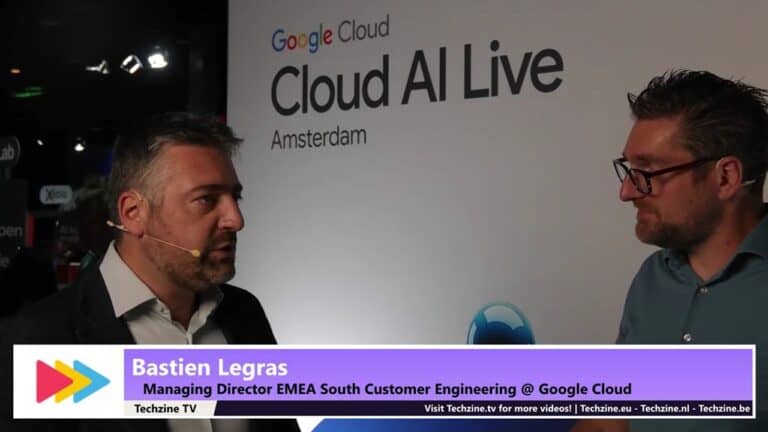
Most enterprise leaders underestimate what AI can do today, and their concepts and ideas are already obsolete by the time they act. At Google Cloud AI Live in Amsterdam, Bastien Legras, Managing Director EMEA South Engineering at Google Cloud, explains what real AI adoption looks like inside large organizations, and where the biggest gaps are.
One of the most consistent patterns Legras observes when working with enterprise customers is a fundamental mismatch between what decision-makers think AI can do and what it can actually do. “What they think AI can do is generally obsolete three months, six months after,” he says. A common example: many executives still think of AI primarily as a chatbot. But the technology has moved well beyond that, into the era of intelligent agents that can operate autonomously across complex business workflows.
To close this gap, Google actively invites C-suite executives to its offices for dedicated education sessions. The goal is not just to inform them about current capabilities, but also to give them a realistic picture of where the technology is heading.
The real hurdle: going beyond the general concept
When asked whether the biggest challenge is people, technology, or data, Lesgras points firmly to education and depth of understanding. “They know it’s big, but they don’t know too much into the details what it is capable of,” he explains. The agentic capabilities now available through platforms like Gemini go far beyond employee productivity. They can reshape business process efficiency and even influence how companies design their next generation of products.
The gap becomes clearest when you look at specific departments. What AI can do for an HR team is fundamentally different from what it can do for a legal department or a sales organization. Without going into that level of detail, enterprises are left with a vague sense of potential but no clear roadmap to create value.
Google’s approach: ideation to prototype to production
Google’s go-to-market approach with enterprise customers varies depending on where they are on the digital maturity spectrum. Google approaches a digital-native company very differently from a traditional bank, a manufacturer, or a public sector organization. But the core journey follows a consistent pattern.
It starts with an ideation workshop. This is a structured session where Google and the customer explore possible use cases together and begin to model potential ROI. Is the value in cost savings? In increasing revenue? In accelerating product development? Once the direction is identified, the team moves to prototyping. “Thanks to AI, the barrier of design, the barrier of implementation is super low,” Legras notes. “We spend more time designing than implementing.” Prototypes can be up and running in a matter of weeks. But getting to a working prototype is only part of the challenge.
The production reality check
Moving from prototype to production is where many AI initiatives stumble or even fail. A prototype might cost only a few dollars to run, but the economics of running it at enterprise scale can make a huge difference. “Do we still have ROI?” is the critical question Legras says must be answered before committing to full deployment. Google puts a lot of focus on design-first thinking, the solution should be scalable from the start, not just technically impressive in a demo environment.
“You can get something fancy, but which is actually for whatever reason not scalable,” he warns. The technology itself is not the bottleneck. The risk is in building something that works brilliantly at small scale but becomes extremely expensive when deployed across an entire organization.
How quickly will AI standardize across industries?
Legras is optimistic about the pace of maturation. While every industry, manufacturing, retail, banking, travel, is still in relatively early days, things are moving. Large system integrators are advising customers across sectors, and the collective learning curve is steep. Legras estimates within a single-digit number of years, it will be possible to say with confidence what AI means for a specific type of customer in a specific industry.
The governance challenge: managing hundreds of AI agents
As enterprises scale, it’s not hard to take AI deployments from a handful of use cases to dozens or even hundreds of agents in a matter of weeks. This creates a new challenge: how to manage and govern all those agents.
Google’s response includes solutions for agent identity management through registries, access control, and observability. This means tracking what each agent has been authorized to do and what it has actually done. Security is an integral part of this picture. When enterprises begin surfacing their internal systems through AI agents, ensuring those agents are properly guarded against misuse becomes a board-level concern, not just an IT issue.
Also read: How Gemini Enterprise connects with APIs, MCP and A2A
The tension between IT and business, and the shadow AI risk
One of the most revealing dynamics Legras describes is the growing tension between IT departments and business units. Business teams feel an intense sense of urgency, they know that if they don’t adopt AI quickly, competitors will disrupt them. IT teams, meanwhile, are trying to enable that innovation while keeping the organization safe and within budget.
“I can feel this tension in every industry at the moment,” Legras says. The risk of moving too slowly is shadow AI: employees and departments simply starting to use free or consumer AI tools outside of any enterprise governance framework. Google’s approach is to help IT build a secure landing zone for AI experimentation, giving departments defined budgets and sandboxed environments where they can prototype safely, with a clear lifecycle for moving validated use cases into production.
In many organizations, the problem of shadow AI is becoming bigger by the day. This highlights the importance of making AI solutions available and developing a clear AI strategy that gives employees the tools they need. Executives can no longer ignore or underestimate AI, they need to adapt, and they need to do it fast.
Also read: Google Gemini Enterprise to become the AI platform for everyone