
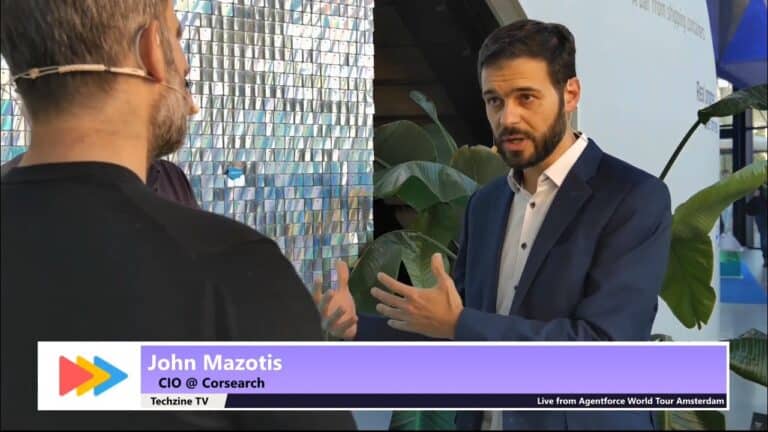
When a global intellectual property services company decides to abandon Microsoft for Google Workspace and Slack, there’s a compelling story behind the decision. John Mazotis, CIO at Corsearch, shares the strategic thinking, implementation challenges, and measurable wins from their three-month migration journey.
Corsearch, a leader in IP services since 1949, recently completed a comprehensive migration from what Mazotis calls their “legacy” Microsoft environment to a modern workspace powered by Google and Slack. The decision wasn’t taken lightly, given that the company operates globally and relies heavily on collaboration tools for its trademark services and brand protection operations.
Why leave an integrated platform for two separate ones?
On the surface, moving from Microsoft’s unified ecosystem to two separate platforms seems counterintuitive. However, Mazotis explains that the collective capabilities of Google Workspace and Slack far exceeded what Microsoft 365 offered. “The combination of those two has better security, has better user experience, has way more features, has a lot more integration capabilities,” he notes.
The reality, according to Mazotis, is that even within Microsoft’s 365 “one platform”, users actually navigated multiple disconnected tools. With Slack as the central hub, everything from spend approvals to meeting notifications happens in one place. “If I need to approve a spend for someone, I click a button in Slack. I don’t need to go to a different platform,” he explains.
Also read: Our experience in building a Digital HQ with Slack
The three-month migration timeline
Corsearch completed its migration in three months, with Slack implementation happening quickly due to its straightforward nature. The Google Workspace migration took longer, particularly because Corsearch is the sum of multiple acquisitions, each bringing legacy systems, some Microsoft, some Google. The consolidation unified everyone into a single Google and Slack environment.
However, Mazotis emphasizes that the technical migration wasn’t the biggest challenge. “Moving a file from Microsoft OneDrive to Google Drive, it works,” he says. The real investment went into change management and the human side of the transformation.
Change management: The real differentiator
Corsearch spent most of its migration budget on change management, education, team training, and ensuring everyone understood the new platforms’ capabilities. “For us, if you only use Slack as a DM tool, you can, and it works. But is it the best use of the tool? No, it’s the very basic. It’s a 10% of what you can do,” Mazotis explains.
The company focused on teaching employees how to structure channels for specific projects, teams, and activities. They created dedicated channels for announcements, celebrating wins, and greeting new joiners. More importantly, they changed how people think about channel participation.
Addressing channel fatigue
One unexpected challenge was channel fatigue. Employees accustomed to a handful of Microsoft Teams channels suddenly faced numerous Slack channels. Corsearch responded with a campaign educating people that it’s perfectly acceptable to leave or mute channels. “We try to make sure that all our channels are public unless they really need to be private. So everything is searchable, everything is easy to access,” Mazotis notes.
Real-time collaboration transforms workflows
Google Workspace’s collaboration features became a game-changer. While Microsoft 365 offers co-editing, Mazotis found it “not as smooth, it’s not as nice, it doesn’t always synchronize easily.” With Google Docs and Sheets, 20 people can collaborate in real time, and you can start instant meetings directly from documents.
Combined with Slack features like huddles and Slack Connect, Corsearch created a central ecosystem for internal teams, vendors, and customers. “I’m now talking to all my vendors and to many of my customers through Slack. I don’t use email,” Mazotis says.
Also read: Google adds more AI functionality to Google Workspace
Integrations: Building the digital headquarters
Mazotis’s vision is to make Slack the go-to location where employees see everything and do everything. “If I could integrate every single system we have within Slack, therefore making Slack the go-to location in the morning where you see everything and you do everything through Slack, that’s kind of the dream for me.”
When Corsearch first moved to Slack in February, this seemed distant. But with the rapid development of new integrations and workflows, Mazotis believes they’re close to an ecosystem where most systems can be interconnected through native integrations or Slack workflows.
AI integration: Gemini and custom agents
One significant benefit of choosing Google Workspace was automatic access to Gemini AI, NotebookLM, and Studio AI. These tools are heavily used within Corsearch and measured as key performance indicators by the executive team.
Recently, Corsearch launched AI HR agents trained on company policies, handbooks, and local legislation. “Every question you have for HR can be answered through AI, at least as a first line of support,” Mazotis explains. This reduces ticket volume while providing instant, accurate responses to employee questions.
Slack’s AI features, particularly conversation and thread summarization, help employees across different time zones catch up quickly on missed discussions.
Continuous learning and adoption
For Corsearch, change management didn’t end at go-live. The company continuously educates employees on new features from both Google Workspace and Slack. Rather than overwhelming everyone with every update, Mazotis acts as a “traffic light,” directing relevant updates to appropriate teams; sales features to sales teams, finance features to finance, and so on.
This approach prevents overwhelm while ensuring teams can leverage capabilities most relevant to their work. “The improvements over the last period have actually enabled Slack to be the operating system and more than a tool on the side,” Mazotis reflects.
Advice for other organizations
Reflecting on lessons learned, Mazotis acknowledges that channel fatigue was something they could have handled better from the start. His advice: educate people early that leaving or muting channels is acceptable and even encouraged.
More broadly, he emphasizes investing heavily in change management rather than in technical implementation. The technology migration is straightforward; getting people to change how they work and adopt new behaviors is where success is truly determined.
For organizations considering a similar move, Mazotis’s experience demonstrates that moving from one integrated platform to two specialized ones can actually simplify workflows when implemented thoughtfully. The key is choosing tools that excel at their specific purposes and integrate seamlessly. At the same time invest in the human side of adoption to realize the full value of the technology.