
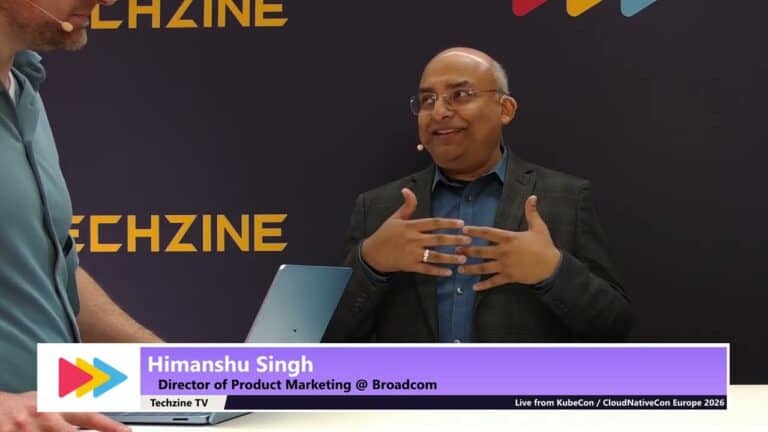
VMware Cloud Foundation now includes vSphere Kubernetes Service (VKS), a CNCF-certified Kubernetes runtime that enables organizations to manage both virtual machines and Kubernetes clusters from a single control plane. At KubeCon + CloudNativeCon Europe, Himanshu Singh, Director of Product Marketing at Broadcom for the VMware portfolio, explained how this integration delivers enterprise-grade Kubernetes without vendor lock-in.
The approach represents a significant evolution from VMware’s 2018 acquisition of Heptio. Back then, Kubernetes was built directly into the vSphere codebase rather than treating it as a separate layer. This architectural decision enables administrators to provision both VMs and Kubernetes clusters through the same platform, eliminating infrastructure silos.
Watch more videos from KubeCon & CloudNativeCon Europe
CNCF-certified Kubernetes without the opinions
Singh emphasized that VKS maintains close alignment with upstream Kubernetes, typically releasing new versions within two months of community releases. “We do not want to force people to learn our Kubernetes,” he explained. There is a Kubernetes standaard at VMware stays very close to it, which means that it just runs all your applications. This unopinionated approach extends to the CNCF ecosystem. Any CNCF-conformant service or tool integrates with VKS, including existing developer toolsets like Argo CD and Helm charts. The platform doesn’t impose a proprietary ecosystem but rather fits into whatever cloud native stack organizations already use.
Also read: Broadcom brings secure AI agent environment to VMware Tanzu
Enterprise features through infrastructure, not Kubernetes customization
The distinction between VKS and other Kubernetes distributions lies in where enterprise capabilities originate. Rather than modifying Kubernetes itself, VKS delivers security, reliability, and lifecycle management through the underlying vSphere infrastructure that VMware has refined over 25 years.
Containers run inside virtual machines, providing six layers of isolation, the same architecture hyperscalers use in their cloud environments. “This is exactly the reason why all the hyperscalers run containers in virtual machines,” Singh noted. “So why wouldn’t you do that in your private cloud as well?”
This architecture enables IT teams to enforce governance, set policies, and maintain control while platform teams and developers enjoy self-service capabilities within defined guardrails. Organizations don’t need to open infrastructure tickets for every provisioning request.
The VMs versus containers debate has been resolved
Singh addressed the persistent narrative that containerization requires eliminating virtual machines. “We’ve had this conversation about VMs will be replaced by containers for probably a decade at this point in time. That has not happened,” he stated.
The market has recognized that enterprises care about application performance, security, and data protection, not the underlying mechanism. Whether workloads run in VMs, containers, or both becomes secondary to operational requirements. VKS enables organizations to run whatever combination their applications demand without platform constraints or replatforming exercises.
For organizations modernizing monolithic applications, VKS provides guidance and tooling to transform or extend legacy workloads while remaining on the same platform. Teams don’t need to learn entirely different infrastructure management approaches mid-migration.
Business value beyond technology
For organizational leaders managing P&L responsibility, VKS delivers several strategic advantages. A single platform for VMs, containers, and AI applications increases team productivity while addressing the industry skills gap. Existing administrators can upskill to Kubernetes without organizations needing to hire specialized talent in a competitive market. The total cost of ownership benefits stem from higher infrastructure utilization, particularly for GPU resources used in AI workloads. Organizations extract more value from hardware investments when running on VCF.
Security, compliance, and lifecycle management capabilities that enterprises require come standard through the vSphere foundation, providing what Singh called the “checkboxes” that organizational leaders need to satisfy.
Every VKS release comes with 24 months of support with n-2 version compatibility. Application teams don’t need to upgrade simultaneously; each can move to new versions when ready. Given that six to eight Kubernetes releases typically occur within 24 months, this support window provides substantial flexibility.
Licensing and availability
VKS, VMware’s private AI services, and all related capabilities are included in VMware Cloud Foundation licensing with no additional fees. This licensing approach removes financial barriers to Kubernetes adoption for organizations already invested in the VMware ecosystem, enabling them to extend their infrastructure capabilities without budget negotiations or procurement delays.