
In the first quarter of 2026, ASML generated revenue of 8.8 billion euros and posted a net profit of 2.8 billion euros. This is evident from the quarterly figures published on Wednesday by the Veldhoven-based company.
On an annual basis, this represents revenue growth of 13 percent and a 17 percent increase in net profit. The gross margin came in at 53 percent, at the upper end of the previously issued forecast.
The results are thus slightly above analysts’ expectations, who had forecast an average of 8.7 billion euros in revenue and 2.6 billion euros in net profit. At the same time, revenue is lower than in the previous quarter, when ASML reported 9.7 billion euros. The number of new lithography systems sold also fell from 94 to 67 units.
On the other hand, revenue from Installed Base Management, which includes service and upgrades, actually rose to nearly 2.5 billion euros. This shift underscores the growing importance of recurring revenue from the existing machine fleet.
Notable is the shift in the geographic revenue breakdown. South Korea accounted for 45 percent of revenue in the first quarter, thereby taking over China’s position as the largest market, writes the FD. China still accounted for 19 percent of revenue, down from 36 percent a quarter earlier. Demand from South Korea is driven primarily by memory chip manufacturers such as SK Hynix and Samsung. About two-thirds of ASML’s revenue comes from sales of its most advanced EUV systems.
Demand for chips continues to outpace supply
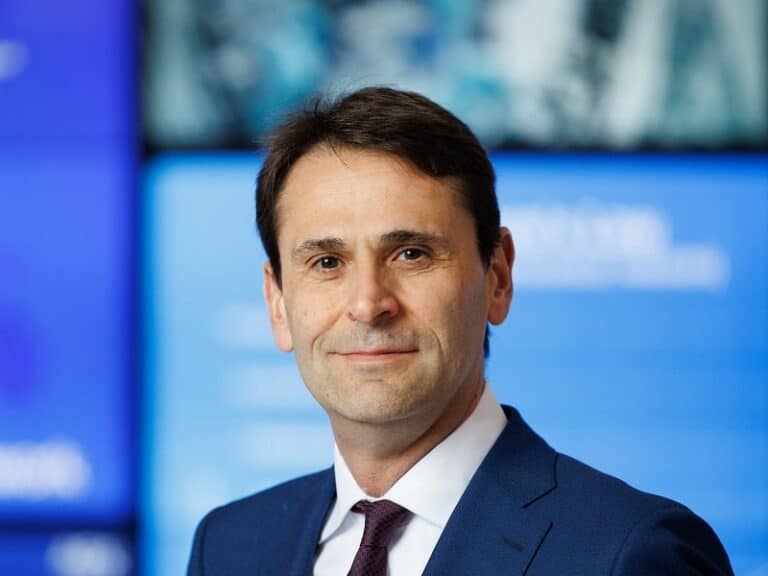
CEO Christophe Fouquet (photo) states that the results are in line with expectations and emphasizes that margins are developing strongly. He points out that the outlook for the semiconductor industry is continuing to improve, mainly due to investments in AI infrastructure. According to Fouquet, demand for chips is growing faster than supply, causing customers to accelerate their expansion plans while simultaneously signing long-term contracts to secure capacity. He notes that customers in the memory segment are already largely fully booked through 2026 and that supply issues are likely to persist beyond that.
According to the CEO, customers have raised their demand forecasts for the short- and medium-term in recent months. This translates into a very strong order intake for ASML. However, the company no longer publishes these order figures on a quarterly basis, as they are said to fluctuate too much to provide a representative picture of the financial situation. ASML says it is working closely with customers to meet demand, both by delivering new systems and upgrading existing installations.
CFO Roger Dassen expects the company to produce approximately sixty EUV systems this year. Production is set to ramp up to at least 80 systems over the coming years. This momentum supports the expectation that 2026 will be another year of growth for all of ASML’s activities.
Impact of export restrictions
For the second quarter, the company anticipates revenue between 8.4 and 9.0 billion euros and a gross margin of 51 to 52 percent. For all of 2026, ASML has slightly raised its expectations. The company now expects annual revenue between 36 and 40 billion euros, with a gross margin of 51 to 53 percent. Fouquet notes that this range leaves room for various outcomes in ongoing discussions regarding export restrictions.
This uncertainty is linked to political developments in the United States and elsewhere, where a bill has been introduced to further restrict the export of chip manufacturing equipment to China, including through allies such as the Netherlands and Japan. Despite these uncertainties, the figures continue to illustrate the structural demand for advanced chip manufacturing equipment, with AI investments in particular driving the market.