
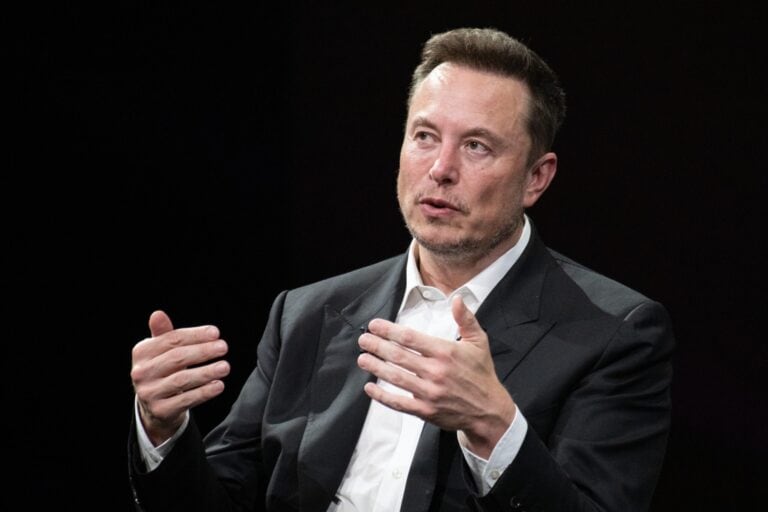
SpaceXAI will use Nvidia’s new Vera processors to further expand its AI infrastructure. The technology will play a role in the systems behind Grok, but is also set to go into space. Elon Musk (photo) aims for the first launch of a modified Vera Rubin NVL72 in the fourth quarter of 2027, followed by scaling up in 2028.
The choice of Vera is linked to the rise of AI agents. Although GPUs handle the heavy computational load for AI models, agentic AI shifts part of that load to the CPU. For example, agents must execute code, process data, control external tools, and coordinate various tasks.
SpaceXAI intends to use Vera for these tasks, ensuring that the GPUs remain available for model computations as much as possible. Nvidia claims that Vera can handle tasks, including those related to agentic AI, reinforcement learning, and data processing, up to 1.8 times faster than x86 processors.
88 proprietary CPU cores
Vera is a CPU developed in-house by Nvidia and designed specifically for AI infrastructure. The processor features 88 Olympus cores and utilizes Spatial Multithreading. LPDDR5X memory delivers a bandwidth of up to 1.2 TB per second.
With this move, Nvidia is making a more decisive foray into the data center market, traditionally dominated by x86 processors from Intel and AMD. In the AI infrastructure sector, the company is increasingly seeking to supply more components of the complete system itself, in addition to the GPUs that made it famous.
SpaceXAI will use Vera as part of the Vera Rubin platform. This platform combines CPUs and GPUs with, among other things, NVLink interconnects, Spectrum-X Ethernet, and BlueField data processors. The company plans to deploy this architecture as it continues to expand the infrastructure behind Grok.
Scaling up to gigawatts
This expansion should ultimately result in several gigawatts of available computing capacity. At that scale, it’s not just the speed of individual chips that matters. Network capacity, energy consumption, and how long expensive GPUs stay in operation also determine the infrastructure’s efficiency.
As a result, the CPU’s role becomes more important. When an AI agent needs to run a lot of code or process data between model calls, a shortage of CPU capacity can put GPUs on hold. Vera is designed to reduce such bottlenecks.
First system to launch into space by late 2027
SpaceXAI also wants to use the same architecture outside of data centers on Earth. Under the name Starmind, the company is working on AI computing infrastructure in Earth orbit. The first generation of satellites is to be based on a version of Nvidia’s Vera Rubin NVL72 system adapted for use in space.
Musk has since set a timeline for this. According to him, SpaceXAI and Nvidia plan to launch the first modified Vera Rubin NVL72 into Earth orbit in the fourth quarter of 2027, reports The Register. A significantly larger rollout is then scheduled for 2028. Nvidia itself does not mention these dates in its announcement.
In doing so, SpaceXAI is linking two ambitions to the same hardware foundation. On the one hand, Vera Rubin is intended to support the rapid growth of Grok and its associated AI data centers, while the same architecture is also set to form the basis for experiments with AI infrastructure in space starting next year.